

What Should You Look for in a Barcode Ribbon Supplier?
A reliable barcode ribbon supplier should do more than provide wax, wax-resin, or resin ribbon at a competitive price. For B2B buyers, the more important questions are whether the supplier can match the ribbon to your printer and label material, maintain consistent coating and slitting quality, support repeat orders, provide samples, and customize specifications when required.
The correct ribbon affects print darkness, barcode readability, abrasion resistance, printing speed, printhead performance, and ultimately the cost of each usable label. A ribbon that is slightly cheaper per roll can become more expensive if it causes rejected labels, unreadable barcodes, frequent printer adjustments, or unnecessary downtime.
This guide is designed for importers, distributors, barcode solution providers, label converters, industrial manufacturers, logistics companies, packaging operations, and private-label buyers comparing suppliers before a bulk purchase.
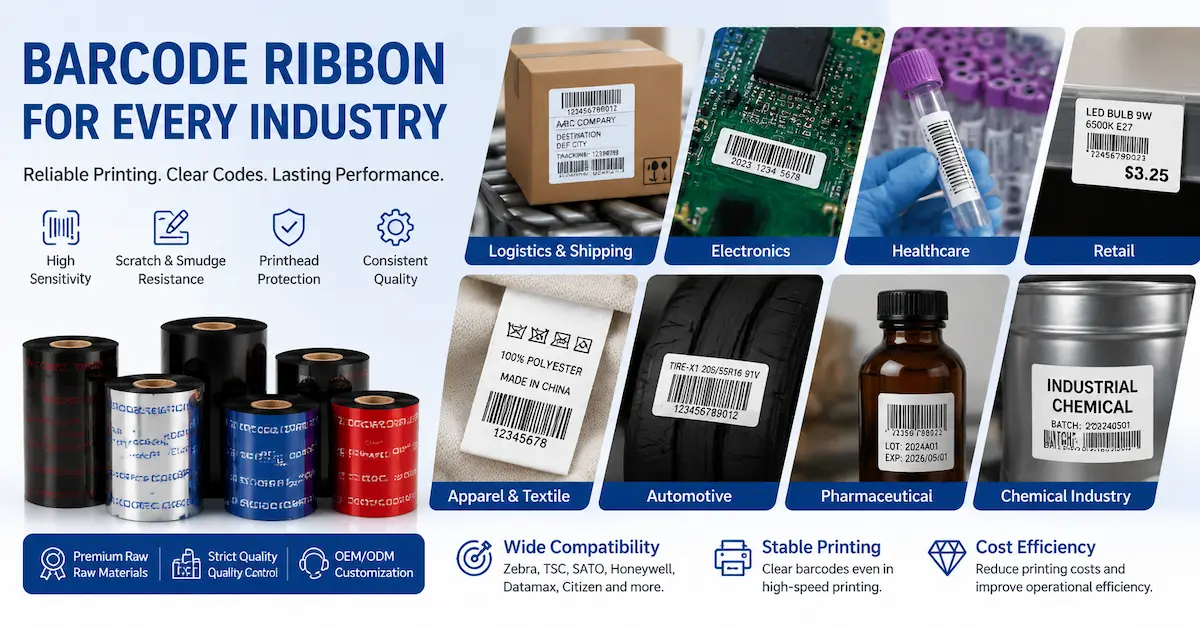
Start by Confirming Whether Your Application Actually Needs a Ribbon
Before comparing suppliers, confirm the printing method.
Thermal transfer printing uses a ribbon, while direct thermal printing relies on heat-sensitive media and does not require one. Zebra's technical guidance makes the same distinction between thermal transfer and direct thermal systems.
This sounds basic, but it is an important procurement filter. A good barcode ribbon supplier should ask about the printer model and printing method before recommending a product.
Information to Provide Before Requesting a Quote
A useful RFQ should normally include:
- Printer brand and model
- Flat-head or near-edge printing technology
- Label or packaging material
- Required ribbon width and length
- Core diameter
- Ink side, if specified by the printer
- Required print speed
- Barcode type and print resolution
- Exposure to abrasion, moisture, heat, chemicals, or outdoor conditions
- Expected order quantity
- OEM branding or packaging requirements
If a supplier recommends one universal ribbon without asking about these factors, further testing is advisable before committing to volume.
You can review CODEWEL's current barcode ribbon product range to see how different formulations are separated by application and performance level.
Match the Ribbon Formulation to the Label and Application
Barcode ribbons are not interchangeable simply because they have the same dimensions.
The main formulation families are wax, wax-resin, and resin. Specialized products such as TTO near-edge ribbon and wash-care resin ribbon serve more specific printing systems and environments.
Zebra's official ribbon portfolio likewise separates thermal transfer products into wax, wax/resin, and resin formulations according to application durability requirements. GS1 guidance also identifies these three broad ribbon types and distinguishes their typical substrate and durability ranges.
Barcode Ribbon Type Comparison
| Ribbon Type | Typical Substrates | Durability Level | Typical Applications | Procurement Focus |
|---|---|---|---|---|
| Wax | Coated and uncoated paper | Basic | Shipping, inventory, retail, carton and warehouse labels | Cost, speed, darkness |
| Wax-Resin | Coated paper and many synthetics | Medium | Product labels, logistics, manufacturing and general industrial labels | Balance of cost and abrasion resistance |
| Resin | PET, PP and other synthetic materials | High | Electronics, automotive, chemical and durable identification | Chemical, heat and scratch resistance |
| TTO Near Edge | Flexible films and packaging materials | Application-specific | Food, pharmaceutical and automated packaging lines | Near-edge compatibility, speed, film adhesion |
| Wash Care Resin | Satin, nylon, TPU and textile label materials | High for textile use | Garment care labels, uniforms, industrial laundry | Washing, ironing and dry-cleaning resistance |
A buyer sourcing ordinary paper shipping labels may not need a premium resin formulation. Conversely, an automotive or chemical label printed with a low-cost wax ribbon may fail long before the product reaches the end of its required service life.
That is why the best supplier is not necessarily the one offering the strongest ribbon. It is the one that can recommend the appropriate performance level without unnecessary cost.
Understand What Is Inside a Thermal Transfer Ribbon
A knowledgeable thermal transfer ribbon supplier should be able to discuss more than the finished roll dimensions.
Thermal transfer ribbons normally use a thin polyester carrier film with a functional ink coating. Depending on the construction, release and back-coating layers also influence transfer behavior, ribbon handling, and interaction with the printhead. Zebra describes thermal transfer ribbons as a thin polyester film coated with application-specific ink.
For buyers, several manufacturing variables matter:
Base Film Consistency
Stable carrier film thickness supports more consistent winding and heat transfer. Irregular film can contribute to poor tracking or uneven printing.
Ink Formulation
Wax, resin, and mixed wax-resin systems melt and transfer differently. The formulation determines much of the ribbon's adhesion, darkness, abrasion resistance, chemical resistance, and printing-energy requirement.
Coating Uniformity
Inconsistent coating can create variation within a roll or between batches. In production environments, that can force operators to repeatedly change printer darkness or speed settings.
Back Coating
A properly engineered back coating can reduce friction between the ribbon and thermal printhead and support smooth ribbon travel.
Slitting and Rewinding
Accurate slitting and stable winding matter especially on high-volume industrial printers. Poor edge quality, telescoping, excessive tension, or loose winding can create wrinkles and feeding problems.
These are useful subjects to discuss with a prospective barcode ribbon manufacturer, particularly when evaluating private-label or repeat-volume supply.
For a deeper manufacturing overview, see CODEWEL's thermal transfer ribbon manufacturer guide.
Printer Compatibility Should Be Verified Before Bulk Purchasing
A roll that physically fits inside a printer is not automatically the correct ribbon.
Compatibility can depend on:
- Printer model
- Printhead technology
- Maximum printable width
- Ribbon core
- Ribbon length
- Ink-side orientation
- Print speed
- Print energy
- Label substrate
Zebra's documentation, for example, shows that some desktop thermal-transfer models support specific ribbon lengths and core arrangements, while adapters may be required for some configurations.
Flat-Head vs Near-Edge Printing
This distinction is especially important.
Conventional barcode printers commonly use flat-head thermal printing. Flexible-packaging systems and TTO equipment may instead use near-edge technology with different transfer behavior and ribbon requirements.
GS1 notes that thermal transfer overprinting can be used inline on flexible packaging in continuous or intermittent printing modes.
A supplier serving both markets should not treat a standard flat-head ribbon and a near-edge TTO ribbon as interchangeable products.
CODEWEL currently lists both standard thermal-transfer products and super wax-resin near-edge ribbon for applications requiring different printing configurations.
Technical Specifications to Confirm with a Barcode Ribbon Supplier
Before requesting final pricing, create a specification sheet that can be attached to the PO.
| Specification | Why It Matters |
| Ribbon formulation | Determines substrate compatibility and durability |
| Width | Should suit the label and printer path |
| Length | Must fit the printer and expected operating cycle |
| Core size | Required for correct installation |
| Ink side | Must match the printer configuration |
| Color | Black is common, but application-specific colors may be required |
| Printer model | Helps confirm physical and thermal compatibility |
| Printhead type | Flat-head and near-edge ribbons have different requirements |
| Label substrate | One of the most important formulation-selection variables |
| Printing speed | Higher speeds may require different transfer behavior |
| Environmental exposure | Determines required abrasion, moisture, heat and chemical resistance |
| Packaging | Important for distributors and private-label buyers |
| Lot identification | Useful for traceability and repeat-order control |
Do not rely only on a supplier's statement that a product is "compatible with all barcode printers." Compatibility is more useful when linked to an actual printer, ribbon specification, media, and application.
How Should You Evaluate Ribbon Print Quality?
Print darkness alone is not enough.
A barcode can look visually black but still perform poorly if bars, spaces, edges, contrast, or dimensions are outside acceptable limits.
The current ISO/IEC 15416:2025 standard defines a standardized methodology for evaluating the print quality of linear barcode symbols. GS1 also recommends barcode verification methods based on applicable ISO/IEC standards and evaluates factors such as symbol contrast, modulation, defects, decodability, and dimensional characteristics.
For a B2B ribbon qualification test, consider checking:
- Barcode sharpness and edge definition
- Scanner readability
- Print density
- Smudge resistance
- Scratch resistance
- Adhesion to the actual label material
- Performance at the planned print speed
- Performance across different areas of the roll
- Ribbon wrinkling or tracking
- Repeatability across sample rolls
For critical applications, use appropriate barcode verification equipment rather than relying only on smartphone or handheld scanner tests.
Why Supplier Testing Cannot Replace Your Own Application Test
Ribbon performance depends on the entire printing system.
The same ribbon can behave differently when you change:
- Printer
- DPI
- Printhead condition
- Label coating
- Printer darkness
- Speed
- Pressure
- Ambient conditions
That means a responsible supplier can recommend and test a formulation, but the buyer should still approve the ribbon under actual production conditions before a large order.
Manufacturer, Distributor, or Stockist: Which Supplier Is Better?
There is no universal answer.
| Supplier Type | Main Advantage | Possible Limitation | Best Fit |
| Manufacturer | Customization, production control and larger-volume economics | MOQ may be higher | Importers, distributors, OEM brands, large factories |
| Distributor | Local support and mixed product access | Less control over formulation or OEM changes | Local users and smaller mixed orders |
| Stockist | Fast availability of common specifications | Limited customization | Maintenance and urgent replacement demand |
A barcode ribbon supplier with manufacturing capability is particularly relevant when the project requires non-standard dimensions, private labeling, custom packaging, repeat batch consistency, or large annual purchasing volumes.
A local distributor may still be the better choice when the priority is immediate stock, small quantities, or mixed brands.
The procurement decision should therefore start with your operating requirement rather than assuming that one supply model is always superior.
OEM and Private-Label Capabilities to Check
For distributors and brand owners, OEM capability can be as important as ribbon performance.
Before approving an OEM barcode ribbon supplier, confirm which variables can actually be customized.
Common Customization Requirements
- Ribbon width
- Ribbon length
- Core size
- Ink-side orientation
- Ribbon formulation
- Ribbon color
- Inner and outer labels
- Carton design
- Brand logo
- Packaging quantity
- Private-label identification
CODEWEL's current ribbon listings show customizable width, length, core size, ink side, color, and related specifications on products such as its wax-resin CW603 ribbon.
For repeat OEM programs, buyers should also establish revision control. If artwork, packaging, core specifications, or formulation changes, both sides should identify which version applies to the next production batch.
Quality Control Matters More Than a Single Good Sample
A sample only proves that one sample performed adequately.
What matters in long-term sourcing is whether the barcode ribbon supplier can reproduce that performance from one production batch to another.
Questions worth asking include:
- How are incoming materials controlled?
- How is coating consistency checked?
- Is finished ribbon tested by printing?
- How are roll width and winding checked?
- Are sample records retained?
- Can production lots be identified?
- How are customer complaints traced back to a batch?
- Is the approved sample linked to a production specification?
These questions are often more useful than asking only whether the factory has "strict QC."
For industrial customers, a written sample approval and defined specification reduce misunderstandings after production begins.
Use Samples Before Placing a Large Barcode Ribbon Order
A practical supplier qualification process can follow seven steps.
Step 1: Send the Application Information
Provide printer model, media, ribbon size, use environment, print speed, and durability requirement.
Step 2: Let the Supplier Recommend a Formulation
Do not specify "resin" automatically unless the application actually requires it.
Step 3: Test Samples on Your Printer
Use the same printer model, label stock, barcode design, and operating settings expected in production.
Step 4: Evaluate Print and Scan Performance
Check visual print quality, barcode verification where relevant, adhesion, smudging, scratching, and other required durability characteristics.
Step 5: Record the Approved Settings
Document printer darkness, speed, media, ribbon SKU, and other variables.
Step 6: Run a Pilot Order
A small commercial batch can reveal packaging, consistency, logistics, and operator issues not visible during laboratory sampling.
Step 7: Approve the Bulk Specification
The final PO should reference the approved ribbon specification rather than only a generic name such as "wax resin ribbon."
This process makes supplier comparison much more objective.
Compare Total Cost, Not Only Price per Roll
Low unit price is attractive, but professional buyers should calculate the cost of usable printed output.
A simplified procurement model is:
Total Printing Cost = Ribbon Cost + Label Waste + Operator Time + Printer Downtime + Reprints + Maintenance Cost
For example, suppose one ribbon is cheaper but requires frequent darkness adjustments, produces more rejected labels, or causes ribbon wrinkles during high-volume printing. The purchase price may be lower while the operating cost is higher.
When comparing wholesale barcode ribbons, ask suppliers to quote the same:
- Formulation level
- Width
- Length
- Core
- Packaging
- Quantity
- Shipping basis
Otherwise, apparent price differences may simply reflect different specifications.
Application Environment Should Guide Supplier Selection
Different industries place very different demands on the printed image.
| Buyer / Industry | Typical Priority | Likely Ribbon Direction |
| Logistics and Warehousing | Cost, speed, scanner readability | Wax or wax-resin |
| E-commerce Fulfillment | Shipping label economy | Wax |
| General Manufacturing | Moderate durability | Wax-resin |
| Electronics | Small labels, abrasion and heat resistance | Wax-resin or resin |
| Automotive | Long-term identification and harsh exposure | Resin |
| Chemical Packaging | Chemical resistance and durable identification | Resin |
| Food Packaging | High-speed variable-data coding | TTO near-edge |
| Pharmaceutical Packaging | Traceability and durable coding | TTO or application-specific resin |
| Apparel | Wash and ironing resistance | Wash-care resin |
| Industrial Laundry | Repeated washing durability | Wash-care resin |
These are selection directions rather than universal rules. Actual testing with the intended substrate remains necessary.
Zebra's label portfolio demonstrates the same principle: different paper, polypropylene, polyester, vinyl, and specialty materials are paired with different wax, wax-resin, or resin solutions according to the performance requirement.
What Should Distributors and Importers Verify Before Ordering?
Distributors face a different risk from end users: they must support multiple customers and printer configurations.
A distributor evaluating a barcode ribbon supplier should pay particular attention to:
Product Range
Can one source cover economy wax, premium wax, wax-resin, resin, near-edge, textile, and custom specifications?
Specification Flexibility
Common markets may require several widths, lengths, and cores rather than one SKU.
Repeatability
A distributor's reputation depends on receiving a similar product every time the same SKU is reordered.
Private Label Support
Labels, cartons, model numbers, and packaging must remain consistent across shipments.
Technical Support
When an end customer reports poor print quality, the supplier should be able to troubleshoot the printer, ribbon, label, and settings as a system instead of immediately blaming one component.
Capacity and Continuity
High-volume customers should verify whether production capacity and lead-time planning can support forecast demand.
According to CODEWEL's current company information, its production profile includes more than 10 TTR coating and cutting lines, a production base of over 6,000 m², and annual ribbon output exceeding 100 million square meters. Buyers can review additional company information on the CODEWEL About Us page.
Red Flags When Comparing Barcode Ribbon Suppliers
Price should not be the only warning sign.
Be cautious when a supplier:
- Recommends a ribbon without asking about label material
- Cannot confirm printer or printhead compatibility
- Uses only vague terms such as "high quality" or "universal"
- Cannot provide a clear product specification
- Refuses sample testing before a large order
- Changes specifications without notification
- Cannot explain the difference between wax, wax-resin, and resin
- Treats flat-head and near-edge ribbons as identical
- Cannot trace quality complaints to a production lot
- Offers durability claims without defining the test conditions
A professional supplier should be comfortable discussing both where a ribbon works and where it should not be used.
B2B Barcode Ribbon Supplier Evaluation Checklist
Before approving a new source, confirm the following:
- Printing method: Thermal transfer, not direct thermal
- Printer: Brand, model, DPI and printhead type
- Media: Paper, PET, PP, PE, textile or other substrate
- Ribbon type: Wax, wax-resin, resin, TTO or wash-care
- Dimensions: Width, length and core size
- Ink side: Correct orientation for the printer
- Performance: Print darkness, speed and required resistance
- Samples: Tested on the actual production setup
- QC: Defined incoming, production and finished-product controls
- Traceability: Production lot identification
- OEM: Packaging and branding requirements confirmed
- Capacity: Appropriate for current and forecast demand
- Lead time: Confirmed before PO
- Commercial terms: Same specification used for all price comparisons
- Technical support: Troubleshooting available after delivery
If these points are documented before ordering, comparing suppliers becomes significantly easier and less dependent on sales claims.
Why Consider CODEWEL as a Barcode Ribbon Supplier?
CODEWEL focuses on thermal-transfer and barcode-printing products, with a current ribbon portfolio covering wax ribbon, wax-resin, premium wax-resin, resin, TTO near-edge, and wash-care formulations. Its broader product system also includes thermal printers, printheads, labels, scanners, printer spare parts, and related equipment.
For distributors, solution providers, label converters, and industrial buyers, this wider product coverage can be useful when a project requires more than a single ribbon SKU.
Rather than choosing a formulation from the product name alone, buyers can send CODEWEL their printer model, label material, ribbon size, operating environment, and durability requirements for compatibility evaluation.
For OEM, sample, or bulk purchasing requirements, use the CODEWEL contact page to provide the complete application specification before requesting a quotation.
Frequently Asked Questions About Barcode Ribbon Suppliers
1. What information should I send to a barcode ribbon supplier for a quotation?
Provide the printer brand and model, ribbon width and length, core size, ink side if known, label material, required ribbon type, order quantity, and operating environment. For OEM orders, also include packaging and branding requirements.
2. Which barcode ribbon is best for paper labels?
Wax ribbon is commonly used for coated and uncoated paper when cost and general barcode readability are the main priorities. Wax-resin may be preferable when greater abrasion or environmental resistance is required. GS1 similarly identifies wax as a common option for paper-based barcode printing.
3. When should I choose wax-resin instead of wax?
Choose wax-resin when the label needs more resistance to rubbing, moisture, or handling, or when the substrate is more demanding than ordinary paper. The final choice should still be validated through printing tests.
4. When is resin ribbon necessary?
Resin ribbon is typically considered for durable synthetic labels exposed to abrasion, chemicals, temperature, or long service periods. Zebra's 5095 resin specification, for example, is designed for synthetic materials and applications requiring strong chemical and temperature resistance.
5. Can one ribbon work with all Zebra and TSC printers?
Not necessarily. Printer architecture, ribbon dimensions, core, ink side, printhead design, speed, and media can differ. Confirm the exact model instead of relying on a broad "compatible" claim.
6. How do I test a new barcode ribbon supplier?
Request samples, test them on your actual printer and label material, record the printer settings, verify barcode readability, evaluate durability, and then run a pilot commercial order before committing to high volume.
7. Does a darker barcode always mean better barcode quality?
No. Barcode quality also depends on contrast, bar and space dimensions, edge definition, defects, modulation, and decodability. ISO/IEC 15416 provides standardized methods for evaluating linear barcode print quality.
8. Can barcode ribbons be customized for private-label distribution?
Yes, depending on supplier capability. Common OEM variables include ribbon width, length, core, ink side, color, formulation, labels, cartons, and branded packaging. Confirm each customization item before sample approval.
9. Should I choose the cheapest barcode ribbon supplier?
Not automatically. Compare total cost per usable print, including ribbon consumption, rejected labels, downtime, operator adjustments, reprinting, and maintenance. A lower roll price does not always produce a lower operating cost.
10. How can I request a barcode ribbon sample from CODEWEL?
Prepare your printer model, label material, ribbon dimensions, operating conditions, and expected quantity first. You can then contact CODEWEL so the application can be matched to an appropriate ribbon type before sample or bulk-order discussion.
Conclusion
Choosing a barcode ribbon supplier is ultimately a compatibility and consistency decision, not simply a price comparison.
Start by identifying the printer, label substrate, printhead technology, ribbon dimensions, printing speed, and environmental exposure. Then compare suppliers on formulation knowledge, manufacturing consistency, QC, sample testing, traceability, OEM capability, capacity, and technical support.
For routine paper labels, wax may provide the most economical solution. For higher handling resistance, wax-resin often offers a practical balance. For demanding synthetic labels, chemicals, heat, textiles, or specialized packaging lines, resin, wash-care, or TTO formulations may be necessary.
The safest purchasing process is to qualify the ribbon on the actual printer and media, document the approved specification, and only then move to repeat or bulk procurement.
Explore CODEWEL's full barcode ribbon range, or contact the CODEWEL team with your printer model, label material, dimensions, and application requirements to evaluate a suitable ribbon configuration.