
Choose a Supplier Around What Your Customers Can Actually Use
A barcode ribbon wholesale supplier should help you build a range that customers can identify, install, and reorder correctly. For a distributor, the objective is not simply buying more rolls at a lower price; it is matching each stocked configuration to a defined customer requirement while controlling inventory exposure. CODEWEL’s barcode ribbon range includes wax, premium wax, wax-resin, resin, TTO near-edge, and wash-care categories. Use those categories to shortlist products, then qualify the specific model, dimensions, printer, and label material before adding a sellable item to your catalog. A supplier’s range is a selection resource—not a reason to stock every available variation.
Who Benefits From a Wholesale Ribbon Program?
This approach is intended for barcode consumables distributors, printer dealers, label converters, regional importers, and private-label businesses serving multiple end customers. Build your purchasing brief around the printers already in use, the materials customers print, and their replenishment history. A dealer serving routine paper-label users needs a different assortment from a converter supporting industrial identification or a supplier serving packaging lines. A wholesale program is less suitable when the requirement is one urgent replacement roll or when the intended customer applications remain unknown. In those situations, first resolve availability and compatibility rather than committing to a large assortment in pursuit of a discount.
Map Customer Applications Before Expanding Your Range
Ask your barcode ribbon wholesale supplier to review customer applications in groups rather than treating all inquiries as demand for one universal black ribbon. Separate general paper labels, product and warehouse identification, durable industrial labels, flexible-packaging coding, and textile care labels. Record the material, required readability, handling conditions, and printing equipment for each group. CODEWEL’s barcode ribbon selection guide distinguishes wax, wax-resin, resin, near-edge/TTO, and wash-care options by application. Keep formulation and printer technology as separate fields: wax-resin describes a formulation, while near-edge describes a printing-technology requirement. Confirm thermal-transfer operation as well; direct thermal printing uses heat-sensitive media without a ribbon.
Create One Specification Record for Every Wholesale SKU
A SKU, or stock-keeping unit, should identify one sellable configuration. Before requesting a quotation, give your barcode ribbon wholesale supplier a consistent specification record for each proposed item. A description such as “110 mm × 300 m black ribbon” is incomplete without the formulation, core, ink side, and approved use. The table below is a buyer-side specification template; unknown values should remain marked for confirmation rather than being copied from another printer or customer.
| Specification Field | Information to Record | Wholesale Purchasing Purpose |
|---|---|---|
| Supplier model and buyer SKU | Exact formulation reference and your internal item code | Connect the purchased ribbon to the resale listing |
| Printer configuration | Complete model, resolution, and flat-head or near-edge technology | Define the compatibility review |
| Label or film material | Supplier reference, surface material, and representative sample | Link approval to a known printing surface |
| Width and length | Finished width in millimeters and length in meters | Keep quotation and catalog units consistent |
| Core and roll geometry | Core diameter, length, notches, and maximum roll diameter as applicable | Confirm physical installation |
| Ink side | Ink coated inside, IN, or outside, OUT | Confirm the orientation required by the equipment |
| Print requirements | Layout, smallest text, barcode, speed, and settings | Establish sample-test conditions |
| Application exposure | Actual rubbing, moisture, washing, or substance contact | Define relevant durability checks |
| Packaging | Rolls per inner pack and carton, item label, and artwork revision | Support receiving and customer order picking |
| Commercial requirements | Quantity per SKU, destination, forecast, and required date | Obtain an order-specific quotation |
Check Materials and Workmanship, Not Just the Roll’s Appearance
CODEWEL’s ribbon manufacturing overview describes PET carrier film, ink coating, back coating, slitting, and winding. For wholesale qualification, turn those manufacturing topics into questions about the finished product: what dimensions are controlled, how are edges and winding checked, and what identifies the supplied formulation? Ask for the selected model’s technical data and distinguish carrier thickness from total ribbon thickness when reviewing specifications. Request representative print samples and finished rolls, not only photographs. Agree which changes to the approved construction or configuration require notification. These are proposed purchasing controls; the actual inspection method and available records should be confirmed with the supplier.
Qualify Samples at the Customer-Application Level
Evaluate a barcode ribbon wholesale supplier with samples that represent the intended resale configuration. Use the customer’s printer model, label material, normal layout, and agreed operating settings; include the smallest required text and barcode. Define any rubbing, washing, or liquid-contact treatment before starting, and record what counts as an acceptable result. Retain the sample identity, material reference, settings, and results together. Treat a successful trial as approval for that documented combination—not as evidence that the ribbon works on every printer carrying the same brand. For customers requiring formal barcode verification, include their specified assessment in the approval plan rather than relying only on one successful scan.
Keep Quality Records and Compliance Documents Separate
Before releasing a resale SKU, agree how incoming rolls will be checked against the approved specification, including identification, dimensions, core, winding, packaging, and representative print performance. Also request the documents required by the end customer and verify their product scope, company details, issue date, and covered material or color. Do not turn a document for one product into a compliance claim for an entire range. Separately agree how complaints will be investigated and what information should accompany a returned roll. A useful distributor file connects the customer order to the supplier model and batch where available, while keeping technical approval, documentation, and commercial warranty terms clearly identifiable.
Review Production Capacity and the Actual Replenishment Schedule
CODEWEL’s company profile states that its ribbon operation includes more than ten coating and cutting TTR production lines and a production base exceeding 6,000 square meters. These are company-reported manufacturing figures, not a reserved allocation for a distributor. Ask your barcode ribbon wholesale supplier to quote the schedule for the exact mix of formulations, sizes, packaging, and quantities. Separate sample preparation, approval, manufacturing, inspection, dispatch, and transit. For a mixed shipment, confirm whether all items must be ready before dispatch or whether partial deliveries are available and commercially sensible. Record which buyer approval or payment event starts the agreed production period.
Compare CODEWEL Models by Their Role in Your Resale Range
The models below illustrate different product positions, not a universal ranking. Formulations and listed dimensions come from CODEWEL product pages; the proposed stocking roles are planning suggestions. Actual availability, price, compatibility, and minimum quantities need confirmation for the selected configuration. Start with the models that correspond to established customer demand, then add specialist products when a defined application justifies them.
| Model | Published Product Position | Suggested Resale Role | Qualification Priority |
|---|---|---|---|
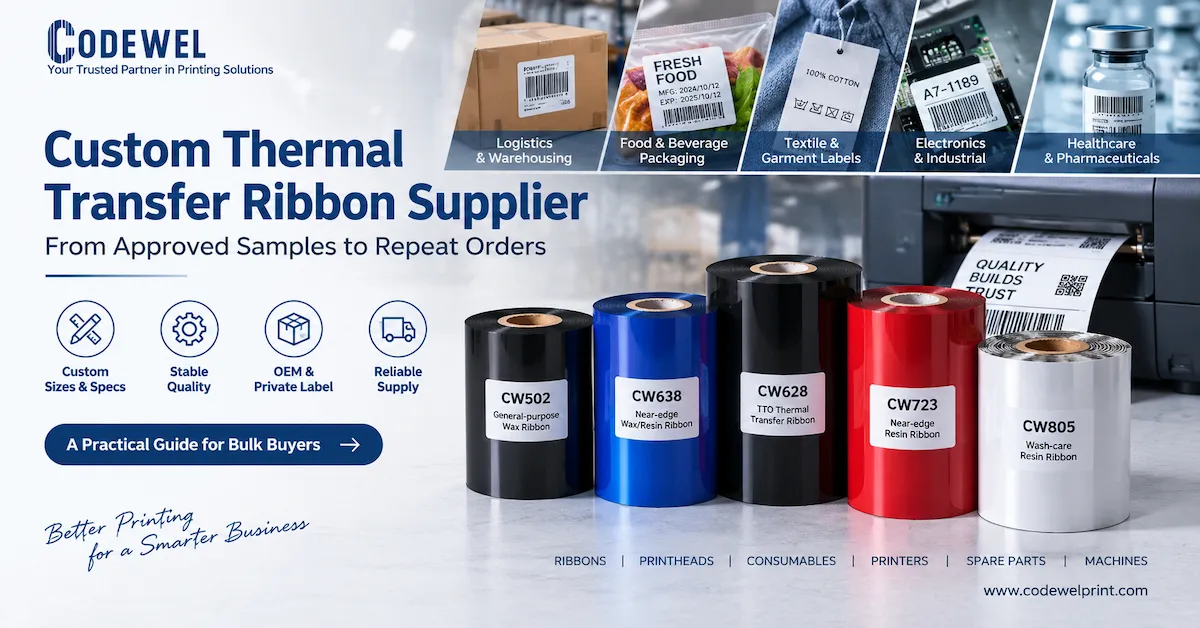
| CW502 wax ribbon | General-purpose wax; lists widths from 30–110 mm and custom options. | Routine label-printing accounts with a cost-sensitive requirement | Actual label material, handling requirements, and finished-roll configuration |
| CW603 wax-resin ribbon | Economical wax-resin positioned for demanding label surfaces and selected synthetic substrates. | Customers whose application calls for a wax-resin candidate | Substrate-specific print and durability results |
| CW709 resin ribbon | Standard full resin; lists electronics, product identification, and electrical-nameplate applications. | Industrial identification accounts | Required abrasion and environmental tests on the actual label construction |
| CW628 TTO ribbon | Near-edge/TTO wax-resin; lists 22, 25, 33, 35, and 55 mm widths plus custom options. | Packaging customers with identified TTO equipment | Printer, film, operating speed, and roll geometry |
| CW805 wash-care ribbon | Wash-care resin for textile substrates; lists 25–55 mm widths in 5 mm increments plus custom options. | Garment-label and textile customers | Readability after the agreed washing and ironing conditions |
Clarify Wholesale Pricing and MOQ for Each Configuration
Request a line-by-line quotation from your barcode ribbon wholesale supplier, not just one headline discount. Confirm whether the minimum order quantity, or MOQ, applies per formulation, size, packaging version, or total shipment. Ask whether mixed configurations qualify for the quoted price tier and whether sample or pilot quantities have different terms. Normalize quotations by formulation, dimensions, core, ink side, packaging, and delivery basis before comparing them. For example, a 110 mm × 300 m roll contains 33 square meters of ribbon; a 60 mm × 300 m roll contains 18. Area is useful for understanding quantity, but it does not make different formulations or finished-roll specifications commercially equivalent.
Evaluate the Discount Against the Stock You Must Hold
Consider this illustrative comparison, not CODEWEL pricing: 1,000 rolls at $2.80 require a $2,800 purchase, while 500 rolls at $3.00 require $1,500. The larger order saves $0.20 per roll but commits an additional $1,300. If demand during the review period is only 500 rolls, half of the larger order remains unsold. That does not automatically make the smaller order better; it means the discount must be evaluated alongside expected repeat demand, storage, financing, handling, and possible obsolescence. In your own purchasing model, separate acquisition cost from customer-service expenses such as replacement shipments and complaint handling. Compare the same cost categories for both offers rather than allowing a lower roll price to hide additional obligations.
Plan Reorders by Configuration, Not by Total Ribbon Volume
Separate your range into regularly stocked items, customer-specific repeat items, and samples or unapproved candidates. Ask the barcode ribbon wholesale supplier which configurations support the replenishment schedule you need, but base stock decisions on your own demand records. As a simplified planning example, a SKU used at 80 rolls per week with a seven-week replenishment lead time requires 560 rolls to cover expected lead-time demand. Adding an illustrative 160-roll buffer gives a 720-roll reorder threshold. Assess that threshold against usable on-hand stock plus confirmed incoming quantities minus committed customer demand. The buffer is an assumption, not a recommended universal level; revise the plan when demand, lead time, or order-review frequency changes.
Specify Private-Label Options Without Losing Product Identity
A barcode ribbon wholesale supplier may offer several types of customization, but branding approval should not replace technical approval. CODEWEL’s CW638 near-edge wax-resin product information lists dimensional, core, and ink-side options, and its FAQ identifies customer-logo printing on leader film. Confirm boxes, labels, carton quantities, artwork, and any other requested packaging separately. Maintain a cross-reference between your private-label code and the approved supplier model even when that reference is not printed on the customer-facing pack. Treat a proposed new formulation as a separate technical-development request; a logo or packaging service does not establish that a new formulation is available.
Give Sales and Support Teams the Same Approved Product Record
Build customer-facing descriptions from the approved specification rather than from broad phrases such as “universal compatibility” or “industrial strength.” Record which printer and material combinations have actually been evaluated, which remain candidates, and what information sales staff must collect before recommending an alternative. For a complaint, ask for the customer SKU, supplier reference, batch where available, printer model, material, settings, and photographs of the result. Compare the complaint with the original approval before deciding whether it is a product defect, configuration mismatch, or unresolved application issue. Agree return authorization and remedy terms in advance; do not promise unrestricted returns or immediate replacements unless those terms have been confirmed.
Send a Wholesale RFQ That Can Become Your First Purchase Order
Prepare one line for each proposed SKU, supported by the printer, material, roll specification, application, and trial requirements. Add expected quantities, your repeat-order forecast, destination, packaging needs, and requested quotation basis. Ask the barcode ribbon wholesale supplier to identify unresolved technical points before final pricing. For a new range, propose an agreed sequence of sample review, customer-application testing, a manageable pilot order, and regular replenishment; pilot availability and quantities remain commercial items to confirm. Send CODEWEL your wholesale ribbon requirements with this information so the discussion can address product selection, configuration, and supply terms together.
Frequently Asked Questions
What Should I Send a Barcode Ribbon Wholesale Supplier for a Quote?
Provide the proposed supplier model or application, complete printer model, label material, ribbon width and length, core, ink side, quantity per SKU, destination, and packaging requirements. Mark unknown fields for confirmation. Include a forecast separately from the quantity you are committing to purchase.
Which Ribbon Should I Consider for General Paper Labels?
CODEWEL positions CW502 as a general-purpose wax option for cost-sensitive label printing. Use it as a candidate rather than an automatic approval: test the actual label material, layout, printer settings, and handling requirements before stocking it for an account.
Does a Larger Mixed Order Automatically Qualify for Wholesale Pricing?
Do not assume that it does. Ask whether the price tier is calculated by total order value, total area, rolls per configuration, or another agreed basis. Confirm whether custom packaging or specialist formulations have separate minimums.
Can One Ribbon Configuration Cover All My Customers’ Printers?
Treat that as a compatibility question, not an inventory shortcut. Check the complete printer configuration, core, ink side, dimensions, material, and application requirements. Consolidate items only when the proposed shared configuration has been evaluated for the relevant uses.
Are Samples Available Before a Wholesale Order?
CODEWEL’s product FAQ states that free samples are available with international courier charges borne by the buyer. Confirm the model, dimensions, quantity, and any custom-sample conditions first, so the sample represents the proposed purchase.
Does CODEWEL Offer Private-Label Barcode Ribbons?
Relevant product information confirms leader-film logo printing and configuration options. Request written confirmation of the full private-label scope, including any packaging and artwork requirements. Keep the approved technical specification linked to your resale code.
How Many Ribbon SKUs Should a New Distributor Stock?
There is no useful fixed number without customer and equipment information. Begin with configurations supported by actual demand and application approval. Add specialist or custom items when the forecast and customer commitment justify the additional stock.
How Should I Handle Shelf Life and Storage?
Request the selected model’s storage guidance, manufacturing or batch identification, shelf-life information, and any minimum remaining-life requirement at delivery. Agree stock-rotation practices accordingly. Do not convert a storage-temperature range into an assumed shelf life.
What Should Happen When a Customer Reports Poor Printing?
Collect the product and application records before replacing stock or changing grades. Compare the printer, material, settings, and supplied configuration with the approval record. Preserve representative affected samples and follow the supplier’s agreed investigation and return process.
Can I Negotiate Exclusive Distribution or Reserved Stock?
You can request these arrangements, but do not treat them as included in a wholesale quotation. Confirm whether they are available and document any territory, product scope, purchase commitment, duration, stock ownership, or release conditions separately.
Conclusion
The right barcode ribbon wholesale supplier supports a range you can specify, qualify, price, and replenish—not simply a large first shipment. Build the assortment around customer printers and materials, use model-specific samples, clarify minimum quantities and mixed-order terms, and compare discounts against the inventory they require. Preserve the connection between supplier models, private-label codes, customer approvals, and repeat orders. To develop a CODEWEL sourcing proposal, submit your ribbon configurations and demand forecast, including the applications, quantities, destination, and branding requirements that will determine the appropriate product and commercial review.