
What Should a Bulk Thermal Transfer Ribbon Supplier Actually Provide?
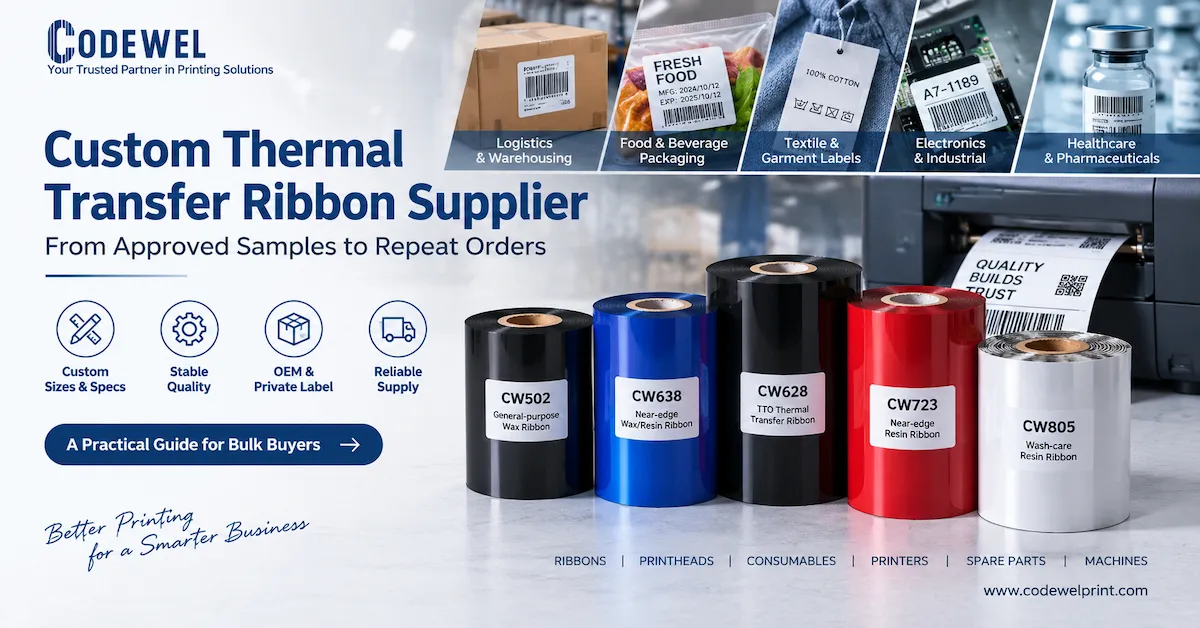
A reliable bulk thermal transfer ribbon supplier should provide more than large quantities of ribbon at an attractive unit price. For professional buyers, the real objective is to establish a ribbon specification that can be tested, approved, manufactured repeatedly, and reordered without creating avoidable compatibility or quality problems. That means the purchasing discussion should connect ribbon formulation, printer technology, label or film material, finished-roll dimensions, core configuration, ink side, application conditions, packaging requirements, and batch identification. CODEWEL currently organizes its thermal transfer ribbon product range into wax, premium wax, wax-resin, premium wax-resin, super wax-resin, resin, premium resin, TTO near-edge, and wash-care resin categories, allowing bulk buyers to narrow the selection according to the actual printing task rather than treating every black ribbon as interchangeable.
Which Buyers Benefit Most From Bulk Thermal Transfer Ribbon Sourcing?
Bulk purchasing is most relevant to ribbon distributors, barcode consumables wholesalers, private-label brands, label converters, packaging manufacturers, industrial factories, logistics operators, garment-label suppliers, printer dealers, and system integrators with predictable recurring demand. A distributor may prioritize a portfolio of standard sizes and formulations that can be replenished consistently; a label converter may care more about substrate compatibility and converting requirements; a packaging producer may need near-edge ribbons matched to TTO equipment and flexible film; a textile supplier may require wash-care formulations for garment labels. Bulk sourcing is less useful when the application, printer, substrate, or annual demand remains undefined, because a large order magnifies an incorrect specification. Before requesting volume pricing, buyers should first establish whether the application needs ordinary wax, wax-resin, resin, TTO near-edge, or wash-care technology. CODEWEL’s thermal transfer ribbon supplier guide follows the same application-first approach and separates the major formulation families according to printing and durability requirements.
Start With the Printing Application Before Discussing Volume
The first question for a bulk thermal transfer ribbon supplier should not be “How much is one million square meters?” but “What exactly will this ribbon print?” Paper shipping labels, coated warehouse labels, synthetic industrial labels, flexible food packaging, electronics identification, and garment care labels impose different requirements. Standard wax ribbons are generally the economical starting point for common paper labels; wax-resin formulations are useful when buyers need a balance between cost and additional durability; resin products are selected for more demanding synthetic-label applications; TTO near-edge products address packaging and near-edge printing systems; wash-care resin products serve textile and garment labeling. A buyer should therefore describe the printer, substrate, finished application, handling conditions, expected service life, and any relevant exposure before choosing the formulation. The important purchasing principle is simple: select the ribbon according to the complete printer–ribbon–substrate–application combination, not according to price or product grade name alone.
Build a Bulk Ribbon Specification Before Requesting a Quote
A professional RFQ should become the basis of the future purchase order, sample approval, production check, and repeat order. Instead of asking only for “110 × 300 wax resin ribbon,” create one controlled specification containing the information below. Any unknown item should be marked for confirmation rather than guessed, because core dimensions, winding direction, ink side, and printer technology can determine whether a physically similar roll will actually work in the intended machine.
| Specification Item | Buyer Should Provide | Why It Matters for Bulk Orders |
|---|---|---|
| Printer | Brand and complete model | Helps confirm technology and physical compatibility |
| Printhead technology | Flat-head or near-edge where applicable | Determines suitable ribbon family |
| Substrate | Paper, coated paper, PET, PP, textile, film,or other material | Influences adhesion and durability |
| Ribbon formulation | Wax, wax-resin, resin, TTO, or wash-care | Defines the performance direction |
| Width | Required finished width | Avoids unnecessary waste and installation problems |
| Length | Required roll length | Affects roll geometry and purchasing comparison |
| Core | Diameter, length,notch or other details | Must fit the intended printer |
| Ink side | IN or OUT | Must match equipment configuration |
| Color | Black or required custom color | Requires product-specific confirmation |
| Print settings | Speed, darkness/energy and resolution where relevant | Creates repeatable trial conditions |
| End-use conditions | Handling, abrasion, washing, heat, oil or chemical contact as relevant | Defines what should be tested |
| Branding | Leader film, label,packaging or private-label requirements | Separates technical and branding customization |
| Order forecast | Trial, initial order and repeat volume | Supports production and inventory planning |
| Destination | Country, port or delivery location | Needed for commercial and logistics planning |
Ribbon Construction and Formulation Matter in High-Volume Printing
A thermal transfer ribbon is not simply a roll of black film. CODEWEL’s thermal transfer ribbon manufacturing guide describes the basic structure as PET film, an ink coating, and a back coating.In practical sourcing terms, the carrier supports the ribbon through the printing process, the formulation determines how the image transfers to the substrate and performs after printing, and the back-coating side interacts with the printhead during operation. Coating uniformity, carrier consistency, slitting accuracy, winding condition, and finished-roll geometry become increasingly important as purchasing volume rises because a small inconsistency repeated across thousands of rolls can create more operational cost than a small unit-price difference. Bulk buyers should therefore request product-specific technical data and evaluate finished samples rather than making a decision only from ribbon appearance or a generic statement such as “premium quality.”
Wax, Wax-Resin, Resin, TTO, and Wash-Care Are Different Purchasing Decisions
The correct formulation depends on the job. Wax is normally evaluated for economical paper-label printing where extreme resistance is not the priority. Wax-resin increases the performance range and is frequently considered for coated papers and applications requiring better resistance than standard wax. Resin moves toward higher-demand synthetic-label applications where abrasion, heat, oils, chemicals, or long-term durability may be relevant, although the actual substance and exposure conditions still need testing.Near-edge/TTO ribbons must also match the printing technology and packaging application, while wash-care formulations are developed specifically for textiles and garment labels. A bulk buyer should therefore avoid replacing a lower-performing formulation with the “strongest” ribbon by default; paying for performance that the application does not require can increase cost without adding commercial value, while choosing too low a performance level can create unreadable labels, reprints, complaints, or production interruptions.
Compare CODEWEL Ribbon Models by Application and Verification Requirements
For buyers evaluating a bulk thermal transfer ribbon supplier, model comparison should identify which product deserves testing rather than declare one ribbon universally better. The examples below come from current CODEWEL product information and represent different positions within the available range. Final compatibility should still be verified on the buyer’s actual printer, media, and operating conditions.
| CODEWEL Product | Published Product Direction | Example Specification | Suitable Evaluation Direction | Bulk Buyer Should Verify |
|---|---|---|---|---|
| CW502 wax ribbon | Standard wax | General wax family | Paper labels, general barcode printing, cost-sensitive applications | Printer compatibility, print darkness, handling resistance and required roll configuration |
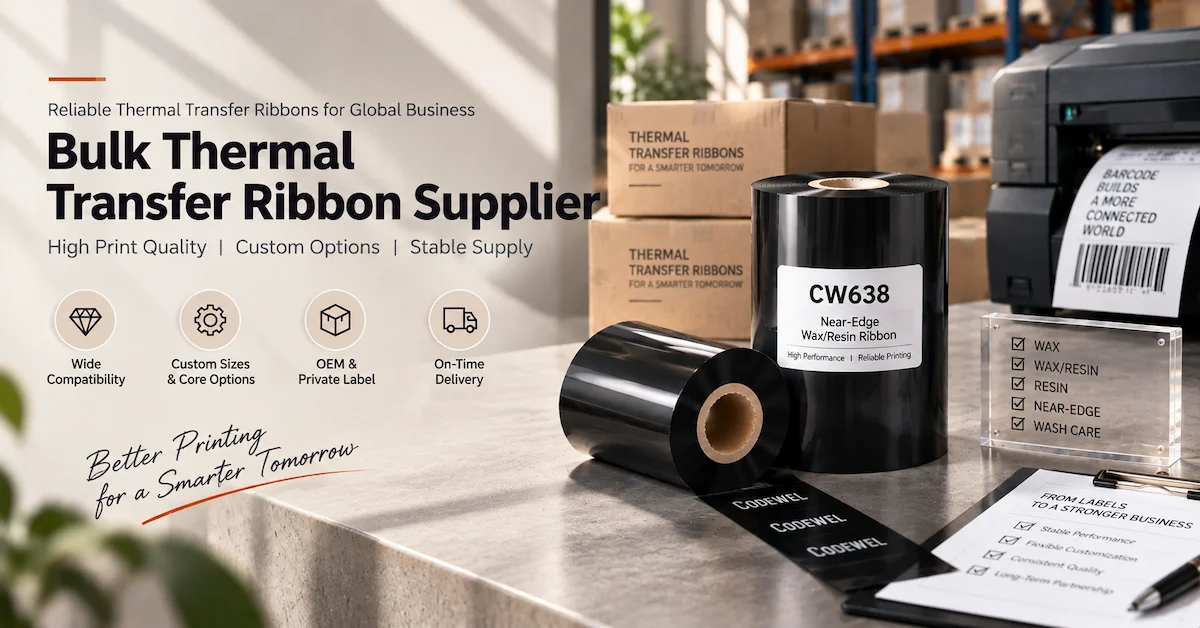
| CW638 near-edge wax/resin ribbon | Near-edge wax/resin | 2–10 IPS; IN/OUT; ½" or 1" cores; customizable widths and lengths | Applications requiring a near-edge wax-resin option | Printer technology, actual substrate, speed, winding and durability requirements |
| CW624 TTO wax/resin ribbon | TTO near-edge premium wax/resin | Published speed up to 20 IPS; configurable dimensions | Flexible packaging and TTO printing evaluation | TTO printer, packaging film, production speed and print durability |
| CW723 near-edge resin ribbon | Near-edge premium resin | 0–10 IPS; 22/25/33/35/55 mm or customized widths | More demanding near-edge applications involving oils or other defined exposure | Exact film, contact substance, exposure time, speed and print quality |
| CW805 wash-care resin ribbon | Wash-care resin | 0–6 IPS; multiple listed widths and customized options | Garment care labels and textile identification | Textile substrate, washing process, ironing conditions and post-treatment readability |
These published values should be treated as product-page specifications, not as universal settings for every printer or substrate.For example, CW638 is explicitly identified as a near-edge wax/resin product, so its position in the “Super Wax/Resin” family should not be interpreted as proof that it is a general-purpose flat-head ribbon. Similarly, CW723’s application claims should be tested against the actual substance and film involved rather than translated into a blanket statement that the ribbon is resistant to every chemical.
How Manufacturing Capability Affects Bulk Order Consistency
Bulk ribbon purchasing changes the supplier evaluation from “Can this sample print?” to “Can this approved configuration be reproduced consistently?” CODEWEL states on its About Us page that its ribbon operation includes more than 10 coating and cutting production lines, a production base exceeding 6,000 square meters, annual output above 100 million square meters, and exports to more than 100 countries. These are company-level manufacturing statements and provide useful context for a bulk buyer, but they should not be treated as a guaranteed allocation or delivery date for an individual purchase order.A procurement team should still confirm the production plan for its specific formulation, dimensions, branding, quantity, inspection requirements, and delivery destination.
Coating, Slitting, and Winding Should Be Part of Supplier Evaluation
When qualifying a bulk thermal transfer ribbon supplier, ask how the approved ribbon moves from coating to finished roll. Coating consistency influences image transfer and repeatability; slitting determines whether the roll width and edge condition are suitable for stable feeding; winding affects roll condition, tracking, and installation; final identification helps separate models, dimensions, and batches. For private-label or multi-SKU programs, these details become particularly important because a warehouse may contain several visually similar black ribbons with different formulations or configurations. Buyers should therefore agree on a product code, model, width, length, core, ink side, batch or lot reference where available, and packaging identification. The approved specification should be sufficiently clear that another purchasing colleague can reorder the same product without relying on memory or an old photograph.
Sample Approval Should Reproduce the Real Printing Conditions
A free sample is useful only when the test represents the intended production job. Several CODEWEL product pages state that samples are available and that international courier charges are normally borne by the buyer; however, buyers should confirm the exact sample model, dimensions, and commercial terms for the current project rather than assuming every custom configuration is immediately available. During testing, use the actual printer, intended label or film, representative print content, and realistic speed and energy settings. Record the ribbon model, batch where available, printer, substrate, settings, date, and evaluation result. If the application requires resistance to rubbing, oil, washing, ironing, or another treatment, define the treatment before the test instead of judging durability by an informal hand-rub test. The purpose of sample approval is to create a reproducible purchasing reference, not simply to obtain one good-looking barcode.
Quality Control for Bulk Orders Should Follow the Approved Specification
A large order should not be approved simply because the outer carton carries the correct product name.Incoming inspection can compare finished width, roll condition, core configuration, ink side, packaging identification, and sample print performance against the approved reference. Where the application is critical, buyers can define additional application tests and acceptance criteria before the order is released. The supplier and buyer should also agree how nonconforming material will be identified and investigated. If the ribbon formulation, carrier, dimensions, core, winding, branding, or another approved characteristic changes, a review may be necessary before the revised configuration enters regular supply. This type of control is especially useful to distributors and private-label buyers because a complaint may occur several steps downstream from the original supplier.
Bulk Ribbon Cost Should Be Compared on an Equivalent Basis
The cheapest roll is not automatically the lowest-cost ribbon. Compare quotations only after normalizing formulation, width, length, core, ink side, quantity, packaging, delivery terms, and any private-label requirements. A 300 m roll and a 450 m roll cannot be compared solely by roll price, and a standard wax product should not be benchmarked against a premium resin product without accounting for the different applications. Buyers can calculate ribbon cost per meter, cost per square meter, or—where production data is available—cost per accepted label.The last method is particularly useful because it exposes waste caused by poor print quality, repeated setup, incompatible material, or rejected labels. Freight, customs, warehousing, minimum quantities, sample testing, packaging development, obsolete stock, and line stoppage risk should also be considered. The commercial goal is not simply to purchase cheaper ribbon; it is to achieve a stable accepted print at a sustainable total cost.
Avoid Building Too Many Custom SKUs Too Early
A bulk purchasing program can become inefficient when every customer, printer, or salesperson creates a slightly different ribbon specification. Before approving another custom width, length, color, core, or private-label version, determine whether an existing approved SKU can satisfy the requirement. SKU consolidation can simplify inventory, forecasting, quality control, and repeat ordering. At the same time, unnecessary standardization can create compatibility problems, so consolidation should never override the printer or application requirement. A practical approach is to separate the range into core high-volume SKUs, application-specific products, and genuinely custom configurations. That structure allows wholesalers and distributors to maintain a manageable stock portfolio while still supporting customers who require a specialized TTO, resin, or wash-care solution.
OEM and Private-Label Requirements Should Be Defined Separately From Ribbon Performance
For an OEM or private-label project, “custom ribbon” can describe several different activities. The ribbon may use an existing formulation but require a customized width, length, core, ink side, color, leader-film identification, product label, or packaging. CODEWEL’s CW638 page, for example, lists customizable widths and lengths, IN/OUT ink-side options, multiple core options, custom color, and leader-film logo possibilities. These options provide useful starting points for a bulk private-label project, but the exact available combination, quantity, artwork requirement, packaging method, and production schedule should be confirmed for the selected model. A buyer requesting a new formulation or materially different printing performance should treat that requirement separately from a branding project because a technical modification requires its own evaluation and sample-approval criteria.
Repeat Orders Need More Control Than a Previous Invoice Number
A successful first bulk order should create a reference package for future purchasing.That package can contain the CODEWEL model, buyer SKU, formulation, dimensions, core, ink side, approved color, artwork version, packaging, reference sample, test record, quotation or purchase-order revision, and any application-specific acceptance criteria. When the next order is placed, purchasing can compare the new requirement against this controlled reference rather than writing “same as last time.” If the printer model, label material, packaging film, or end-use environment has changed, the buyer should determine whether the previous approval still applies. This protects both buyer and supplier because expectations remain tied to a defined configuration rather than informal assumptions.
How Should Buyers Evaluate Lead Time and Supply Continuity?
Do not evaluate delivery by asking only for one generic production number. Separate stock availability, custom preparation, sample approval, branding or artwork approval, production, inspection, export preparation, and international transport. Common-size products may follow a different schedule from a customized bulk order, and a multi-SKU purchase may contain products with different readiness dates. A qualified supplier should therefore quote the actual project conditions rather than apply one website lead-time statement to every order.For long-term programs, buyers can also discuss rolling forecasts, reorder points, expected monthly or quarterly consumption, safety stock responsibilities, and change-notification procedures. Supply continuity becomes more important as the customer moves from occasional purchasing to distributor inventory or continuous manufacturing.
What Should Be Included in a Bulk Thermal Transfer Ribbon RFQ?
A useful RFQ to a bulk thermal transfer ribbon supplier should contain enough information for technical and commercial teams to evaluate the same project. Include the complete printer model, printing technology where known, substrate, existing ribbon reference, required formulation, width, length, core, ink side, color, application conditions, expected order quantity, annual forecast, branding or packaging requirements, destination, and required sample-testing process. Attach photographs of existing ribbon labels, printer information, or packaging where they help clarify the requirement. When a specification is unknown, state that it requires confirmation instead of supplying a guessed value. Buyers can review the CODEWEL barcode ribbon range before preparing the RFQ, then contact CODEWEL with the selected application, specifications, volume, and customization requirements for an order-specific evaluation.
Frequently Asked Questions
1. What information does a bulk thermal transfer ribbon supplier need for a quotation?
A useful quotation normally starts with printer model, ribbon formulation, width, length, core, ink side, substrate, application, quantity, destination, and any OEM or private-label requirement. If the current ribbon is already working well, supplying its model, label photograph, and sample can make the comparison more specific.
2. Is wax ribbon always the best option for high-volume orders because it costs less?
No.Wax can be economical for general paper-label applications, but a lower roll price does not help if the application requires durability that the selected wax formulation cannot provide. Compare the formulation against the substrate and end-use requirement before comparing volume prices.
3. When should bulk buyers choose wax-resin instead of wax?
Wax-resin is commonly evaluated when buyers require more resistance than standard wax while still wanting a balanced commercial solution. The decision should be tested on the actual label material because coated papers, synthetics, printer settings, and handling conditions can affect the result.
4. When is resin ribbon worth the higher purchasing cost?
Resin formulations become relevant where synthetic labels or more demanding abrasion, heat, oil, chemical, or service-life requirements justify additional performance. The exact exposure should be defined and tested; “industrial use” alone is too broad to prove that resin is required.
5. Can TTO ribbon be purchased only by matching its width and length?
No.TTO and near-edge applications also depend on the printer technology, film or packaging substrate, speed, formulation, core, winding, and other equipment requirements. The same dimensions do not guarantee compatibility.
6. Can CODEWEL provide customized ribbon dimensions?
Selected CODEWEL product pages list customized width, length, core and other configuration options. Because the available range varies by model, buyers should confirm the exact custom specification for the selected ribbon rather than assume every possible dimension is available across every formulation.
7. Can private-label buyers add their own branding?
CODEWEL product information states that leader film can carry customer logo information on relevant products. Packaging, labels, artwork, color, quantities, and other private-label requirements should be confirmed separately so the technical ribbon approval and branding approval do not become confused.
8.Should a bulk buyer test samples before every order?
A complete requalification may not be necessary for every unchanged repeat order, but the first approved configuration should be documented and incoming checks should verify that the delivered material corresponds to it. A new test may be appropriate when the ribbon, printer, substrate, operating condition, or another relevant specification changes.
9. How should distributors reduce inventory risk when buying ribbons in bulk?
Separate regular high-volume SKUs from lower-volume application-specific products, build forecasts from actual consumption, avoid unnecessary custom variants, and identify each formulation and configuration clearly. A lower price on excessive stock can become expensive when the product is slow moving or tied to only one customer.
10. How can I compare two bulk ribbon suppliers fairly?
Give both suppliers the same printer information, substrate, formulation requirement, dimensions, core, ink side, volume, packaging request, destination, and test method.Approve samples under the same conditions and compare total purchasing cost, print performance, specification control, repeatability, communication, customization requirements, and order-specific delivery terms—not merely the quoted price per roll.
Conclusion
Selecting a bulk thermal transfer ribbon supplier is ultimately a repeatability and supply-chain decision rather than a simple search for the lowest roll price. Professional buyers should first define the printer, substrate, formulation, dimensions, core, ink side, application and required durability; then compare candidate ribbons under controlled sample conditions, document the approved specification, and build that specification into purchasing, inspection, branding, and repeat-order procedures. CODEWEL publishes wax, wax-resin, resin, TTO near-edge, and wash-care ribbon options together with manufacturing capabilities for volume supply, while individual models provide different dimensional, performance, and customization starting points. Buyers planning wholesale, distributor, private-label, converter, packaging, textile, logistics, or industrial ribbon programs can review the CODEWEL thermal transfer ribbon range and submit their bulk sourcing requirements to CODEWEL with the printer, substrate, ribbon configuration, expected volume, destination, and application conditions required for a focused product and quotation review.