
What Does “Thermal Transfer Ribbon for Packaging” Actually Mean?
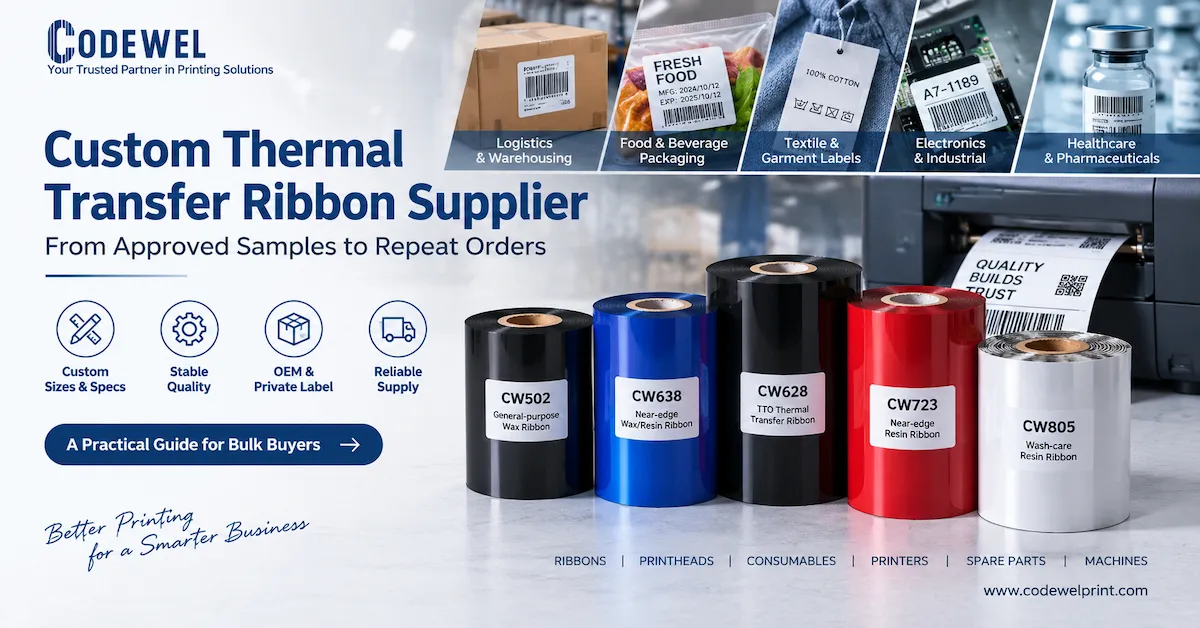
A thermal transfer ribbon for packaging can describe two different purchasing problems, and buyers should separate them before selecting a product. The first is printing barcode or identification labels that are later applied to cartons, bottles, pallets, or retail packs. The second is thermal transfer overprinting, commonly referred to as TTO, where variable information such as dates, batch codes, barcodes, ingredients, or traceability data is printed through a near-edge thermal system onto flexible packaging material or a related printable surface. CODEWEL’s thermal transfer ribbon range includes standard wax, wax-resin, resin, TTO near-edge, and wash-care categories, so the correct starting point depends on whether the buyer is printing a separate label or running an in-line packaging process.
For flexible packaging and high-speed production lines, the most relevant starting point is usually the TTO near-edge family rather than a general flat-head ribbon. CODEWEL lists CW624, CW625, and CW628 within its near-edge/TTO wax-resin range and CW723 within its near-edge resin range. These products serve different performance requirements and should be compared against the actual printer, film, speed, and exposure conditions rather than selected only by the words “premium” or “resin.”
Who Should Use This Packaging Ribbon Selection Process?
This selection process is most relevant to food processors, snack and confectionery manufacturers, frozen-food producers, dairy and beverage packers, pharmaceutical-packaging operations, contract packers, flexible-packaging converters, personal-care manufacturers, logistics-label suppliers, and distributors serving TTO users. Their priorities differ: one factory may need clean expiry-date printing on laminated film at high line speed, another may need resistance to oils or grease, while a distributor may need several widths and lengths that can be reordered consistently for different customer printers.
The process is less useful when the buyer has not identified the printer or packaging material. A request such as “I need a good ribbon for food packaging” leaves important questions unanswered: Is the printer near-edge or flat-head? What film is being printed? What is the production speed? Does the print contact oils, moisture, cleaning agents, or heat? What width and core does the printer require? A reliable purchasing decision begins with these variables rather than with the ribbon price.
Start With the Packaging Line, Not With the Ribbon Grade
The best thermal transfer ribbon for packaging is the one that performs correctly in the complete printing system. Buyers should first document the TTO printer brand and model, printhead technology, packaging-machine speed, printable area, film structure, print content, and current ribbon specification. If the line already has an approved ribbon, keep its product code, width, length, core, and ink-side information as a comparison reference.
Packaging material deserves particular attention because surfaces that appear similar can behave differently. Flexible packaging may involve different film structures, coatings, laminates, or treated surfaces. A ribbon that produces a strong image on one film should not automatically be approved for another material without testing. The same applies when a converter changes film supplier or coating: the ribbon did not change, but the printing surface did, so the previous approval may no longer represent the new package.
Build a Packaging Ribbon Specification Before Requesting a Quote
A professional RFQ should give technical, production, purchasing, and quality teams one shared product definition. The following specification structure helps prevent a quotation from being based only on width and length.
| Specification Area | What the Buyer Should Provide | Why It Matters |
|---|---|---|
| TTO printer | Brand, complete model, configuration | Confirms near-edge compatibility |
| Packaging machine | Machine type and line arrangement | Provides production context |
| Film/material | Film type, supplier reference, sample if available | Determines transfer and adhesion behavior |
| Print content | Date, batch code, barcode, text, logo, etc. | Defines print-quality requirements |
| Line speed | Normal and maximum operating speed | Helps evaluate ribbon performance |
| Ribbon width | Required finished width | Controls fit and material consumption |
| Ribbon length | Required roll length | Influences changeover frequency |
| Core | Diameter, width, notch where relevant | Must physically fit the printer |
| Ink side | IN or OUT | Must match the printer |
| Color | Black or other required color | Requires model-specific confirmation |
| Exposure | Rubbing, oil, moisture, heat, cleaning or other conditions | Defines durability testing |
| Order volume | Sample, trial, regular order and annual forecast | Supports quotation and replenishment planning |
| Branding | Leader film, packaging, private-label requirements | Separates technical and commercial customization |
Why Near-Edge/TTO Ribbon Is Important for Flexible Packaging
Near-edge thermal printing differs from conventional flat-head printing in how the ribbon and printhead interact, so packaging buyers should not assume that a general barcode ribbon will perform correctly in a TTO printer. CODEWEL’s CW628 page identifies CW628 as a near-edge/TTO wax-resin formulation designed for near-edge or TTO printers and lists a published speed range of 6–20 IPS. It also lists IN or OUT ink-side options, ½-inch, 1-inch, or customized cores, widths of 22/25/33/35/55 mm or customized widths, and lengths of 300/450/500/600 m or customized lengths. Review the CODEWEL CW628 TTO ribbon.
These values are useful for product selection, but they are not universal operating settings. The actual usable speed still depends on the printer, packaging film, print energy, print layout, line conditions, and required durability. The correct interpretation is therefore “CW628 is a candidate for testing within the published product range,” not “every packaging line can run CW628 at 20 IPS.”
Wax-Resin or Resin: Which Is Better for Packaging?
Wax-resin is often the practical first candidate for high-volume packaging because it balances printing efficiency, media flexibility, and durability. CODEWEL’s CW624 is positioned as a premium TTO wax-resin ribbon for applications including food packaging, pharmaceutical packaging, logistics labels, clothing tags, and retail labels. The page lists speeds up to 20 IPS together with configurable widths, lengths, cores, and ink-side options. View CW624 TTO wax-resin ribbon.
Resin should be considered when the printed image faces more demanding exposure. CODEWEL’s CW723 is a near-edge resin formulation positioned for substrates and conditions involving grease, edible fats/oils, and chemicals; it lists a published speed range of 0–10 IPS and multiple standard or customized dimensions. View CW723 near-edge resin ribbon.
The practical rule is not “resin is always better.” If CW624 or CW628 passes the required film, speed, and durability test, a resin formulation may add cost without improving the buyer’s actual process. If wax-resin fails a defined oil, chemical, abrasion, or other relevant requirement, a near-edge resin such as CW723 becomes a logical candidate for further testing.
Compare Packaging Ribbon Models by the Problem They Solve
| CODEWEL Model | Published Type | Published Speed | Useful Packaging Starting Point | Buyer Should Verify |
|---|---|---|---|---|
| CW624 | Premium TTO wax-resin | Up to 20 IPS | Food, pharmaceutical and general flexible-packaging evaluation | Film, speed, scratch requirement and roll configuration |
| CW628 | Near-edge/TTO wax-resin | 6–20 IPS | High-speed TTO lines requiring low-energy, efficient printing evaluation | Printer, film, energy setting and production speed |
| CW723 | Near-edge premium resin | 0–10 IPS | Packaging involving grease, oils or other specified exposure | Exact substance, contact time, film and print-quality requirement |
The comparison should be used to shortlist a sample, not to declare one model universally superior. CW624 and CW628 provide wax-resin options for TTO packaging, while CW723 targets more demanding resistance requirements.
Film Compatibility Must Be Tested on the Actual Packaging Material
Packaging converters frequently change film structures for sealability, barrier properties, appearance, or cost. Those changes can also affect printing behavior. A packaging ribbon should therefore be approved on the actual film planned for production. If the same product is packed in several film structures, treat each material as a separate approval unless testing shows that one ribbon configuration performs acceptably across all of them.
A useful sample test records the film supplier and grade, TTO printer, ribbon model, ribbon batch where available, print speed, energy setting, environmental conditions, print layout, and test result. Keep the printed sample with the record. When the film changes later, quality personnel can compare the new result with the approved reference instead of relying on memory.
Do Not Approve Packaging Ribbon From One Large Date Code
Packaging printing often contains more than a large expiry date. A realistic test should include the smallest characters, narrow lines, batch codes, barcodes, logos, or other variable data that the production line actually prints. If multiple fonts or codes are common, include representative examples.
Print quality should be checked across the full required print area. A sample can look acceptable in the center while showing inconsistent density or missing elements elsewhere. Barcode users should also verify readability under the requirements of their own system rather than assuming that visually dark bars automatically mean acceptable barcode quality.
Define Durability With a Test, Not an Adjective
Terms such as “scratch resistant,” “oil resistant,” or “chemical resistant” are useful only when the exposure is defined. For food packaging, for example, “oil resistance” could mean incidental contact with edible oil during filling, surface contamination during transport, or continuous exposure inside a production environment. Those are different tests.
For any important durability requirement, record the substance, concentration if relevant, exposure time, rubbing method, temperature, and pass/fail criterion. CODEWEL’s CW723 page identifies grease, edible fats/oils, and chemicals as target conditions, but a buyer should still validate the exact exposure encountered in production rather than interpreting that description as resistance to every possible chemical.
Coating, Slitting, and Winding Matter to Packaging-Line Stability
In high-volume packaging, ribbon quality includes more than the transferred image. Coating consistency affects print transfer, slitting affects finished width and edge condition, and winding affects how the ribbon behaves as the roll unwinds. CODEWEL’s thermal transfer ribbon manufacturing guide describes PET carrier film, coating, back coating, slitting, and winding as important stages in ribbon production.
For a packaging buyer, these manufacturing topics should become measurable purchasing questions: Is the width controlled? Is the roll tightly and evenly wound? Is the core correct? Is the ink side clearly identified? Is the model or batch traceable? A supplier does not need to disclose proprietary formulation details for the buyer to establish meaningful finished-product acceptance criteria.
Quality Control Should Follow the Approved Packaging Specification
Incoming inspection should verify that the delivered ribbon corresponds to the approved configuration. Useful checks include product code, formulation, width, length where practical, core, ink side, winding condition, packaging identification, and representative printing performance. More demanding operations can add application-specific tests based on actual production risk.
If the ribbon formulation, carrier, roll dimensions, core, ink-side configuration, or other approved characteristic changes, determine whether the sample should be requalified. This becomes particularly important for food, pharmaceutical, or contract-packaging operations where the printing consumable may be approved as part of a broader production process.
Production Speed Should Be Treated as a System Variable
CW624 is published at up to 20 IPS and CW628 at 6–20 IPS, but those numbers should not be turned into a guaranteed packaging-line speed without qualification. The actual result depends on the TTO printer, film, print area, ribbon formulation, energy, environmental conditions, and line setup.
A sensible trial therefore begins at the established production condition, not at the highest number printed in a product table. Once print quality is stable, the engineering team can evaluate whether higher speed is appropriate. The goal is not to achieve the largest IPS number; it is to maintain readable, repeatable coding at the production output the packaging line actually needs.
Ribbon Length and Width Affect More Than Material Price
A longer ribbon can reduce the number of roll changes, but only if the printer can physically accept the roll and the application benefits from the additional length. A ribbon wider than the print area may increase consumable usage, while one that is too narrow can fail to cover the required printing width. The correct economic comparison therefore combines roll dimensions, usable printing area, changeover frequency, operator time, and rejected packaging.
For continuous packaging operations, downtime has a commercial value. A slightly more expensive configuration may be attractive if it reduces appropriate changeovers and performs reliably, while a cheaper roll can become costly if it increases rejected film or line interruptions. Compare cost per accepted package, not only price per roll.
How Should Packaging Buyers Evaluate Total Ribbon Cost?
A practical total-cost model can include ribbon purchase price, transport, customs where applicable, rejected film, test material, changeover labor, downtime, and rework. These costs vary by factory, so the calculation should use production data rather than a generic percentage. If one ribbon reduces roll price by 5% but increases packaging waste or unplanned stops, the purchase-price saving may not translate into a production saving.
This is also why the highest-performance resin should not automatically be selected. The best commercial result is normally the lowest-cost configuration that reliably passes the agreed packaging requirements.
Customization Should Follow the Printer and Line Specification
CODEWEL’s CW628 product page lists black or custom color, IN or OUT ink side, ½-inch, 1-inch or customized cores, multiple standard widths and lengths, and customized dimensions. The same page states that customer logos can be printed on leader film. For distributors, private-label brands, and large packaging groups, these options can support standardized internal SKUs or branded supply programs.
However, technical and branding customization should remain separate. Changing leader-film artwork does not change ribbon performance; changing formulation or roll geometry can. Keep a controlled technical specification beneath any private-label code so that branding never hides the actual ribbon configuration.
Capacity and Lead Time Should Be Confirmed for the Exact Order
CODEWEL states that its ribbon operation includes more than 10 coating and cutting lines, a production base above 6,000 square meters, and annual production exceeding 100 million square meters. See CODEWEL manufacturing information. These company-level figures can be useful when evaluating large-volume supply, but they do not establish the lead time of a particular packaging order.
The CW628 and CW624 product FAQs publish indicative timing for common, customized, and very large orders, but packaging buyers should use the current quotation and purchase order as the binding planning reference because formulation, dimensions, artwork, order mix, inspection, and transport can affect the actual schedule.
What Should You Send With a Packaging Ribbon RFQ?
A useful RFQ should include the TTO printer brand and model, packaging machine, current ribbon reference, packaging-film description or sample, print width, ribbon width and length, core, ink side, normal and maximum line speed, print content, application exposure, quantity, annual forecast, destination, and any custom-logo or packaging requirements. Where the current product is causing a problem, attach photographs or samples and describe the problem rather than requesting an undefined “stronger ribbon.”
Buyers can first review CODEWEL’s barcode ribbon range and then send the packaging application to CODEWEL for a model-specific discussion.
Frequently Asked Questions
1. What Is the Best Thermal Transfer Ribbon for Packaging?
There is no single best product for every package. Select the ribbon from the printer, film, production speed, print layout, and durability requirement. For near-edge/TTO flexible packaging, CW624 or CW628 may be practical wax-resin candidates, while CW723 can be evaluated where stronger resistance is required.
2. Is TTO Ribbon Different From Normal Barcode Ribbon?
Yes. TTO packaging applications commonly use near-edge printing technology, so the ribbon should be designed for the relevant printhead and line conditions. Do not select a conventional flat-head ribbon only because its width and length appear to fit.
3. Is Wax-Resin Suitable for Food Packaging?
CODEWEL positions CW624 for applications including food packaging and lists CW628 as a near-edge/TTO wax-resin product. Final suitability should still be tested on the actual packaging film and production line.
4. When Should I Consider a Resin TTO Ribbon?
Consider near-edge resin when the printed image faces requirements that the approved wax-resin candidate does not meet, such as defined grease, oil, chemical, or other demanding exposure. Test the exact substance and film rather than relying on the resin name alone.
5. How Do I Choose the Correct Ribbon Width?
Confirm the TTO printer specification and required print area. The ribbon must cover the printed image while remaining compatible with the printer. Excessive width can create unnecessary consumption, while insufficient width can compromise printing.
6. Does a Longer Ribbon Always Reduce Packaging Costs?
Not necessarily. The printer must accept the roll, and the longer configuration should be evaluated against changeover frequency, purchase price, available space, waste, and production requirements. Compare total cost per accepted package.
7. Can CODEWEL Customize TTO Ribbon Dimensions?
The CW628 and CW624 pages list multiple standard widths and lengths along with customized size options and different core configurations. Confirm the requested combination for the exact model before ordering.
8. Can My Brand Be Printed on the Ribbon?
CODEWEL’s product FAQ states that a customer logo can be printed on leader film. Confirm artwork, quantity, placement, packaging, and approval requirements for the specific order.
9. How Should I Test a Packaging Ribbon Sample?
Use the intended TTO printer, actual packaging film, normal production speed, realistic print layout, and relevant exposure tests. Record printer settings and retain the approved print so future orders can be compared against the same reference.
10. What Information Is Needed for a Bulk TTO Ribbon Quote?
Provide the printer, film, ribbon dimensions, core, ink side, print speed, print content, application conditions, quantity, forecast, destination, and any customization requirements. This gives the supplier enough information to discuss both technical suitability and commercial terms.
Conclusion
Choosing the right thermal transfer ribbon for packaging requires more than selecting wax-resin or resin from a catalog. Packaging buyers should define the TTO printer, film, line speed, print content, roll dimensions, core, ink side, exposure requirements, and approval method before comparing price. CODEWEL’s CW624 and CW628 provide near-edge/TTO wax-resin options for flexible-packaging evaluation, while CW723 provides a near-edge resin route for applications requiring more demanding resistance. The final decision should come from a controlled test on the actual production film and printer, followed by a documented specification that can be used for quality inspection and repeat orders. Review the CODEWEL thermal transfer ribbon range or contact CODEWEL with your packaging application to compare the appropriate TTO ribbon configuration for your line.