

What Should a Compatible Printhead Supplier Help You Verify?
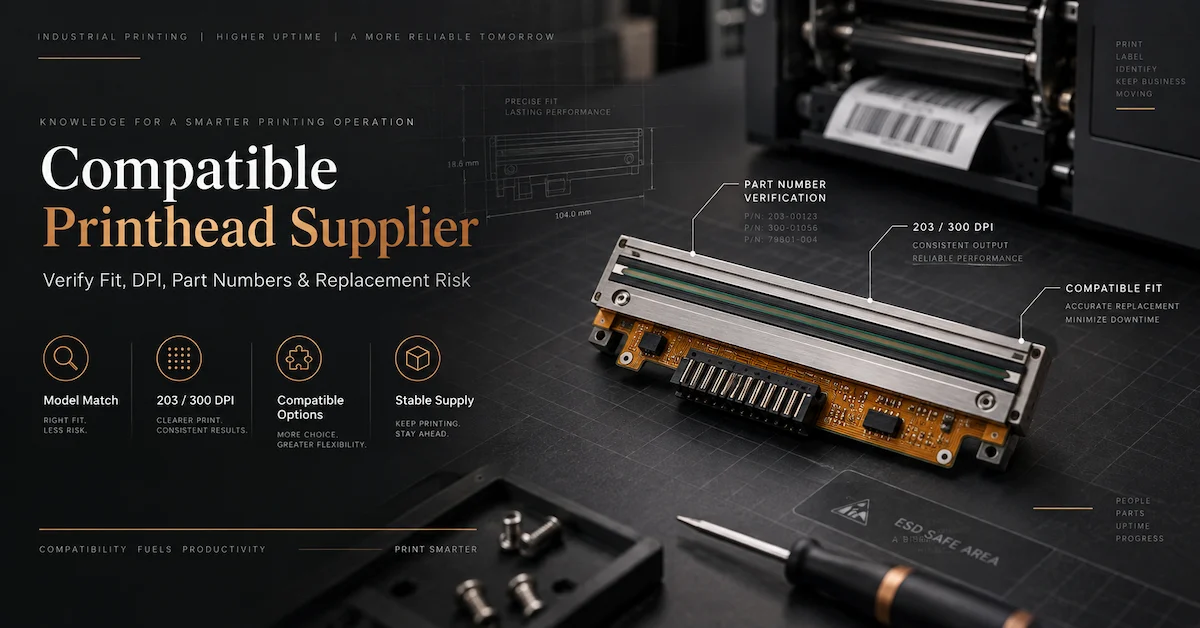
A compatible printhead supplier should help a buyer confirm exactly which replacement component is being supplied before price becomes the main decision. A printhead may look similar to another part while differing in printer model, DPI, printing width, connector, installation structure, or printer generation. CODEWEL’s printhead product category currently organizes replacement heads across printer families including Zebra, TSC, Datamax, Rohm, Avery, Sato, Markem, Videojet, Domino, CAB, Godex, Toshiba, Honeywell Intermec, Valentin, Bizerba, DIGI, Citizen, Argox, and Allen Coding. That breadth is useful for sourcing, but a brand-level category is not proof that every model or resolution is interchangeable.
For B2B buyers, the correct purchasing objective is a traceable replacement specification: printer brand, complete machine model, printhead model or part number where available, DPI, installation details, product status as original or compatible, and the warranty applicable to that exact SKU. If any of these items are uncertain, they should be confirmed before shipment rather than inferred from photographs.
Who Should Consider Compatible Thermal Printheads?
Compatible printheads can be relevant to printer repair businesses, barcode equipment distributors, maintenance contractors, label-printing factories, logistics operations, manufacturing plants, retail system integrators, and businesses managing fleets of thermal printers. These buyers often need replacement parts to restore equipment without automatically purchasing an original head for every repair.
A compatible product is less appropriate when a customer contract explicitly requires an OEM-original component, when the machine remains subject to service terms that restrict third-party parts, or when the printer configuration has not been identified accurately. In those cases, purchasing should resolve the original/compatible requirement before asking for a quotation. CODEWEL itself lists both original and compatible printheads, so the product status should be treated as a controlled specification rather than assumed from the supplier name.
Compatible vs. Original Printhead: Define the Difference Before Comparing Price
“Compatible” should mean a replacement product intended to operate with the specified printer configuration; it should not be marketed as “original” unless the product documentation identifies it that way. This distinction matters because CODEWEL currently has listings with clearly different product statuses. For example, the ZD220/ZD230/GC420T/TLP2844/GK888 203 dpi printhead is explicitly listed as New Compatible, while the TSC ME240 203 dpi printhead is listed as Original.
This status should appear in the RFQ, quotation, PO, packing identification, and resale listing where relevant. A distributor that mixes original and compatible products under one generic description such as “replacement printhead” increases the risk of customer disputes even if both parts physically fit a printer.
Do Not Select a Printhead by Printer Brand Alone
A Zebra-compatible or TSC-compatible description is only the beginning of the compatibility check. CODEWEL’s barcode printing supplies guide advises buyers to confirm the exact printer model together with DPI, print width, connector, mounting structure, printer generation, and compatible ribbon/media. That approach is much safer than assuming that one head works across every machine in a brand family. See CODEWEL’s barcode printing supplies guide.
A purchasing request such as “I need a Zebra printhead” leaves too many unanswered questions. A more useful request is: “Printer model ZD230, 203 dpi, existing printhead photos attached, current part reference attached, quantity 20 pieces.” The second request gives a supplier enough information to start an actual compatibility review.
Build a Printhead Identification Sheet Before Requesting a Quote
A good compatible printhead supplier should encourage buyers to organize technical information before shipment. The following format can be used by purchasing teams, repair companies, and distributors when requesting a replacement.
| Identification Item | What the Buyer Should Provide | Why It Matters |
|---|---|---|
| Printer brand | Full printer brand | Narrows the equipment family |
| Printer model | Complete model and suffix | Similar series can use different heads |
| Existing printhead model | Printed model/reference if visible | Provides another matching reference |
| Part number | OEM or existing replacement part number | Helps reduce model ambiguity |
| Resolution | 203, 300, 600 dpi or exact installed specification | Different DPI versions may not be interchangeable |
| Print width | Actual printer/head width where known | Helps confirm physical compatibility |
| Connector | Photo and type where uncertain | Important for installation matching |
| Mounting structure | Photos of the removed head and mounting area | Helps identify physical differences |
| Printer generation | Version or generation where relevant | Model updates can change components |
| Original/compatible requirement | State which status is acceptable | Prevents product-status disputes |
| Quantity | Trial quantity and expected repeat demand | Supports quotation and supply planning |
| Existing problem | White lines, missing dots, uneven density, or other symptom | Helps determine whether replacement is justified |
Why DPI Must Match the Printer Configuration
DPI, or dots per inch, describes print resolution. It should not be selected simply because a higher figure appears more precise. CODEWEL’s printhead guidance discusses common 203 dpi, 300 dpi, and 600 dpi configurations and associates higher resolutions with increasingly detailed print requirements. However, the replacement head still needs to correspond to the printer’s actual configuration rather than being treated as an independent upgrade.
CODEWEL’s original 105SL / 105SL Plus printhead listing, for example, separates 203 dpi and 300 dpi variants and provides different part numbers for the respective versions. This is a useful illustration of why “105SL printhead” alone is an incomplete purchasing description.
| Printer Variant | Resolution | Published Part Number |
|---|---|---|
| 105SL | 203 dpi | G32432-1M |
| 105SL | 300 dpi | G32433M |
| 105SL Plus | 203 dpi | P1053360-018 |
| 105SL Plus | 300 dpi | P1053360-019 |
The purpose of this table is identification, not to suggest that these four products are technically interchangeable.
Part Number Matching Can Reduce Replacement Risk
When a reliable part number is available, include it together with the printer model and DPI. For example, CODEWEL’s ME240 printhead page identifies the ME240, 203 dpi configuration with part number 64-0330001-00LF. The page also marks this particular product as original.
A part number alone is still not a reason to skip verification. Old machines may have been modified, model names can be copied incorrectly, and an online listing can contain incomplete information. For higher-volume orders, combining the machine label, removed-head label, part number, DPI, and photographs provides a stronger reference than any single field.
Use Product Status as a Required Quotation Field
A professional quotation should state whether a printhead is original or compatible. This should not be buried in the product description because buyers often use the quotation to create internal material codes and resale listings.
CODEWEL’s current pages demonstrate why this matters. The compatible ZD220/ZD230/GC420T family page explicitly identifies the condition as New Compatible, while TSC ME240 and several other listings identify the product as Original. CODEWEL’s printhead category therefore contains a sourcing ecosystem rather than one uniform product status.
For a distributor, a practical internal naming format could be:
Printer family + model + DPI + part number + Compatible/Original
This makes warehouse picking, quotation comparison, and repeat ordering easier to control.
How Should Buyers Evaluate a Compatible Printhead Sample?
A compatible printhead should be evaluated in the intended printer before a larger purchase whenever the application and order size justify testing. The trial should use the normal label or media, representative ribbon where thermal transfer printing is used, normal print speed, and a label design that includes the smallest required text and barcode elements.
Do not judge the replacement only from one large text sample. Check whether the printing is even across the usable width, whether expected barcode and text elements are complete, and whether the printer operates normally after installation and calibration. CODEWEL’s compatible ZD220/ZD230 family listing states that the listed product is 203 dpi and “100% Tested”; for purchasing purposes, buyers should still perform their own application-level acceptance test because the supplier’s product inspection and the customer’s actual printer application answer different questions.
Compare Compatible and Original Products Using the Same Data Fields
The table below is not a performance ranking. It shows how a buyer can distinguish product identity, status, resolution, and published warranty rather than comparing only price.
| CODEWEL Listing | Status Shown on Page | Resolution | Published Warranty | Buyer Should Confirm |
|---|---|---|---|---|
| ZD220/ZD230/GC420T/TLP2844/GK888 compatible printhead | New Compatible | 203 dpi | 5 months or 50 km | Exact printer model, mounting and application |
| ME240 printhead | Original | 203 dpi | 3 months or 30 km | Part number 64-0330001-00LF and printer configuration |
| MX240 printhead | Original | 203 dpi | 3 months or 30 km | Exact MX240 configuration |
| 105SL / 105SL Plus printhead | Original | 203 or 300 dpi variants | Product-specific terms should be confirmed | Model, DPI and matching part number |
These listings also show why buyers should not rely on a generic warranty statement. Published terms differ between products, so warranty should be confirmed against the exact SKU quoted rather than assumed to be identical for all original and compatible printheads.
Compatible Printhead Cost Should Include Replacement Risk
The purchase price is only one part of replacement cost. A lower-priced compatible printhead can be commercially attractive, but the comparison should also consider installation labor, test labels, rejected prints, technician time, downtime, return freight, and the probability of ordering the wrong configuration.
A useful internal calculation is:
Total replacement cost = printhead purchase price + installation cost + test/rework cost + downtime attributable to replacement + logistics/return cost
This does not mean the compatible option will necessarily cost more or less. It means both compatible and original alternatives should be compared under the same cost structure. If one option costs less initially but requires repeated installation attempts because the specification was incomplete, the apparent saving can disappear quickly.
Do Not Replace the Printhead Before Basic Troubleshooting
A print-quality problem does not automatically prove that the printhead is defective. CODEWEL’s printhead content identifies warning signs such as repeated vertical white lines, missing barcode elements, uneven darkness, reduced print quality, increased pressure requirements, and problems that remain after cleaning and calibration. Read CODEWEL’s printhead supplier guide.
Before ordering a replacement, document the symptom and check the normal maintenance items appropriate to the printer. If the problem remains, retain a sample of the defective print, take clear photographs of the existing head and labels, and provide the machine information with the RFQ. This gives the supplier more context and helps the service team compare the replacement against the actual problem rather than treating every poor print as a failed head.
Ribbon and Media Compatibility Still Matter After the Printhead Is Replaced
A new printhead cannot correct every ribbon or media problem. In thermal transfer printing, the head, ribbon, label material, print energy, speed, and mechanical settings operate as a system. CODEWEL’s barcode printing supplies guide specifically advises buyers to consider compatible ribbon and media when selecting a printhead.
This is particularly important when a customer reports that a newly installed head prints more lightly or requires different settings. Before concluding that the replacement itself is defective, compare the same ribbon, label stock, printer settings, and print design used during the approval test. Changing several variables at once makes diagnosis much more difficult.
How Should a Supplier Control Compatible Printhead Quality?
For B2B sourcing, “high quality” should be converted into specific acceptance evidence. The compatible ZD220/ZD230 product page states that the unit is new, compatible, 203 dpi, and 100% tested. Those statements are useful product-level information, but buyers should ask what the final inspection covers for the SKU they are ordering and what identification accompanies the product.
A practical incoming inspection can include product code, printer compatibility reference, DPI, visual condition, connector condition, packaging, quantity, and an application test for selected units according to the buyer’s own procedure. If the buyer is a reseller, keeping each incoming batch linked to its supplier reference can simplify complaint handling later.
Warranty Terms Must Be Checked by Exact SKU
One of the most important purchasing findings on CODEWEL’s current product pages is that warranty information is not uniform across every listing. The compatible ZD220/ZD230/GC420T family page lists 5 months or 50 km, while original TSC ME240 and MX240 pages list 3 months or 30 km.
Therefore, a buyer should request the warranty for the exact quoted SKU and clarify how the warranty is measured, what information is needed for a claim, and what exclusions apply. A general website FAQ should not replace the product-specific commercial terms agreed in the quotation or order.
Ask for Model-Specific Availability Instead of Generic Capacity Claims
CODEWEL’s website lists a wide range of printhead categories, but the public pages reviewed here do not provide a single printhead-specific production-capacity number that can responsibly be applied to every compatible model. For sourcing purposes, that means the buyer should ask for availability and lead time by exact model rather than assuming that company-level manufacturing figures for other product lines represent printhead inventory.
For distributors and maintenance companies, the useful questions are: Is the model in stock? What is the quantity available now? What is the normal replenishment route? Does the supplier recommend a test quantity first? Can repeat orders reference the same product specification? These questions are more actionable than a generic statement about factory scale.
Manage a Multi-Brand Compatible Printhead Range by Printer Family
CODEWEL organizes its printhead navigation by printer families, including dedicated categories such as Printhead for Zebra and Printhead for TSC. This type of category structure can help distributors organize a replacement-parts catalog, but each customer-facing SKU still needs exact technical identification.
A distributor should avoid using one broad product title such as “Zebra compatible printhead” for multiple parts. Instead, keep model, DPI, part number, product status, and warranty as separate searchable fields. This improves quotation accuracy and reduces the chance that a salesperson selects the correct brand but the wrong printhead version.
How Should Distributors Handle Repeat Orders?
After a compatible printhead has passed an application test, keep a repeat-order record containing the supplier item, customer item code, printer model, DPI, part number where applicable, product status, approved sample or print result, warranty terms, and packaging information. Future orders should reference this controlled record instead of using “same as last order” as the only specification.
If the printer model changes, the existing approval should be reviewed. If the customer changes only the quantity, the technical specification may remain the same, but the commercial terms and availability should still be reconfirmed. This approach turns a successful trial into a repeatable sourcing process rather than a one-time purchase.
What Should You Send a Compatible Printhead Supplier for a Quote?
A focused quotation request should contain the printer brand and full model, DPI, printhead part number if visible, existing head photographs, connector and mounting photographs when necessary, quantity, destination, and whether compatible or original parts are acceptable. If the customer is experiencing a print problem, attach a sample showing the defect and describe what cleaning or calibration has already been attempted.
Buyers can first review CODEWEL’s printhead categories and printhead sourcing guide, then contact CODEWEL with the exact equipment information for a model-specific compatibility and quotation review.
Frequently Asked Questions
1. What Information Does a Compatible Printhead Supplier Need First?
Provide the printer brand, exact printer model, DPI, current printhead reference or part number, and clear photographs of the existing component where available. Quantity and destination should be included for the commercial quotation, while any unresolved compatibility field should be marked for confirmation.
2. Is a Compatible Printhead the Same as an Original Printhead?
No. The product status should be stated separately. CODEWEL currently lists both original and compatible printheads, including a ZD220/ZD230 family product marked New Compatible and TSC ME240 products marked Original. Do not use the two terms interchangeably.
3. Can I Choose a Printhead by Printer Model Only?
Printer model is essential, but it may not be sufficient. Confirm DPI, part number where available, print width, connector, mounting structure, and printer generation. Model families can contain multiple head configurations.
4. Can I Replace a 203 dpi Printhead With a 300 dpi Version?
Do not assume that DPI is an independent upgrade. CODEWEL’s 105SL listing shows separate 203 dpi and 300 dpi variants with different part numbers. Match the replacement to the actual machine configuration unless the printer manufacturer’s design specifically supports another conversion.
5. How Can I Test a Compatible Printhead Before a Larger Order?
Install the candidate according to the machine’s normal procedure, use the normal ribbon/media combination, run representative labels, and check print consistency across the required print width. Record printer settings and retain a sample result so repeat orders can be compared against the approval.
6. Does CODEWEL Supply Compatible Zebra Printheads?
CODEWEL lists a compatible ZD220/ZD230/GC420T/TLP2844/GK888 203 dpi printhead, and its website also maintains a broader Printhead for Zebra category. Availability should be confirmed for the exact model required.
7. Are Warranty Terms the Same for Every Compatible and Original Printhead?
No universal term should be assumed. Current CODEWEL listings show different published warranty terms for different products, so the warranty for the exact quoted SKU should be confirmed before ordering.
8. When Should I Replace a Thermal Printhead?
Repeated vertical white lines, missing printed elements, uneven density, or persistent quality problems after appropriate cleaning and calibration can indicate the need for further inspection or replacement. Diagnose the printer and consumables before assuming every print defect is caused by the head.
9. Should I Buy a Compatible Printhead Only Because It Is Cheaper?
No. Compare acquisition price together with installation, testing, downtime, rework, warranty, return handling, and repeat-order reliability. A compatible head is commercially useful only when the specified product fits the machine and achieves the required print result.
10. How Can I Reduce Wrong-Model Orders?
Use a standard RFQ containing printer model, DPI, part number, photographs, compatible/original requirement, and quantity. Keep the approved supplier SKU linked to your internal code and customer printer. Do not rely only on brand name or a previous invoice description.
Conclusion
Selecting a compatible printhead supplier is primarily a compatibility and replacement-risk decision. B2B buyers should verify the exact printer model, DPI, part number, print width, connector and mounting information, state whether compatible or original parts are acceptable, and test the candidate on the intended printer before building a repeat-order program. CODEWEL’s current product structure includes both original and compatible printheads, with model-specific differences in resolution, part numbers, product status, and published warranty terms, making accurate SKU identification more important than a broad brand-level compatibility claim. Buyers can review the CODEWEL printhead range and submit printer details through the contact page for a model-specific sourcing discussion.
