
Start with a Ribbon Specification You Can Reorder
Choose a custom thermal transfer ribbon supplier by how clearly the proposed product can be specified, tested, and approved—not simply by the price of the first sample roll. Your purchasing target should be an agreed combination of formulation, dimensions, printer compatibility, print performance, and identification that can be referenced on subsequent orders. CODEWEL’s thermal transfer ribbon range includes wax, wax-resin, resin, TTO near-edge, and wash-care categories, giving buyers several starting points for application-specific selection. The next step is to identify which product and configuration deserve testing for your particular printing task.
When Custom Ribbon Sourcing Makes Sense—and When It Does Not
A custom thermal transfer ribbon supplier is worth considering when you need a particular roll configuration, a documented replacement for an existing consumable, or a branded product for repeat distribution. For a distributor, the priority may be a clearly organized range with consistent product identification; for a packaging factory, it may be matching one printer and film combination; for a garment-label producer, it may be evaluating a ribbon against defined care-label requirements. However, customization should solve an identifiable problem. When an approved standard product already meets the requirement, adding unnecessary variations may complicate purchasing. Also confirm the printing method first: direct thermal printing does not use a ribbon, so ribbon customization is not the appropriate starting point for that process.
Define the Application Before Choosing the Ribbon Grade
Describe what happens to the printed information after printing, rather than requesting an undefined “high-quality” ribbon. For warehouse labels, record the label material, handling conditions, expected service period, and scanning requirements. For flexible packaging, provide the film specification, thermal transfer overprinter model, production settings, and any anticipated contact with oils or cleaning substances. For textile care labels, identify the fabric or label substrate and the washing or ironing conditions that the finished print must withstand. Turn each requirement into a proposed acceptance check: what will be exposed, how it will be treated, and what must remain readable afterward. This application brief gives the supplier a meaningful selection task without assuming that one formulation is suitable for every environment.
Create a Custom Ribbon Specification Sheet Before Requesting a Quote
Give your custom thermal transfer ribbon supplier one specification sheet that purchasing, production, and quality personnel can all reference. CODEWEL’s CW628 listing, for example, includes IN/OUT ink-side options, ½-inch and 1-inch cores, several listed widths and lengths, and customization options. These are starting points for that model, not confirmation that every configuration fits every printer. Use the following framework to identify the information that still needs agreement before ordering.
| Specification | Information to provide | What to confirm before approval |
|---|---|---|
| Printer identification | Brand, complete model, and relevant configuration | Compatibility with the proposed ribbon |
| Printing technology | Flat-head, near-edge, or TTO equipment details | Correct technology-specific formulation |
| Label or packaging material | Material name, supplier reference, and sample where available | Performance on the actual printing surface |
| Ribbon width and length | Required dimensions and current roll reference | Agreed finished dimensions and usable length |
| Core and roll geometry | Core diameter, core length, notches, and maximum roll diameter where applicable | Physical fit and loading requirements |
| Ink side | Ink coated inside or outside, supported by the existing roll or equipment information | Correct winding and ink-side orientation |
| Formulation and color | Candidate grade, current ribbon reference, and color requirement | Exact product designation and sample |
| Printing conditions | Speed, resolution, darkness or energy settings, and print layout | Settings used for the approval trial |
| Durability requirements | Actual handling, washing, chemical contact, or other relevant exposure | Written test conditions and acceptance criteria |
| Branding and identification | Logo requirements, product code, packaging concept, and order quantity | Confirmed customization scope and artwork |
Evaluate the Carrier Film, Ink, and Back Coating Together
Thermal transfer ribbons use a thin carrier film with an ink coating; release and back-coating layers also form part of the construction described in CODEWEL’s thermal transfer ribbon manufacturing overview. When reviewing a candidate, request its technical data rather than judging the roll only by color or appearance. Compare carrier thickness with carrier thickness and total ribbon thickness with total ribbon thickness—these are different measurements. Ask how the proposed construction relates to the intended printing setup, then verify the result through samples. Avoid selecting a ribbon merely because it is thinner, thicker, or described as premium. Those descriptions need an application-specific reason and supporting results before they become useful purchasing criteria.
Check Slitting, Winding, and Repeat-Order Control
Ask a custom thermal transfer ribbon supplier how it controls finished-roll dimensions, winding condition, core positioning, and product identification. Request a proposed inspection plan covering width, roll condition, damaged edges, loose winding, and any other characteristics important to your equipment. For repeat supply, agree which reference sample and specification revision will govern production, and ask how batches can be identified if a problem appears later. Also establish a change-notification requirement: a proposed change to formulation, carrier, roll configuration, or other approved characteristics should be reviewed before shipment. These are recommended purchasing controls, not a claim that every supplier already operates the same inspection system. CODEWEL’s barcode ribbon supplier guide discusses coating, slitting, winding, and consistency as relevant evaluation topics.
Approve Samples Against Written Quality Criteria
Evaluate a custom thermal transfer ribbon supplier using a trial that can be repeated. Print the actual label layout on the intended material and equipment, record the settings, and agree how many samples or how much production running will be reviewed. Check the smallest required text, barcode readability, print consistency, and any relevant handling or exposure requirements. For a washing test, specify the treatment and number of cycles; for contact with a liquid, identify the substance, concentration, and exposure time. Retain an approved sample together with the test record and specification revision. When customer requirements include certificates, declarations, or laboratory reports, request documents identifying the relevant product and scope, and verify their dates. Treat documentation review and print-performance testing as separate approval tasks rather than assuming that one substitutes for the other.
Separate Production Capacity from Your Order’s Delivery Schedule
CODEWEL’s company profile describes more than ten coating and cutting TTR production lines and a production base exceeding 6,000 square meters. This provides manufacturing context, but it is not a delivery commitment for a particular custom order. When comparing a custom thermal transfer ribbon supplier, request separate confirmation of sample preparation, production, inspection, dispatch, and international transportation. Ask what starts the production clock: specification approval, artwork approval, deposit receipt, or another agreed event. Clarify the minimum order quantity for each formulation and size combination rather than assuming that a total mixed order satisfies every requirement. Your purchase order should state the confirmed configuration, quantity, packaging, schedule, delivery terms, and applicable after-sales conditions.
Compare CODEWEL Models by Application, Not by Grade Name Alone
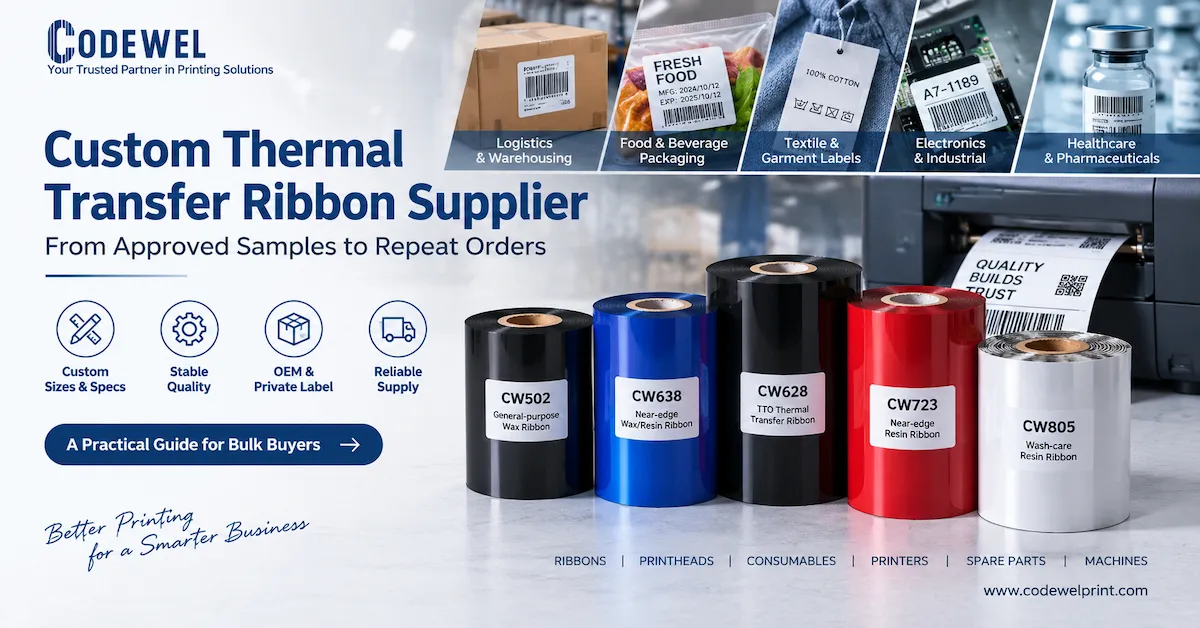
The following comparison uses CODEWEL’s published product descriptions and speed ranges. IPS means inches per second. These figures are selection references, not validated results on your printer and material, and the products should not be treated as interchangeable. Use the application column to identify a candidate, then use the final column to define the next verification step.
| CODEWEL model | Published formulation and speed | Useful starting point | What to verify in your trial |
|---|---|---|---|
| CW502 general-purpose wax ribbon | General-purpose wax; 0–6 IPS | Cost-conscious general label printing | Print quality and handling performance on the intended label material. |
| CW638 near-edge wax-resin ribbon | Near-edge wax-resin; 2–10 IPS | Near-edge applications where durability is a selection consideration | Equipment compatibility, settings, and resistance to the actual handling conditions. |
| CW628 TTO wax-resin ribbon | Near-edge/TTO wax-resin; 6–20 IPS | TTO applications requiring evaluation at higher printing speeds | Film compatibility and print quality at the intended production settings. |
| CW723 near-edge resin ribbon | Near-edge premium resin; 0–10 IPS | Applications involving oils, grease, or other specified contact conditions | Performance against the exact material and substance involved. |
| CW805 wash-care resin ribbon | Wash-care resin; 0–6 IPS | Garment-care labels and textile substrates, including small-text requirements | Readability following the agreed washing and ironing treatments. |
Compare Cost per Accepted Print, Not Only Cost per Roll
Evaluate a custom thermal transfer ribbon supplier using comparable dimensions, formulations, quantities, and delivery conditions. As an illustrative calculation—not a CODEWEL quotation—a 55 mm × 450 m roll priced at $4.50 and a 55 mm × 500 m roll priced at $5.00 both cost $0.01 per meter before freight and waste. The lower roll price therefore does not establish a lower material cost. For production trials, go further and calculate cost per accepted print = the job’s ribbon cost plus attributable discarded-label and rework costs, divided by accepted prints. Use measured quantities and avoid counting the same expense twice. This method gives purchasing and production a shared basis for comparison. It also lets you assess whether a different configuration offers a worthwhile benefit rather than assuming that a longer roll or a higher-priced formulation is automatically better value.
Separate Private-Label Branding from Technical Development
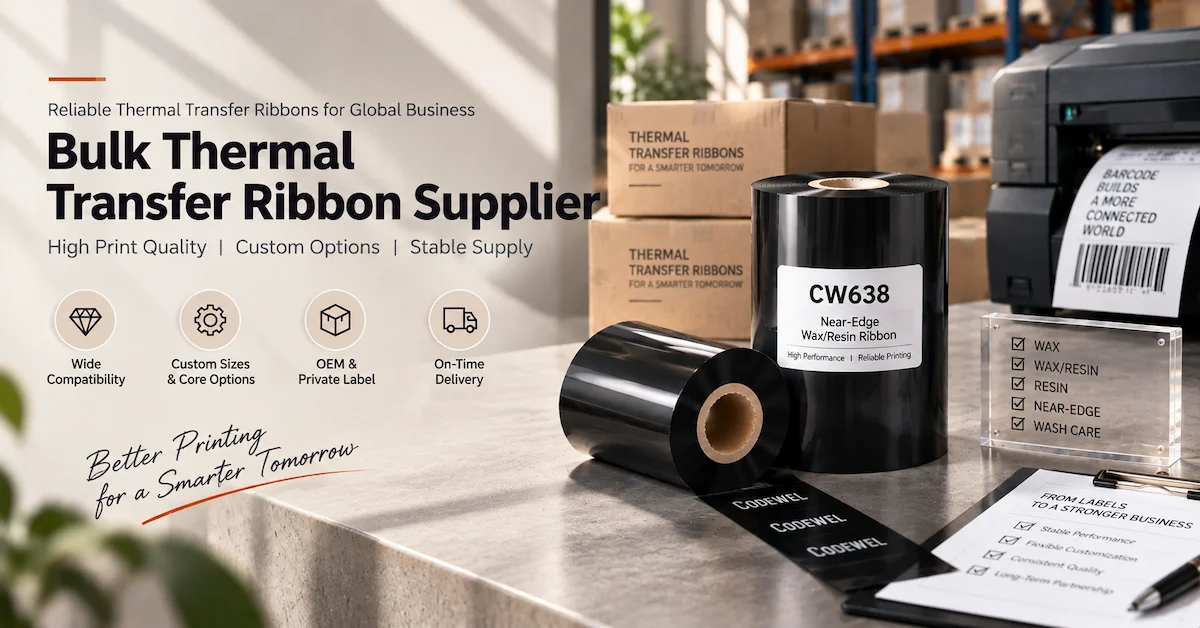
Define what “custom” means in your order. Changing roll dimensions, adding a logo, selecting an existing formulation, and developing a new formulation are different requests and should not be bundled into one vague OEM instruction. CODEWEL’s CW638 product information confirms logo printing on the leader film and lists customized dimensional options. For a private-label project, separately confirm packaging artwork, product codes, pack quantities, carton identification, and the relationship between your commercial name and the approved CODEWEL model. For a request involving different printing performance, color matching, or a new formulation, ask for a feasibility review and agreed trial criteria before discussing bulk approval. Your custom thermal transfer ribbon supplier should receive a precise development brief, not just a request to make the ribbon “stronger” or “more premium.”
Prepare an RFQ That Can Become a Repeatable Purchase Order
A useful request for quotation should connect the application, specification, approval process, and commercial requirements. Send the printer model, label or film information, required roll configuration, current ribbon reference where available, expected order volume, destination, and any branding requirement. Attach photographs when they help identify the existing roll or core, and mark uncertain fields as “to be confirmed” rather than guessing. Include the conditions the sample must pass and identify who will approve the result. To begin that discussion, contact CODEWEL with your custom ribbon requirements. Ask for a quotation that names the proposed product and configuration, so the same information can carry through sample approval, ordering, and future replenishment.
Frequently Asked Questions
What Information Does a Custom Thermal Transfer Ribbon Supplier Need First?
Start with the complete printer model, label or packaging material, ribbon dimensions, core details, ink side, and application requirements. Add your current ribbon reference when available. Provide expected quantity and destination for the commercial discussion, while clearly identifying any technical details that still need confirmation.
Can CODEWEL Supply Custom Ribbon Widths, Lengths, and Core Sizes?
Selected CODEWEL product listings, including CW628, show customized widths, lengths, and core options. The configuration should be confirmed against the specific model and printer before ordering; a customization option on one listing is not an unrestricted specification range for every ribbon.
Can My Logo Be Added to the Ribbon?
CODEWEL’s product FAQ identifies logo printing on the leader film as an available option. Confirm the artwork, placement, quantity, and approval requirements. Treat printed boxes, labels, cartons, and other packaging elements as separate items to be agreed rather than assuming they are included automatically.
Does Customization Always Require a New Ink Formulation?
No. A custom order can involve an existing formulation with a different roll configuration or branding requirement. CODEWEL lists these types of dimensional and identification options. For genuinely different performance requirements, request a separate feasibility discussion instead of assuming that a new formulation is necessary or already available.
What Is the Minimum Order Quantity for Custom Ribbons?
Request the minimum quantity for your exact combination of formulation, width, length, color, and branding. Ask whether it applies per configuration or to the overall order. Do not use an unconfirmed general MOQ when planning several different custom products.
Are Samples Available Before Bulk Ordering?
CODEWEL’s product FAQ offers free samples with international courier charges paid by the buyer. Confirm the available sample specification and any conditions for customized samples before arranging shipment. The sample should represent the configuration you intend to approve, not merely a convenient alternative roll.
Can I Select a Ribbon by Printer Brand Alone?
Use the complete printer model and configuration rather than the brand name alone. CODEWEL’s supplier guidance includes printing technology, material, roll dimensions, core, and ink side among the information needed for selection. Keep those details together when requesting a compatibility review.
How Should I Choose Between CW628 and CW723?
CODEWEL describes CW628 as a near-edge/TTO wax-resin formulation and CW723 as a near-edge resin formulation with applications involving oils, grease, and chemicals. Compare them against your printer, material, speed, and actual exposure requirements; do not choose solely by the higher speed figure or the word “resin.”
How Can I Keep Repeat Orders Aligned with the Approved Sample?
Reference the approved model, full roll specification, artwork version, and test record on subsequent orders. Agree batch identification and change-notification requirements with the supplier. When the printer, substrate, or required use conditions change, review whether a new approval trial is needed.
How Long Will a Custom Ribbon Order Take?
Request an order-specific schedule covering technical confirmation, sample evaluation, artwork approval where relevant, production, inspection, and transportation. Ask which steps can run in parallel and which require your approval first. Use the confirmed quotation and purchase order—not a general website estimate—as the basis for delivery planning.
Conclusion
The right custom thermal transfer ribbon supplier should be evaluated against a clear purchasing objective: an approved ribbon configuration that can be identified, tested, ordered, and reviewed consistently. Start with the printer and material, document the required performance, compare suitable models, and keep customization requests separate from unverified assumptions. Before committing to volume, agree the sample acceptance criteria, commercial terms, and reference information for repeat orders. Discuss your custom thermal transfer ribbon project with CODEWEL and provide the specifications, application conditions, and order requirements needed for a focused product and quotation review.