
What Should an Industrial Label Printing Supplier Provide Beyond Labels?
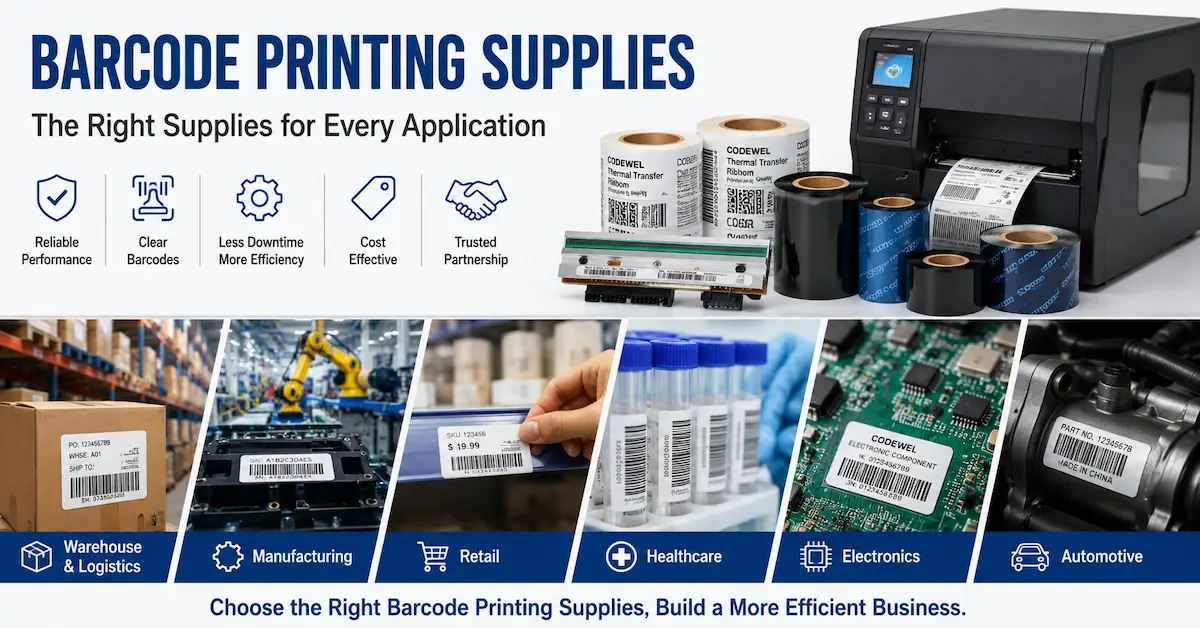
An industrial label printing supplier should help customers build a complete identification solution rather than simply provide rolls of labels. In manufacturing, logistics, warehousing, electronics, automotive, chemical, and packaging environments, labels are part of a larger information system that connects products, inventory, production processes, and traceability records.
A reliable industrial labeling workflow usually includes several elements: label material, printing method, barcode printer, thermal transfer ribbon when required, printhead, scanner, software connection, and maintenance planning. If one element is selected without considering the others, the result may be unclear printing, poor adhesion, excessive consumable waste, or difficulty maintaining consistent production records.
CODEWEL provides related solutions through its printing consumables, barcode printers, thermal transfer ribbons, printheads, and barcode scanners. Buyers should evaluate these products according to their actual workflow instead of treating each component as an independent purchase. 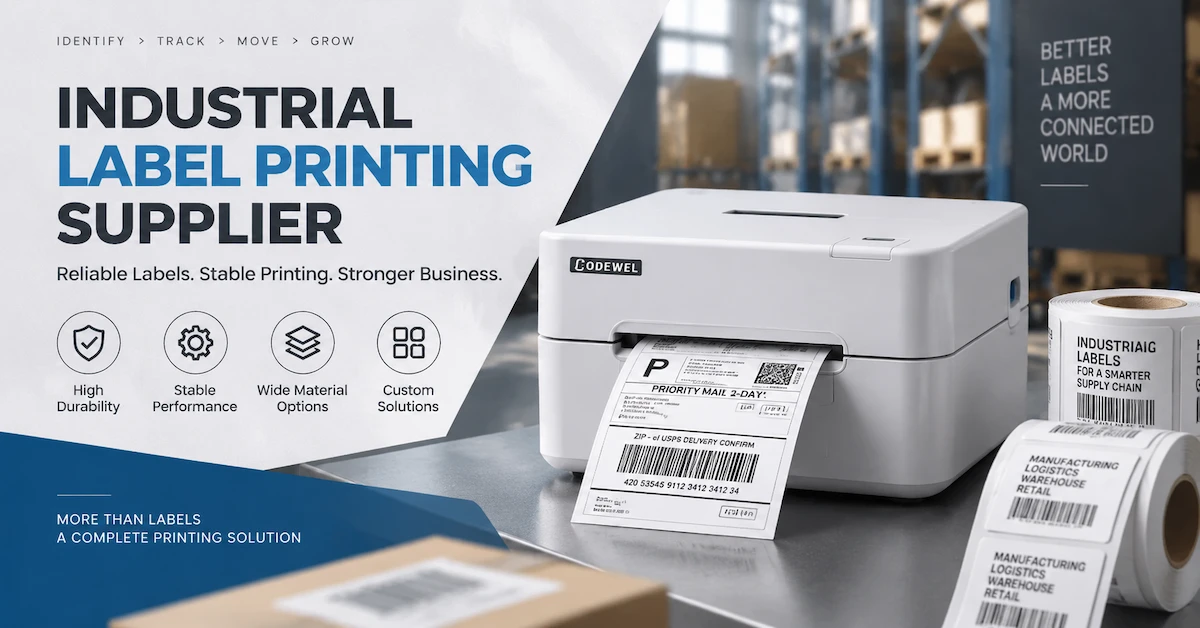
Who Needs Industrial Label Printing Solutions?
Industrial label printing is commonly required by manufacturers, warehouse operators, logistics providers, automotive suppliers, electronics factories, machinery companies, food and beverage producers, pharmaceutical packaging operations, and industrial distributors.
Different industries use labels for different purposes:
| Industry | Typical Label Requirement | Main Consideration |
|---|---|---|
| Electronics manufacturing | Component identification, serial numbers, traceability labels | Small text, barcode accuracy, material compatibility |
| Automotive manufacturing | Parts identification and production tracking | Durability and process reliability |
| Warehousing and logistics | Carton, pallet, location, and inventory labels | Fast printing and scanning efficiency |
| Food and beverage | Packaging and batch information | Material selection and printing conditions |
| Machinery manufacturing | Equipment identification and asset labels | Long-term readability |
| Chemical industries | Product and safety identification | Environmental resistance |
| Retail distribution | Product and shipping labels | High-volume repeat printing |
The correct industrial label printing supplier should first understand the application environment before recommending a product category.
Start With the Label Application, Not the Printer Model
A common purchasing mistake is selecting equipment before defining what the label needs to achieve. Industrial labels are exposed to different conditions depending on their location and purpose.
Before selecting a printing solution, buyers should define:
- Where will the label be applied?
- How long must it remain readable?
- Is the surface paper, plastic, metal, glass, or coated material?
- Will the label face abrasion, moisture, temperature changes, chemicals, or outdoor conditions?
- How small are the required text and barcode elements?
- How frequently will labels be printed?
A warehouse carton label and an electronic-component identification label may both use barcodes, but the required label construction and printing method can be completely different.
Thermal Transfer Printing Is a Common Choice for Industrial Labels
Many industrial applications use thermal transfer printing because it allows the use of different label materials and ribbons according to the required application. The printing process uses a thermal printhead to transfer ink from a ribbon onto the label surface.
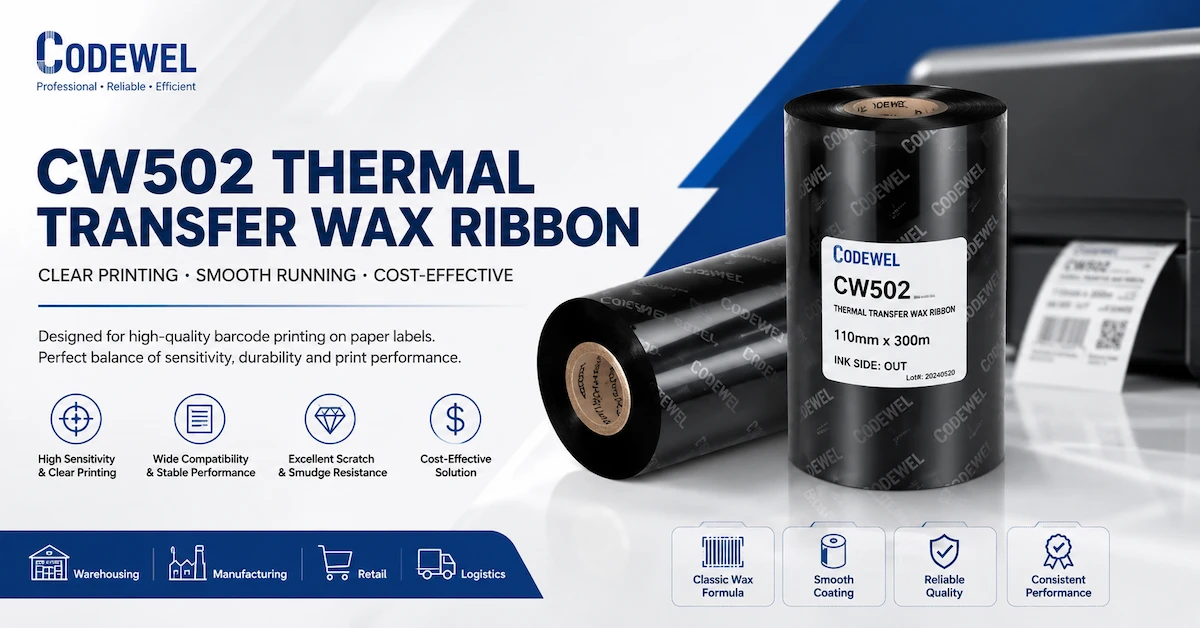
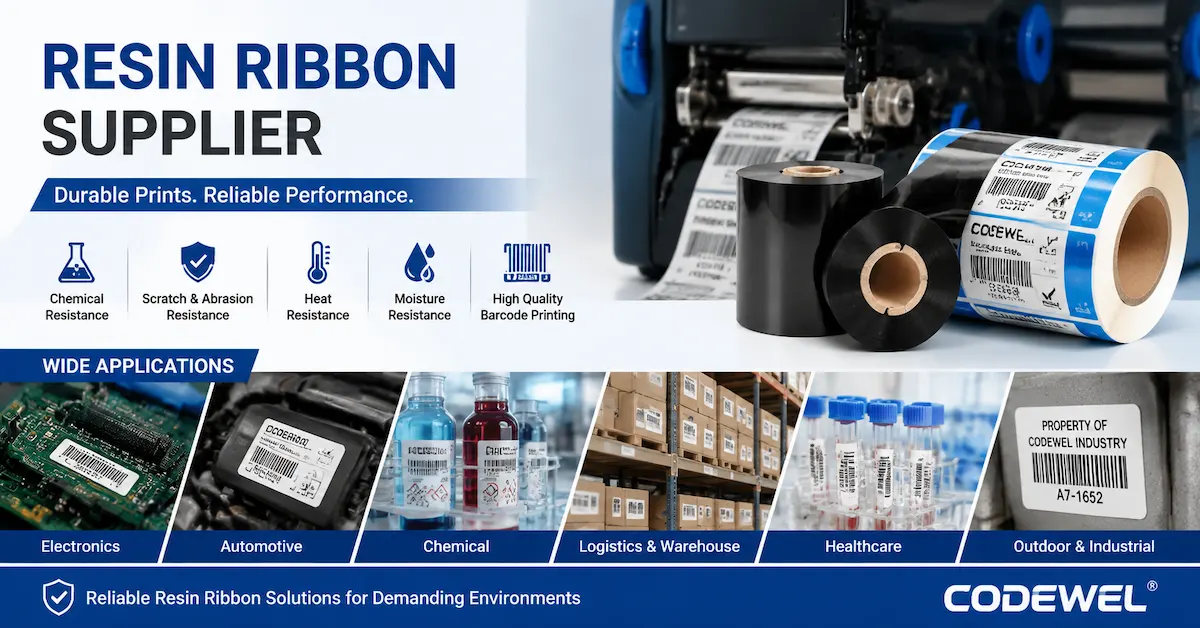
CODEWEL’s thermal transfer ribbon range includes wax, wax-resin, resin, TTO near-edge, and wash-care ribbon categories. These options allow buyers to select different ribbon types according to label material, printing method, and durability requirements.
For industrial label printing, ribbon selection should consider:
| Ribbon Type | Typical Starting Application | Buyer Should Confirm |
|---|---|---|
| Wax ribbon | General paper labels and shipping labels | Required durability and handling |
| Wax-resin ribbon | Coated labels and applications needing improved resistance | Label surface and print requirements |
| Resin ribbon | Synthetic labels and demanding identification | Actual exposure conditions |
| TTO ribbon | Flexible packaging and near-edge printing | Printer type and packaging material |
| Wash-care resin ribbon | Textile and garment labels | Washing and treatment conditions |
The most expensive ribbon is not automatically the best choice. The correct selection is the one that satisfies the actual label requirement.
How to Select the Right Industrial Label Material
An industrial label printing supplier should help customers evaluate the complete label structure, not only the printing surface.
A label normally includes:
- Face material
- Adhesive layer
- Release liner
- Printing method compatibility
- Application environment
For example, a label used on a warehouse carton may focus on barcode readability and printing speed. A label attached to industrial equipment may require a different material because it needs longer service life or stronger adhesion.
CODEWEL’s printing consumables category includes self-adhesive labels and label-related products. The exact material, adhesive, size, and application suitability should be confirmed according to the project requirements.
Build a Technical Specification Before Requesting a Quote
A professional RFQ helps avoid incorrect recommendations. Instead of requesting “industrial labels,” buyers should provide a structured specification.
| Specification | Information Required | Why It Matters |
|---|---|---|
| Application | Product, package, equipment, or location | Defines label purpose |
| Label size | Width and height | Determines printer and roll compatibility |
| Material | Paper, PET, PP, synthetic, or other material | Influences durability |
| Adhesive requirement | Surface type and application condition | Affects bonding performance |
| Printer model | Existing printer or planned equipment | Confirms compatibility |
| Printing method | Thermal transfer or direct thermal | Determines consumables |
| Ribbon requirement | Wax, wax-resin, resin, or TTO | Matches printing performance |
| Barcode type | 1D, 2D, QR, or other format | Defines print quality needs |
| Environment | Temperature, moisture, abrasion, chemicals | Determines material selection |
| Quantity | Monthly or annual demand | Supports supply planning |
This specification should become the reference for quotation, sample approval, and repeat orders.
Choosing the Right Barcode Printer for Industrial Applications
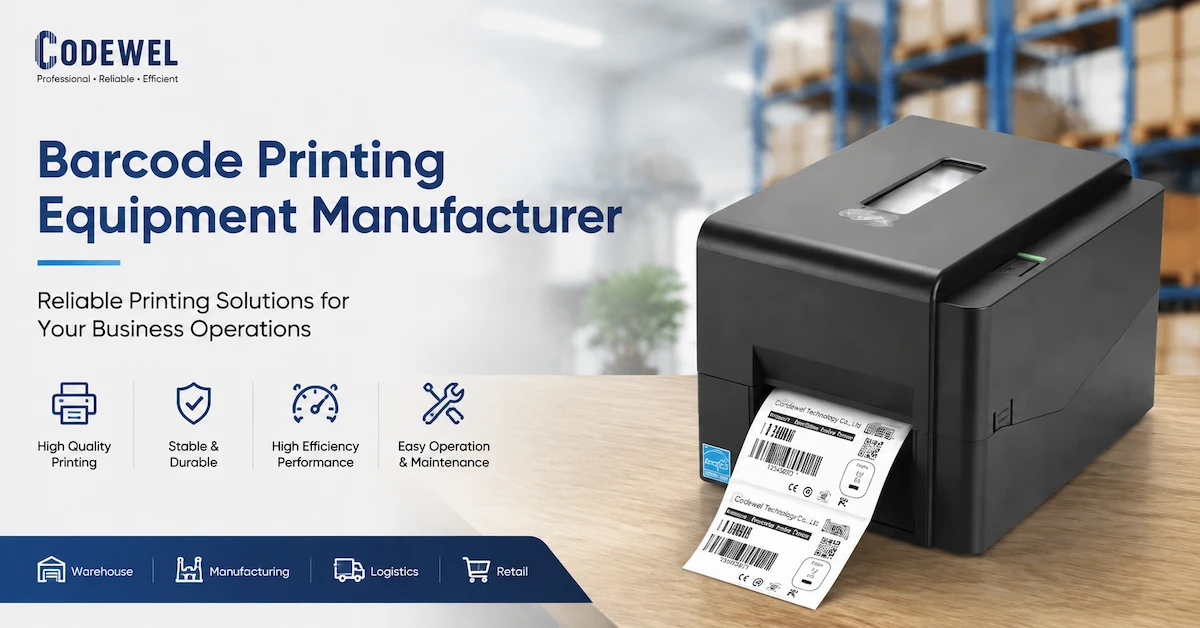
The printer is one part of the industrial labeling system. CODEWEL’s printer category includes barcode printer solutions covering different application directions.
Printer selection should consider:
- Daily printing volume
- Peak printing demand
- Label width
- Required resolution
- Connectivity
- Installation environment
- Maintenance requirements
A low-volume workstation may need a compact printer, while a production line or distribution center may require equipment designed for continuous operation.
Choosing a printer based only on maximum speed can create unnecessary costs. The correct choice should balance workload, label size, maintenance, and long-term operating requirements.
Why Printhead Selection Matters in Industrial Label Printing
The printhead is a critical component in thermal printing systems. A worn or incorrectly matched printhead can cause missing lines, uneven printing, barcode quality problems, or increased maintenance requirements.
CODEWEL provides printhead solutions covering multiple printer brands and models. Buyers should confirm printer model, DPI, part number, print width, and compatibility before ordering replacement printheads.
For industrial users, maintaining printhead records can reduce downtime:
- Printer model
- Printhead model
- DPI
- Replacement date
- Printing volume
- Maintenance records
This information helps maintenance teams identify replacement timing and avoid ordering incorrect parts.
Barcode Scanning Completes the Identification Process
Printing a barcode is only useful when the warehouse or production system can capture the information correctly.
CODEWEL provides barcode scanner categories covering 1D and 2D barcode scanning requirements.
Scanner selection should consider:
- Barcode type
- Reading distance
- Mobile or fixed operation
- Connection method
- Working environment
- Integration requirements
A complete industrial label printing solution should therefore consider both barcode creation and barcode reading.
Compare Industrial Label Printing Systems by Application
| Application | Recommended Consideration | Main Risk |
|---|---|---|
| Warehouse inventory | Printer + labels + scanner workflow | Poor readability or slow printing |
| Manufacturing traceability | Durable labels and reliable printing | Label failure during production |
| Electronics identification | Small-format labels and high-resolution printing | Missing small text or codes |
| Packaging lines | TTO printing and film compatibility | Incorrect ribbon selection |
| Asset management | Long-life labels and scanning reliability | Label degradation over time |
The best solution depends on the process requirement, not only the product category.
Quality Control Should Focus on the Finished Label Result
A professional industrial label printing supplier should support quality evaluation based on actual output.
Quality checks may include:
- Print clarity
- Barcode readability
- Label adhesion
- Material consistency
- Roll condition
- Printer compatibility
- Repeatability between orders
A label that looks acceptable immediately after printing may still fail if the application requires long-term durability.
Testing should use:
- Actual printer
- Actual label material
- Actual ribbon
- Actual print settings
- Real application environment
This creates a reliable approval standard before large-scale purchasing.
Cost Evaluation Should Include the Entire Printing Process
Industrial label printing costs are not limited to label prices.
A complete cost evaluation should include:
- Printer investment
- Label cost
- Ribbon cost
- Printhead replacement
- Maintenance labor
- Downtime
- Rejected labels
- Inventory management
A cheaper consumable may increase costs if it causes more waste or maintenance problems.
The goal is not always the lowest unit price. The goal is a stable printing process with predictable operating costs.
How Should Buyers Manage Repeat Orders?
A successful industrial labeling project should create a controlled purchasing record.
Keep information including:
- Approved label specification
- Printer model
- Ribbon type
- Print settings
- Sample approval record
- Supplier model number
- Packaging information
- Purchase history
When future orders are placed, purchasing teams can reorder according to the approved specification instead of relying on memory or old invoices.
Customization and Private Label Requirements
Many distributors and industrial buyers require customized solutions, including:
- Label dimensions
- Packaging
- Product codes
- Private-label identification
- Ribbon specifications
Customization should be based on a clear requirement. Changing packaging or branding is different from changing printing performance.
A controlled specification prevents confusion between commercial customization and technical changes.
What Should You Send an Industrial Label Printing Supplier?
A useful inquiry should include:
- Application scenario
- Label size
- Material requirement
- Printer model
- Printing volume
- Barcode type
- Environmental conditions
- Ribbon requirement
- Scanner requirement
- Destination market
- Forecast quantity
Buyers can review CODEWEL’s industrial printing product range and contact CODEWEL with project details for a more accurate evaluation.
Frequently Asked Questions
1. What Does an Industrial Label Printing Supplier Provide?
An industrial label printing supplier may provide labels, printers, ribbons, printheads, scanners, and related printing components. The exact scope depends on the supplier’s product range and the customer’s application.
2. What Labels Are Commonly Used for Industrial Printing?
Industrial labels may include paper labels, synthetic labels, PET labels, PP labels, and application-specific materials. The correct material depends on the surface and environment.
3. Is Thermal Transfer Better for Industrial Labels?
Thermal transfer is often considered for industrial labels where longer print life or wider media options are required. The final choice depends on the application.
4. How Do I Choose Between Wax and Resin Ribbon?
Wax is commonly used for general paper labels, while resin is considered for more demanding synthetic-label applications. Wax-resin provides a middle option. Testing the actual label is recommended.
5. Can One Printer Handle All Industrial Labels?
Not always. Printer capability depends on label size, volume, resolution, media type, and application requirements.
6. How Can I Reduce Barcode Printing Problems?
Match the printer, label, ribbon, and printhead correctly. Maintain consistent specifications and test new combinations before large-scale use.
7. What Information Should I Provide Before Ordering Labels?
Provide label size, material, adhesive requirement, application surface, printer model, quantity, and environmental conditions.
8. How Often Should Industrial Printheads Be Replaced?
Replacement depends on printing volume, maintenance, ribbon/media conditions, and operating environment. Monitor print quality rather than relying only on time.
9. Can Industrial Labels Be Customized?
Yes, customization may include dimensions, materials, packaging, and identification requirements. Technical changes should be evaluated separately.
10. How Do I Select an Industrial Label Printing Supplier?
Evaluate product range, technical support, compatibility knowledge, quality control, customization ability, and supply consistency rather than only price.
Conclusion
Choosing an industrial label printing supplier is a system decision involving labels, printers, ribbons, printheads, scanners, and workflow requirements. A reliable supplier should help buyers define the application, select suitable materials, validate printing performance, manage replacement components, and maintain consistent supply over time. CODEWEL provides related barcode printing products including printers, thermal transfer ribbons, printheads, printing consumables, and barcode scanners. For manufacturers, warehouses, logistics companies, and industrial distributors, contact CODEWEL with your label requirements, printing workflow, and expected volume to evaluate a suitable industrial identification solution.