
Wax vs Resin Ribbon: Which One Is Right for Your Application?
Choosing between wax resin ribbon, wax ribbon, and resin ribbon is one of the most common decisions faced by companies using thermal transfer printing.
At first glance, these ribbon types may appear similar. They are all designed to transfer an ink layer onto labels, packaging materials, or synthetic substrates through a heated printhead. However, the differences in formulation directly influence print quality, durability, substrate compatibility, operating conditions, and total printing cost.
A common purchasing mistake is assuming that resin ribbon is always the better choice because it offers higher durability, or selecting wax ribbon simply because it has a lower unit price.
The better question is:
Which ribbon formulation provides the required performance for your specific application at the lowest overall operating cost?
For B2B buyers, the right choice depends on multiple factors:
- Label material
- Printer type
- Required resistance
- Printing speed
- Environmental exposure
- Barcode readability requirements
- Production volume
- Cost expectations
A logistics company printing shipping labels may achieve excellent results with wax ribbon.
A manufacturer producing automotive identification labels may require resin ribbon.
A packaging company printing coated labels may find that wax resin ribbon provides the best balance between cost and durability.
Understanding these differences helps buyers avoid common problems such as:
- unreadable barcodes;
- poor adhesion;
- smudged prints;
- unnecessary material costs;
- frequent printer adjustments;
- unstable repeat orders.
This article provides a practical comparison framework to help buyers select the right thermal transfer ribbon for their application.
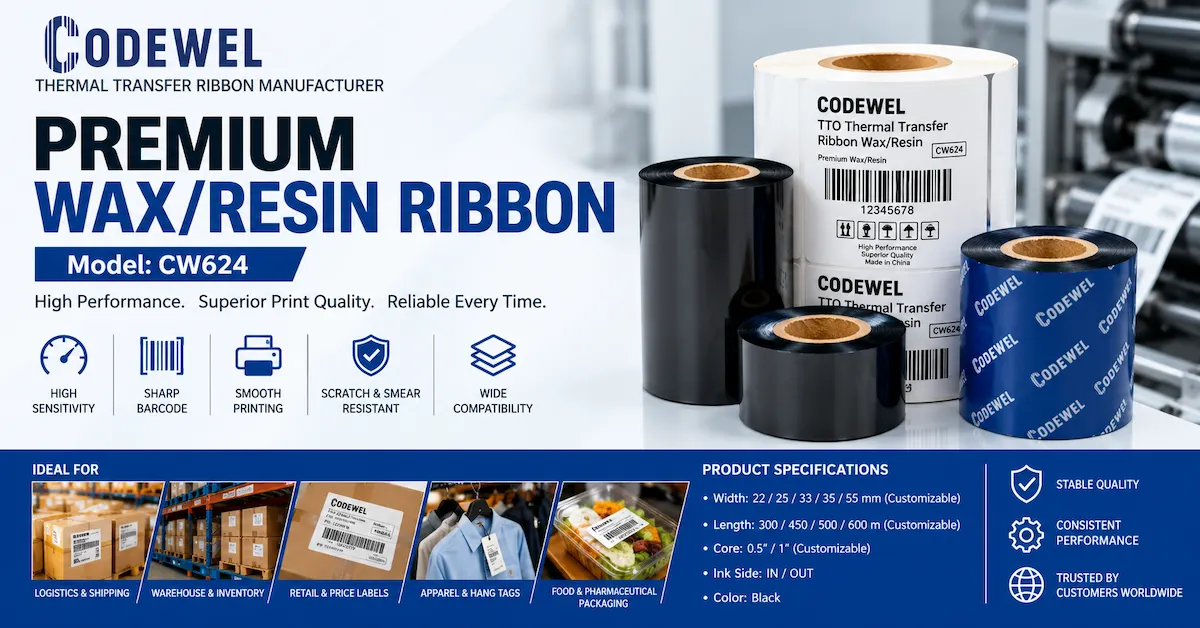
For buyers reviewing available ribbon options, CODEWEL provides different thermal transfer ribbon categories including wax, wax-resin, resin, TTO, and specialty ribbon solutions through its thermal transfer ribbon product range.
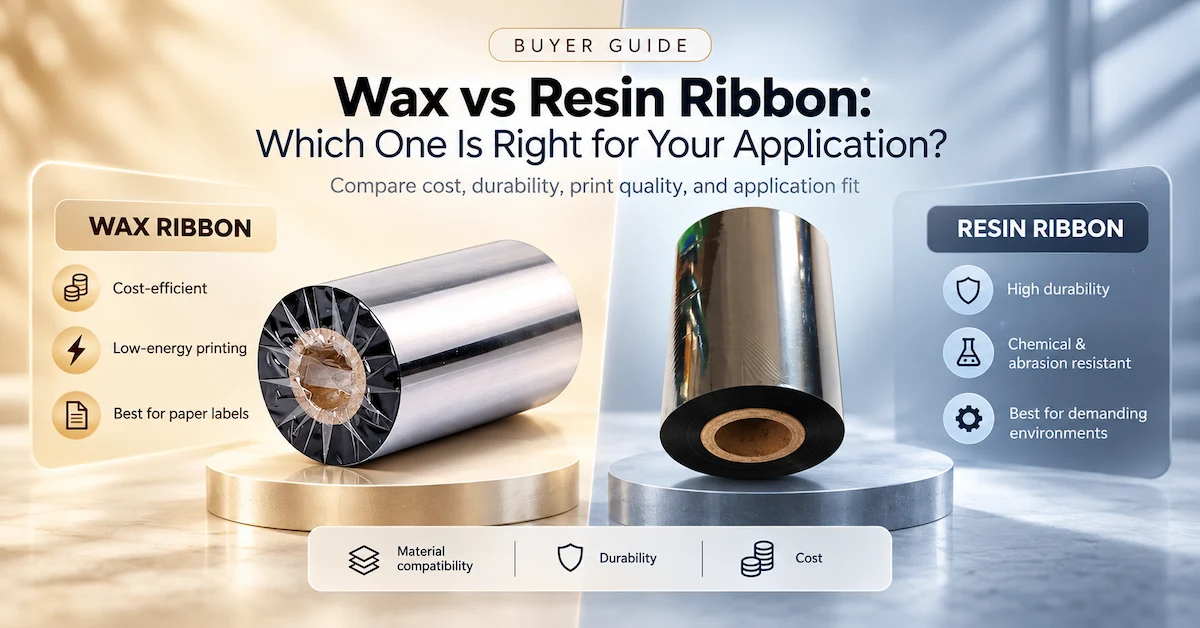
Understanding the Basic Differences Between Wax, Wax Resin, and Resin Ribbon
Before comparing applications, it is important to understand how these ribbon formulations differ.
Thermal transfer ribbon consists of several layers, including:
- PET carrier film;
- ink coating;
- release layer;
- back coating.
The ink formulation determines how efficiently the printed image transfers and how well the finished print survives environmental conditions.
The three common categories are:
| Ribbon Type | Main Characteristics | Typical Applications |
|---|---|---|
| Wax Ribbon | Economical, good print quality on paper | Shipping labels, warehouse labels, retail labels |
| Wax Resin Ribbon | Balanced durability and cost | Product labels, coated paper, logistics, manufacturing |
| Resin Ribbon | Highest durability and resistance | Synthetic labels, industrial identification, harsh environments |
The selection process is not about choosing the highest-performance ribbon.
It is about matching ribbon characteristics with the actual printing requirement.
What Is Wax Ribbon?
Wax ribbon is the most commonly used thermal transfer ribbon formulation for general barcode printing applications.
It uses a wax-based ink formulation designed to transfer effectively onto paper-based label materials with relatively low printing energy.
Because of its cost efficiency and reliable print performance, wax ribbon remains popular in high-volume applications where extreme durability is not required.
Advantages of Wax Ribbon
Wax ribbon is often selected because it provides:
- lower material cost;
- good barcode readability;
- efficient printing on paper labels;
- lower required print energy;
- suitability for high-volume applications.
For businesses printing thousands or millions of labels where environmental exposure is limited, wax ribbon can provide excellent value.
Common Wax Ribbon Applications
Typical applications include:
Shipping Labels
Warehouses and logistics companies frequently use wax ribbon for:
- carton labels;
- shipping identification;
- internal tracking labels;
- inventory management.
These applications usually require clear barcode printing but do not require long-term chemical or abrasion resistance.
Retail Labels
Retail applications may include:
- product price labels;
- shelf identification;
- inventory tags;
- promotional labels.
When labels remain indoors and experience normal handling, wax ribbon is often sufficient.
General Warehouse Printing
Warehouse labels usually prioritize:
- readability;
- printing speed;
- cost control;
- easy replacement.
In these environments, upgrading to resin ribbon may increase cost without creating additional business value.
Limitations of Wax Ribbon
Although wax ribbon is cost-effective, it is not designed for every application.
Wax ribbon may not be suitable when labels must resist:
- heavy scratching;
- repeated friction;
- chemicals;
- oils;
- outdoor exposure;
- high temperatures;
- aggressive cleaning processes.
For example, a warehouse carton label stored indoors may perform perfectly with wax.
However, the same label placed on outdoor equipment or industrial machinery may quickly lose readability.
This is why application analysis is more important than simply selecting the cheapest ribbon.
What Is Resin Ribbon?
Resin ribbon represents the opposite end of the performance spectrum.
It uses a resin-based ink formulation designed for applications requiring stronger adhesion and higher resistance.
Compared with wax-based products, resin ribbon generally requires higher printing energy but provides improved durability when correctly matched with the substrate.
Advantages of Resin Ribbon
Resin ribbon is commonly selected because it provides:
- excellent scratch resistance;
- stronger chemical resistance;
- improved durability;
- better performance on synthetic materials;
- long-term barcode readability.
Common Resin Ribbon Applications
Resin ribbon is widely evaluated for demanding applications such as:
Automotive Identification Labels
Automotive components often require identification that remains readable throughout the product lifecycle.
Labels may face:
- oil;
- heat;
- abrasion;
- industrial handling.
Resin ribbon is frequently considered for these requirements.
Electronics Labels
Electronic products may require:
- small text printing;
- high-density barcodes;
- durable identification;
- resistance during assembly processes.
Synthetic labels combined with resin ribbon can provide better long-term performance.
Chemical and Industrial Labels
Industrial environments may expose labels to:
- solvents;
- cleaning agents;
- moisture;
- temperature changes.
In these situations, resin ribbon is often tested because durability is a critical requirement.
Why Wax Resin Ribbon Is Often the Best Compromise
Many buyers assume they must choose either wax or resin.
In reality, wax resin ribbon is often the most practical solution for many commercial applications.
Wax resin combines characteristics from both formulations:
- better durability than standard wax;
- lower cost than full resin;
- wider substrate compatibility;
- improved print quality on coated materials.
For many manufacturers and distributors, wax resin ribbon represents the ideal balance between performance and cost.
Where Wax Resin Ribbon Fits Between Wax and Resin
The easiest way to understand wax resin is as a middle-performance category.
| Requirement | Wax | Wax Resin | Resin |
|---|---|---|---|
| Paper labels | Excellent | Excellent | Good |
| Coated paper | Limited | Excellent | Excellent |
| Synthetic labels | Limited | Good | Excellent |
| Scratch resistance | Low | Medium-High | High |
| Chemical resistance | Low | Medium | High |
| Cost | Lowest | Medium | Highest |
| General industrial use | Limited | Strong option | Strong option |
For buyers unsure whether wax or resin is appropriate, wax resin is often the first product category worth testing.
How to Choose Between Wax Resin Ribbon and Resin Ribbon
The decision between wax resin ribbon and resin ribbon usually depends on the actual risk of label failure.
Ask:
Will the Label Experience Heavy Handling?
If the label is frequently touched, moved, rubbed, or scanned, durability becomes more important.
Examples:
- manufacturing parts;
- warehouse bins;
- reusable containers;
- industrial assets.
Wax resin may be sufficient for moderate handling.
Resin may be required for more demanding conditions.
Does the Label Contact Chemicals?
Chemical exposure is one of the strongest indicators that resin should be evaluated.
Examples include:
- cleaning chemicals;
- solvents;
- oils;
- industrial fluids.
However, buyers should test the exact chemical exposure rather than assuming all resin ribbons provide identical resistance.
Is the Label Printed on Synthetic Material?
Synthetic materials such as:
- PET;
- PP;
- PE;
- polyester;
often require stronger adhesion than ordinary paper.
Wax resin and resin are usually better candidates than standard wax.
Wax Resin Ribbon vs Resin Ribbon: Application-Based Comparison
When comparing wax resin ribbon and resin ribbon, buyers should avoid making decisions based only on the ribbon category name.
The correct selection depends on the relationship between:
- ribbon formulation;
- label material;
- printer technology;
- printing speed;
- environmental exposure;
- required service life;
- total operating cost.
A ribbon that performs well in a controlled office environment may fail in a manufacturing plant.
A ribbon designed for industrial durability may be unnecessary for simple warehouse labels.
The following comparison helps buyers understand where each formulation creates the most value.
| Application Requirement | Recommended Starting Point | Reason |
|---|---|---|
| Standard paper shipping labels | Wax ribbon | Lowest cost with reliable barcode printing |
| Coated product labels | Wax resin ribbon | Better adhesion and scratch resistance |
| Manufacturing labels | Wax resin or resin | Depends on handling conditions |
| Electronics identification | Resin ribbon | Long-term durability required |
| Automotive components | Resin ribbon | Resistance against harsh environments |
| Warehouse inventory labels | Wax or wax resin | Depends on handling intensity |
| Flexible packaging | Wax resin or TTO resin | Depends on film and exposure |
| Chemical labels | Resin ribbon | Higher resistance requirements |
| Textile care labels | Wash-care resin | Requires washing durability |
How Label Material Determines Ribbon Selection
One of the most important factors when selecting wax resin ribbon or resin ribbon is the label substrate.
Many printing problems are not caused by the ribbon itself.
They happen because the ribbon formulation does not match the label surface.
Paper Labels
Paper remains the most common thermal transfer printing material.
Uncoated Paper
Uncoated paper generally works well with wax ribbon.
Typical applications include:
- shipping labels;
- warehouse labels;
- carton identification;
- inventory tags.
The main goal is usually:
- clear barcode readability;
- economical printing;
- high-volume output.
Using resin ribbon for these applications may increase cost without creating measurable improvement.
Coated Paper
Coated paper has a smoother surface and different ink absorption characteristics.
For coated labels, wax resin ribbon is often a better choice.
Advantages include:
- sharper image quality;
- improved adhesion;
- better resistance to handling;
- cleaner small text printing.
This makes wax resin a popular option for:
- retail product labels;
- cosmetic packaging;
- industrial product labels;
- premium product identification.
Synthetic Labels
Synthetic labels create a different selection challenge.
Common synthetic materials include:
- polypropylene (PP);
- polyethylene (PE);
- polyester (PET);
- vinyl;
- synthetic paper.
These materials usually require stronger adhesion than standard paper.
Why Wax Ribbon May Fail on Synthetic Materials
Wax ribbon is primarily designed for paper-based surfaces.
When used on synthetic materials, possible issues include:
- weak adhesion;
- poor scratch resistance;
- easy removal of printed information;
- insufficient durability.
For synthetic labels, buyers normally evaluate:
- wax resin ribbon;
- resin ribbon.
The final choice depends on the required resistance level.
Flexible Packaging Materials
Flexible packaging is another important area where buyers compare wax resin ribbon and resin ribbon.
Applications include:
- food packaging;
- pharmaceutical packaging;
- personal care products;
- household products.
Printing requirements may include:
- expiry dates;
- batch numbers;
- traceability codes;
- variable product information.
For packaging applications, the correct ribbon depends on:
- film type;
- coating;
- packaging speed;
- printer type;
- environmental exposure.
For high-speed packaging requirements, buyers may also need to evaluate TTO near edge ribbon solutions.
Durability Requirements: The Real Difference Between Wax and Resin
Many purchasing decisions should start with one question:
How long does the printed information need to remain readable?
A shipping label may only need to survive a few days.
An industrial identification label may need to remain readable for years.
Scratch Resistance
Scratch resistance is one of the clearest differences between formulations.
Wax Ribbon
Wax generally provides:
- acceptable resistance for normal handling;
- suitable performance on paper labels.
However, repeated friction can damage the printed image.
Wax Resin Ribbon
Wax resin provides:
- better abrasion resistance;
- improved handling performance;
- stronger image durability.
It is often selected when labels experience regular contact.
Resin Ribbon
Resin generally provides the highest resistance level.
Applications include:
- equipment identification;
- automotive components;
- electrical products;
- industrial assets.
Chemical Resistance
Chemical exposure is another important factor.
Examples include:
- alcohol;
- cleaning agents;
- oils;
- solvents;
- industrial chemicals.
A buyer should never assume that every resin ribbon survives every chemical environment.
The correct approach is:
- identify the chemical;
- identify exposure duration;
- identify label material;
- perform actual testing.
A supplier should recommend testing rather than making broad unsupported claims.
Temperature Resistance
Temperature conditions can influence ribbon selection.
Examples:
- freezer environments;
- production equipment;
- outdoor equipment;
- heated manufacturing areas.
Resin ribbon is often considered for demanding temperature-related applications, but performance depends on the complete label system.
Printing Speed and Energy Requirements
Ribbon selection is not only about the final label.
It also affects production efficiency.
Different formulations require different heat energy levels.
Wax Ribbon Printing Characteristics
Wax ribbon generally provides:
- easy transfer;
- lower energy requirements;
- efficient printing on paper.
This makes it suitable for high-volume economical applications.
Wax Resin Ribbon Printing Characteristics
Wax resin offers a balance between:
- transfer efficiency;
- durability;
- image quality.
This is why many manufacturers choose wax resin as a standard industrial labeling solution.
Resin Ribbon Printing Characteristics
Resin requires more careful matching.
It may require:
- higher print energy;
- suitable substrate;
- optimized printer settings.
When correctly matched, it provides excellent durability.
However, using resin without considering printer settings or label material can create unnecessary cost or printing problems.
Total Cost Analysis: Why Cheapest Ribbon Is Not Always Cheapest
For purchasing teams, the real cost is not the ribbon roll price.
A better calculation includes:
Total Printing Cost = Ribbon Cost + Waste + Downtime + Reprinting + Maintenance + Quality Risk
A cheaper ribbon may create additional expenses through:
- unreadable barcodes;
- customer complaints;
- production interruptions;
- repeated adjustments;
- rejected products.
Example: Warehouse Label Application
Company A uses standard paper shipping labels.
Requirements:
- indoor storage;
- short lifecycle;
- barcode scanning only.
Wax ribbon may provide the best economic result.
Choosing resin ribbon may increase material cost without improving operational performance.
Example: Industrial Equipment Label
Company B produces industrial machines.
Requirements:
- outdoor installation;
- oil exposure;
- long service life.
A low-cost wax ribbon may fail quickly.
Resin ribbon may create lower total cost because replacement and maintenance risks are reduced.
Why Wax Resin Ribbon Is Popular Among Industrial Buyers
Many companies choose wax resin because it provides a practical middle ground.
It avoids two common mistakes:
Mistake 1: Choosing Wax Only Because It Is Cheap
This can create quality problems when labels require more durability.
Mistake 2: Choosing Resin for Every Application
This increases cost unnecessarily.
Wax resin often provides:
- better durability than wax;
- lower cost than resin;
- wider application flexibility;
- good balance between quality and economics.
For many B2B applications, it becomes the default evaluation product.
Buyers can compare available wax resin ribbon products when evaluating balanced performance solutions.
How to Test Wax Resin Ribbon Before Switching Suppliers
Changing ribbon suppliers requires controlled testing.
Do not approve a new ribbon only because it looks similar.
Test the Actual Printer
Use:
- same printer model;
- same printhead;
- same settings.
Different printers can produce different results.
Test the Actual Label Material
A ribbon that works on one label may fail on another.
Use the real production substrate.
Test Real Production Conditions
Evaluate:
- normal printing speed;
- barcode size;
- small text;
- handling;
- environmental exposure.
Compare Against Current Approved Ribbon
A new supplier should be compared against the current approved product.
Measure:
- print quality;
- barcode readability;
- durability;
- consumption;
- stability.
The objective is not finding the cheapest replacement.
The objective is maintaining or improving production reliability.
Common Mistakes When Choosing Wax Resin Ribbon
Choosing by Ribbon Name Only
Different suppliers may use similar product names for different performance levels.
Always evaluate:
- specification;
- application;
- sample performance.
Ignoring Printer Compatibility
Even a high-quality ribbon may perform poorly if it does not match:
- printer type;
- printhead;
- energy settings.
Testing Only Visual Appearance
A dark image does not always mean good performance.
Check:
- barcode quality;
- adhesion;
- resistance;
- repeatability.
Buying Higher Performance Than Needed
More durable does not always mean better.
The best ribbon is the one that meets the application requirement efficiently.
Supplier Selection for Wax Resin Ribbon Purchasing
When purchasing wax resin ribbon in volume, supplier capability matters.
A reliable supplier should provide:
- stable formulation;
- consistent coating;
- accurate converting;
- controlled dimensions;
- technical support;
- repeat-order consistency.
For distributors and OEM buyers, supplier capability becomes even more important because customers expect identical performance across multiple batches.
A supplier with complete product coverage can also help customers move between applications.
For example:
- wax for economical logistics labels;
- wax resin for general industrial labels;
- resin for demanding identification;
- TTO ribbon for packaging applications.
This reduces sourcing complexity.
CODEWEL provides multiple thermal transfer printing solutions including wax, wax resin, resin, and TTO-related products. Buyers can review the company's thermal transfer ribbon solutions to compare different application categories.
Wax Resin Ribbon Selection Checklist
Before placing a bulk order, confirm:
| Question | Answer |
|---|---|
| What is the label material? | Paper / coated paper / synthetic / film |
| What printer is used? | Model and printhead type |
| What durability is required? | Scratch / chemical / heat / moisture |
| How long must the label last? | Days / months / years |
| What is the printing speed? | Production requirement |
| Is barcode readability critical? | Yes / No |
| Is the application industrial? | Environment evaluation required |
| Is OEM packaging required? | Branding and SKU control |
| Has a sample test passed? | Approval required |
FAQ
What is the difference between wax resin ribbon and resin ribbon?
Wax resin ribbon provides a balance between cost and durability, while resin ribbon is designed for higher resistance requirements. Wax resin is often suitable for coated paper and general industrial labels, while resin is preferred for demanding synthetic labels and harsh environments.
Is wax resin ribbon better than wax ribbon?
Wax resin generally provides better durability and broader substrate compatibility than standard wax ribbon. However, wax ribbon may still be the better choice for simple paper-label applications where extreme resistance is unnecessary.
Is resin ribbon always the best choice?
No. Resin ribbon offers higher durability, but it also costs more and may require different printing conditions. The correct choice depends on the actual application requirements.
Can wax resin ribbon print on PET labels?
Yes, wax resin can be evaluated for some PET applications, but the final result depends on the PET surface treatment, printer settings, and durability requirements.
Which ribbon is best for barcode printing?
The best ribbon depends on the barcode application. Wax may work well for shipping labels, wax resin for more durable product labels, and resin for industrial barcode applications requiring high resistance.
Why does my thermal transfer print scratch easily?
Possible causes include incorrect ribbon selection, unsuitable label material, insufficient adhesion, or environmental exposure beyond the ribbon capability.
How do I know whether I need wax resin or resin ribbon?
Evaluate the label material, exposure conditions, required lifespan, and durability requirements. If wax resin meets the requirement, it may provide better cost efficiency than resin.
Does wax resin ribbon require special printers?
Wax resin ribbon works with compatible thermal transfer printers, but printer model, printhead type, ribbon dimensions, and ink-side configuration must be confirmed.
Can wax resin ribbon be used for packaging?
Yes, depending on the packaging material and printing requirements. Flexible packaging applications may require additional evaluation, especially for high-speed or TTO systems.
How should buyers compare wax resin ribbon suppliers?
Compare technical support, sample performance, manufacturing consistency, quality control, product range, delivery reliability, and total cost instead of only comparing roll price.
Conclusion
Choosing between wax, wax resin, and resin ribbon depends on the application, not simply the ribbon price or durability level. Wax works well for economical paper-label printing, resin supports demanding environments, and wax resin provides a practical balance for many industrial and commercial applications.
Before bulk purchasing, validate the ribbon on the actual printer and label material. The right supplier should provide consistent quality, technical support, and a stable specification for long-term production reliability.
For application evaluation, buyers can review CODEWEL’s thermal transfer ribbon products and select a suitable solution based on printer type, substrate, and durability requirements.