
What Is TTO Ribbon Used For?
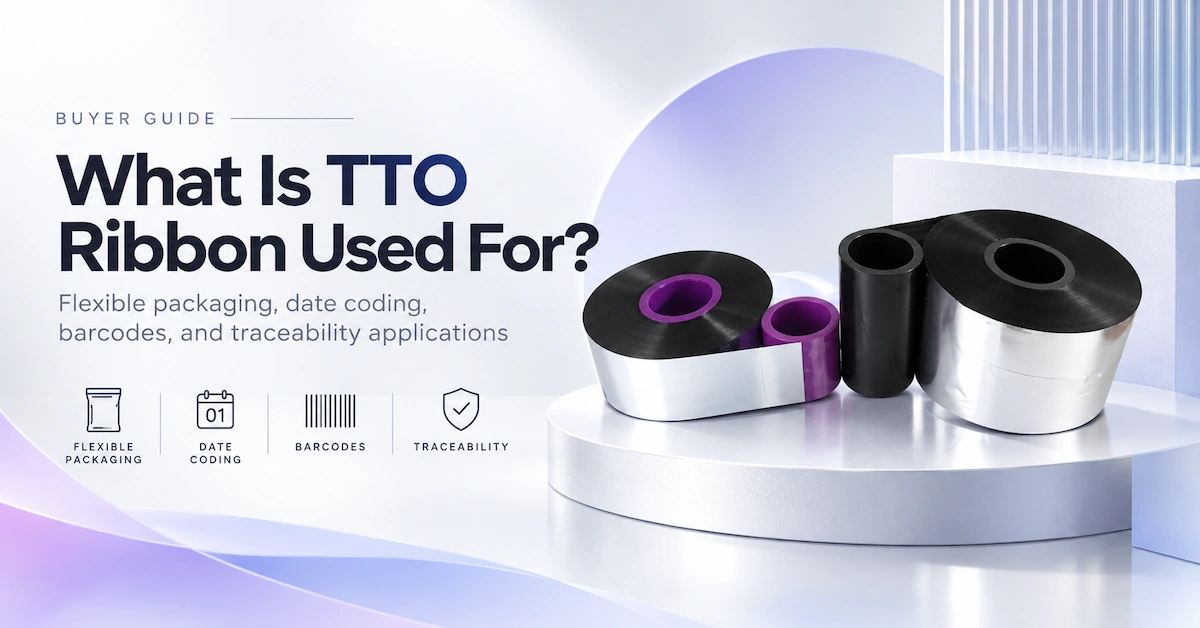
TTO ribbon is primarily used for printing variable information directly onto flexible packaging materials during automated production.
TTO stands for Thermal Transfer Overprinting. Unlike a conventional barcode printer that prints a separate adhesive label, a TTO system is commonly integrated into packaging equipment and prints directly onto packaging film or another compatible surface.
Typical information printed with TTO ribbon includes:
- Expiry dates
- Manufacturing dates
- Batch and lot numbers
- Barcodes
- QR codes and 2D codes
- Product identification
- Traceability information
- Prices
- Serial numbers
- Variable text
- Simple graphics and symbols
This makes TTO particularly useful when the printed information changes from one production batch, product, package, or manufacturing run to another.
For buyers comparing available formulations, CODEWEL provides a dedicated TTO Near Edge Ribbon product category alongside conventional thermal transfer ribbon families.
Why Is TTO Ribbon Different From Standard Barcode Ribbon?
Although both technologies use heat to transfer an ink coating from ribbon onto a printable surface, the operating environment is different.
A standard thermal transfer barcode printer usually prints onto:
- Paper labels
- Synthetic labels
- Shipping labels
- Warehouse labels
- Product identification labels
TTO equipment is more commonly installed directly on automated packaging machinery.
The printing system therefore has to work with:
- Moving packaging film
- Faster production lines
- Short printing cycles
- Repeated starts and stops
- Different packaging-film surfaces
- Small coding areas
- High-volume continuous production
That is why buyers should not treat a standard flat-head thermal transfer ribbon and a near-edge TTO ribbon as interchangeable simply because the dimensions appear similar.
TTO Uses Near-Edge Printing Technology
Most TTO systems use near-edge thermal printheads.
In a near-edge system, the ribbon releases the printed image quickly after passing under the heated printhead. This design supports the printing behavior required by many packaging machines.
Conventional barcode printers often use flat-head technology, where the ribbon and media remain in contact for a longer distance after the heating point.
For procurement teams, the practical rule is simple:
Confirm whether the machine requires flat-head or near-edge ribbon before discussing formulation, price, or order volume.
Where Is TTO Ribbon Commonly Used?
TTO ribbon is used across industries where variable information needs to be added to packaging during production.
Food Packaging
Food production is one of the most common TTO applications.
Flexible packaging lines may need to print information such as:
- Production date
- Best-before date
- Expiry date
- Batch number
- Lot code
- Product code
- Barcode
- Traceability code
Typical packaged products can include:
- Snacks
- Bakery products
- Frozen foods
- Confectionery
- Meat products
- Cheese
- Ready-to-eat food
- Dry food
- Coffee
- Tea
- Seasonings
Why TTO Is Useful for Food Packaging
Food factories often run packaging machines at relatively high speeds.
The printing method therefore needs to provide:
- Fast data changes
- Clear variable information
- Good barcode or code definition
- Reliable transfer onto packaging film
- Consistent printing during long production runs
If the package contains oily or greasy products, buyers should also evaluate whether a higher-resistance ribbon formulation is necessary.
Pharmaceutical Packaging
Pharmaceutical and healthcare packaging often depends heavily on product identification and traceability.
TTO systems may be used to print:
- Batch numbers
- Lot numbers
- Manufacturing dates
- Expiry dates
- Product references
- Variable codes
- Barcodes
- 2D identification codes
The critical purchasing issue is not simply whether the print appears dark.
It should remain readable throughout the required packaging, transportation, storage, and handling process.
For these applications, ribbon qualification should be carried out on the actual packaging material under representative production conditions.
Cosmetics and Personal Care Packaging
Cosmetics, personal-care products, and household products frequently use flexible packaging materials that require variable coding.
Possible information includes:
- Batch identification
- Manufacturing dates
- Expiry information
- Product codes
- Traceability information
- Promotional or regional variable data
A smooth initial print is only part of the requirement.
Buyers should also consider rubbing, moisture, product contact, and transportation.
Industrial and Hardware Packaging
TTO printing can also be useful for industrial products packaged in flexible films or similar materials.
Examples may include:
- Hardware components
- Electrical parts
- Fasteners
- Industrial accessories
- Replacement parts
- Small manufactured components
In these applications, the key requirement may shift from food-line speed toward:
- Traceability
- Barcode readability
- Abrasion resistance
- Long-term identification
- Batch control
Logistics and Retail Packaging
Some packaging applications require variable codes that support downstream warehouse, retail, or distribution processes.
TTO systems can print:
- SKU information
- Barcodes
- Product references
- Batch information
- Price-related data
- Distribution codes
However, TTO should not automatically be selected for every logistics application.
If the requirement is simply to print and apply a separate shipping label, a conventional barcode printer may be more suitable.
What Packaging Materials Can TTO Ribbon Print On?
TTO is commonly associated with flexible packaging, but “flexible film” covers many different materials and surface treatments.
Possible substrates include various:
- Polypropylene films
- Polyethylene films
- Polyester-based films
- Laminated packaging films
- Coated films
- Packaging label materials
- Flexible synthetic surfaces
The exact material matters because two visually similar packaging films may have different surface coatings, treatments, or print-receptive properties.
Do Not Select TTO Ribbon by Film Name Alone
A buyer may send an inquiry saying:
We print on PP film. Please recommend your TTO ribbon.
That information is useful, but it is not always enough.
A better technical inquiry should include:
- Exact packaging-film specification
- Film supplier or reference
- Surface treatment if known
- TTO printer model
- Printing speed
- Required code
- Required ribbon width
- Exposure conditions
Sample testing then confirms whether the ribbon, film, printer, and settings work together.
What Does a TTO Ribbon Actually Print?
One reason TTO is widely used in packaging automation is its ability to print more than a simple date code.
Depending on the printer and software, the printed area may contain several types of variable information.
Dates and Time Information
Common examples include:
- Manufacturing date
- Packing date
- Best-before date
- Use-by date
- Expiry date
These fields can change automatically according to production settings.
Batch and Lot Codes
Batch identification is important for:
- Production records
- Quality management
- Recall management
- Inventory control
- Traceability
Because the information can change between manufacturing runs, variable digital printing is useful.
Barcodes and 2D Codes
TTO can also be used for machine-readable identification.
Possible codes include:
- Linear barcodes
- QR codes
- Data Matrix codes
- Internal traceability codes
Print quality becomes particularly important when scanners or vision systems must read the code later in the supply chain.
Variable Text and Product Data
TTO may also print:
- Product names
- Product variants
- Weight information
- Internal identification
- Promotional information
- Regional data
- Production-line information
The exact printable content depends on the installed TTO system.
TTO Wax-Resin vs TTO Resin Ribbon
One important purchasing decision is the ribbon formulation.
For TTO applications, buyers commonly encounter near-edge wax-resin and resin formulations.
They should not automatically choose resin because it sounds more premium.
The correct choice depends on the real application.
TTO Wax-Resin Ribbon
Wax-resin is often a practical starting point for flexible packaging where buyers require a combination of:
- Good print quality
- High production efficiency
- Smear resistance
- Scratch resistance
- Reasonable durability
- Cost control
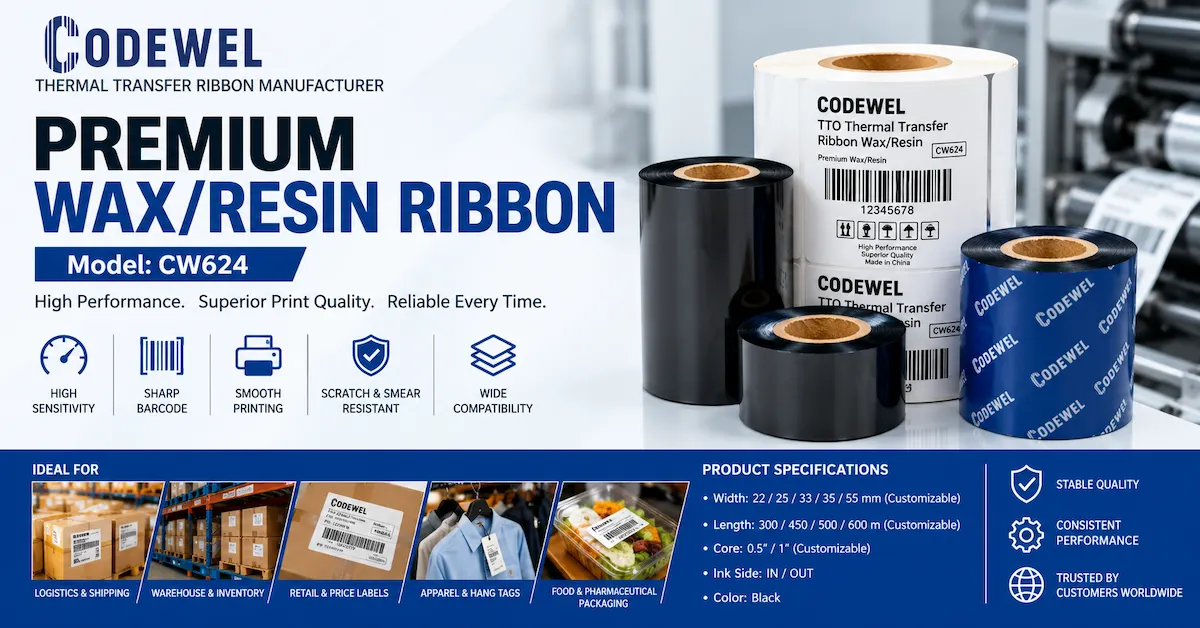
CODEWEL's CW624 TTO wax-resin ribbon is positioned for near-edge/TTO applications and is presented for packaging-related uses including food and pharmaceutical packaging. CODEWEL
A wax-resin formulation may be suitable when the printed package does not require the highest possible chemical or environmental resistance.
TTO Resin Ribbon
Near-edge resin ribbon becomes more relevant when the print faces more demanding exposure.
Examples may include:
- Oils
- Grease
- Chemicals
- Heavy rubbing
- More demanding industrial handling
- Higher durability requirements
CODEWEL's CW723 TTO near-edge premium resin ribbon is positioned for applications where increased durability and resistance need to be evaluated. CODEWEL
The final decision should still be made through application testing.
“Resin” does not mean that every formulation will resist every chemical, oil, temperature, or packaging condition.
TTO Wax-Resin and Resin Comparison
| Selection Factor | TTO Wax-Resin | TTO Resin |
|---|---|---|
| Typical selection goal | Balance of speed, quality and cost | Higher durability |
| Packaging use | General flexible packaging | More demanding packaging |
| Scratch resistance | Medium to high depending on formulation | Generally higher |
| Oil/grease exposure | Requires testing | Often a stronger candidate |
| Chemical exposure | Application-dependent | More suitable for evaluation |
| Printing energy | Generally moderate | Often higher |
| Cost | Usually lower | Usually higher |
| Best purchasing approach | Test against actual film | Test against actual exposure |
The objective is not to buy the most expensive ribbon.
The objective is to use the lowest suitable performance level that passes the required production and durability tests.
TTO Ribbon vs Standard Thermal Transfer Ribbon
The following comparison helps prevent one of the most common procurement mistakes.
| Factor | Standard Thermal Transfer Ribbon | TTO Ribbon |
|---|---|---|
| Typical printer | Barcode label printer | TTO packaging printer |
| Printhead type | Often flat-head | Usually near-edge |
| Typical media | Paper or synthetic labels | Flexible packaging films |
| Production environment | Label printing station | Integrated packaging line |
| Main content | Barcode and label information | Date, batch, barcode and variable package data |
| Production behavior | Roll-fed label printing | Continuous/intermittent packaging cycles |
| Ribbon selection focus | Label compatibility | Film, speed, printer and packaging process |
| Typical ribbon | Wax, wax-resin, resin | Near-edge wax-resin or resin |
If you are unsure which thermal transfer technology your project requires, CODEWEL's thermal transfer ribbon packaging guide provides a broader comparison between packaging-label applications and in-line TTO printing. CODEWEL
Continuous and Intermittent TTO Printing
Packaging lines may operate using different printing motions.
Continuous Printing
In a continuous process, the packaging material continues moving during printing.
The TTO system synchronizes printing with the movement of the film.
This is commonly relevant to continuously moving packaging equipment.
Intermittent Printing
In intermittent operation, the packaging material stops briefly while the required information is printed.
The packaging process then continues.
For ribbon buyers, the important point is not simply identifying “continuous” or “intermittent.”
Provide the exact TTO printer model and packaging machine configuration whenever possible.
This allows the supplier to evaluate compatible ribbon dimensions and construction more accurately.
Why Printing Speed Matters When Selecting TTO Ribbon
Packaging lines are designed around production throughput.
A ribbon that produces an excellent image at a slow laboratory setting may not perform the same way at actual line speed.
During qualification, evaluate the ribbon at realistic:
- Production speed
- Print frequency
- Print density
- Code size
- Printer energy
- Environmental temperature
- Packaging conditions
Watch for:
- Missing print
- Light characters
- Poor barcode edges
- Smearing
- Ribbon wrinkles
- Ribbon breakage
- Inconsistent density
- Unstable transfer after longer runs
Do not approve a TTO ribbon based only on several manually printed samples.
How to Test TTO Ribbon Before Bulk Ordering
A structured trial reduces purchasing risk.
Step 1: Use the Actual TTO Printer
Test on the printer that will be used in production.
Printer model and printhead design directly influence transfer behavior.
Step 2: Use the Actual Packaging Film
Do not approve the ribbon on a convenient substitute film.
Use the intended packaging material, preferably from the same supplier and specification planned for production.
Step 3: Print the Real Code
Test the actual content, including:
- Small text
- Dates
- Batch codes
- Barcodes
- QR or Data Matrix codes
- Solid areas if required
A simple large text sample may hide problems that appear with fine codes.
Step 4: Run at Realistic Production Speed
Qualification should reproduce expected production conditions.
If the machine normally operates at a high speed, testing only at a very slow setting provides limited evidence.
Step 5: Evaluate Durability
Depending on the application, test:
- Smearing
- Rubbing
- Scratching
- Moisture
- Oil
- Grease
- Product contact
- Heat
- Cleaning substances
Acceptance criteria should be defined before the test.
Step 6: Run a Longer Trial
Longer testing can expose problems such as:
- Wrinkling
- Tension instability
- Density changes
- Printhead buildup
- Intermittent transfer failure
The goal is stable production, not one perfect print.
What Information Should a Buyer Send in a TTO Ribbon RFQ?
An inquiry saying:
Need TTO ribbon. Please send price.
does not give the supplier enough information for reliable selection.
A better RFQ should include:
| RFQ Field | Information to Provide |
|---|---|
| TTO printer | Brand and exact model |
| Packaging machine | Model if relevant |
| Printing mode | Continuous or intermittent |
| Film | Exact packaging material |
| Ribbon formulation | Current type or candidate |
| Ribbon width | Required width |
| Ribbon length | Required length |
| Core | Required core specification |
| Ink side | IN or OUT |
| Printing speed | Actual production speed |
| Print content | Date, barcode, text, 2D code, etc. |
| Exposure | Oil, abrasion, moisture, heat, chemicals |
| Quantity | Trial and bulk requirement |
| Forecast | Monthly or annual usage |
| Packaging | Standard or private label |
Unknown information should be marked to be confirmed, rather than guessed.
That makes the quotation and sample-selection process more reliable.
How Should B2B Buyers Compare TTO Ribbon Cost?
The cheapest price per roll is not always the lowest printing cost.
For packaging operations, ribbon problems can affect an entire production line.
Possible hidden costs include:
- Packaging-film waste
- Reprinting
- Production-line stops
- Operator adjustments
- Unreadable codes
- Rejected packages
- Customer complaints
- Printhead wear
- Emergency replacement orders
A better evaluation compares:
Total usable print output + production stability + ribbon consumption + durability + purchase price
Compare Ribbon Consumption as Well as Roll Price
Two quotations can look similar but use different:
- Ribbon widths
- Ribbon lengths
- Roll configurations
- Print-area optimization
- Formulations
Purchasing teams should therefore normalize the comparison before deciding which supplier is cheaper.
Common TTO Ribbon Problems and What They May Indicate
Print Is Too Light
Possible causes include:
- Insufficient printing energy
- Excessive production speed
- Ribbon-film mismatch
- Incorrect formulation
- Printhead condition
Do not immediately increase heat to the maximum setting.
Identify the cause first.
Print Smears Easily
This can indicate:
- Insufficient resistance
- Poor ribbon-substrate compatibility
- Inappropriate formulation
- Incorrect settings
If the print must resist handling or oil exposure, a more durable formulation may need to be tested.
Ribbon Wrinkles
Possible causes include:
- Incorrect loading
- Poor alignment
- Ribbon tension
- Incompatible dimensions
- Excessive energy
- Printer or packaging-machine setup
Wrinkling should not automatically be blamed on ribbon quality until the complete ribbon path has been checked.
Barcode Cannot Be Read Reliably
Possible causes include:
- Low contrast
- Poor edge definition
- Incorrect print energy
- Excessive speed
- Packaging-film movement
- Insufficient barcode size
- Poor ribbon compatibility
Barcode approval should be based on repeatable readability, not whether one scanner can read one sample.
When TTO Ribbon May Not Be the Right Printing Method
TTO is highly useful, but it is not the correct solution for every coding application.
Another technology may be more appropriate when:
- Printing directly onto rigid containers
- Coding irregular three-dimensional surfaces
- Printing onto materials unsuitable for thermal transfer
- Printing large areas beyond the TTO system's capability
- The packaging line is designed around another coding technology
- A separate adhesive label is already required
The correct technology should be selected according to the packaging line, substrate, information type, print area, speed, durability, and total operating cost.
What Should Distributors and OEM Buyers Standardize?
For distributors, importers, and private-label buyers, one successful sample does not automatically create a repeatable product.
Once a TTO ribbon has been approved, establish a specification record containing:
- Product formulation
- Approved printer
- Approved film
- Ribbon width
- Ribbon length
- Core
- Ink side
- Printing mode
- Production speed range used during testing
- Required durability
- Packaging specification
- Product identification
- Approved sample reference
This specification becomes the basis for future orders.
It also reduces the risk of employees ordering “the same ribbon as last time” without knowing exactly what was approved.
For buyers planning customized or recurring ribbon programs, CODEWEL's custom thermal transfer ribbon supplier guide explains why approved samples and repeatable specifications are important for subsequent orders. CODEWEL
Quick TTO Ribbon Selection Checklist
Before approving a ribbon, verify all of the following:
- Is the printer a TTO/near-edge system?
- What is the exact printer model?
- Is the packaging process continuous or intermittent?
- What film is being printed?
- What information must be printed?
- What is the production speed?
- What ribbon width and length are required?
- What core does the machine use?
- Does the printer require ink side IN or OUT?
- Is wax-resin sufficient?
- Is resin necessary?
- Must the print resist rubbing?
- Must it resist oil or grease?
- Must it resist chemicals?
- Has the ribbon been tested on the actual film?
- Has it been tested at production speed?
- Has a longer production trial been completed?
- Has the approved specification been documented?
If several of these answers are unknown, sample qualification should come before a large-volume order.
FAQ
What does TTO mean in printing?
TTO means Thermal Transfer Overprinting. It uses a thermal printhead and ribbon to transfer variable information onto compatible packaging materials, commonly during automated packaging production.
What is TTO ribbon used for?
TTO ribbon is mainly used for printing variable data such as expiry dates, production dates, lot numbers, batch codes, barcodes, 2D codes, and traceability information onto flexible packaging materials.
Is TTO ribbon the same as barcode printer ribbon?
No. Conventional barcode ribbons are often designed for flat-head label printers, while TTO ribbon is generally designed for near-edge packaging printers. Compatibility must be confirmed before use.
What industries use TTO ribbon?
Common applications include food, pharmaceutical, cosmetics, personal care, industrial products, retail packaging, and other automated flexible-packaging operations.
Can TTO ribbon print barcodes and QR codes?
Yes, suitable TTO systems can print machine-readable codes such as linear barcodes and 2D codes. Final readability depends on the printer, ribbon, film, resolution, code size, and production settings.
What is the difference between TTO wax-resin and TTO resin ribbon?
Wax-resin generally balances print quality, durability, production efficiency, and cost. Resin is typically evaluated when greater resistance to abrasion, oils, grease, chemicals, or other demanding conditions is required.
Does every flexible packaging film use the same TTO ribbon?
No. Film chemistry, coating, surface treatment, printer type, speed, and durability requirements can all affect ribbon performance.
How do I choose the correct TTO ribbon size?
Confirm the printer model, required print width, ribbon width, roll length, core specification, and ink-side orientation. Do not determine compatibility from width alone.
Should I test TTO ribbon before bulk ordering?
Yes. Test the ribbon using the actual TTO printer, packaging film, print content, production speed, and expected exposure conditions before approving a bulk order.
What should I send a TTO ribbon supplier for a quotation?
Provide the printer model, packaging film, ribbon dimensions, core, ink side, production speed, print content, durability requirements, expected order volume, and any OEM or private-label requirements.
Conclusion
TTO ribbon is used primarily for printing variable data directly onto flexible packaging during automated production. Its common applications include expiry dates, batch and lot codes, barcodes, 2D codes, traceability information, and variable product data in food, pharmaceutical, personal-care, industrial, and other packaging operations.
For B2B buyers, selecting the right ribbon requires more than asking for a “TTO ribbon.” The printer model, near-edge technology, packaging film, ribbon dimensions, production speed, printing mode, required durability, and real operating environment should all be defined before bulk purchasing.
Buyers can begin by reviewing CODEWEL's TTO Near Edge Ribbon range, compare suitable wax-resin and resin options, and then qualify the final product through testing on the actual packaging line. A documented sample approval and repeatable specification will usually provide more purchasing value than choosing a ribbon based only on price per roll.