
What Should an Industrial Thermal Transfer Ribbon Supplier Help You Solve?
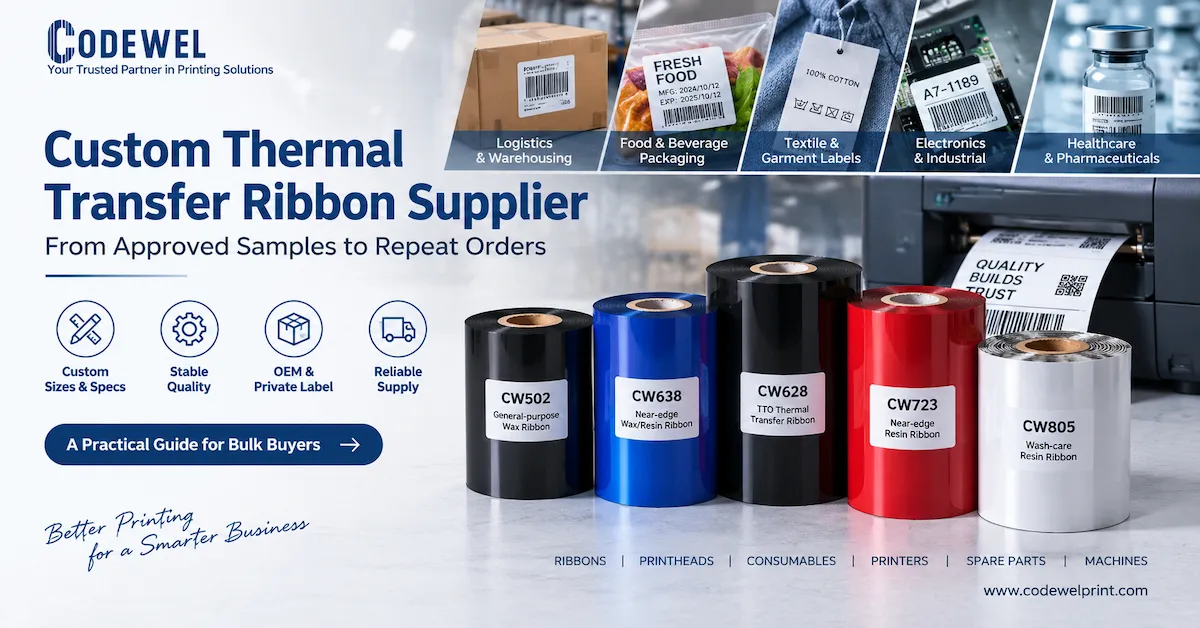
An industrial thermal transfer ribbon supplier should help a buyer create a repeatable printing solution, not simply recommend “resin” whenever a label needs greater durability. Industrial identification may involve electronics components, electrical nameplates, cable labels, automotive parts, chemical-product packaging, warehouse labels, flexible packaging, or textile care labels, and each application places different demands on the printed image and label material. The practical selection process therefore starts with four elements: the printer, the ribbon, the substrate, and the environment in which the finished label will be used. CODEWEL’s thermal transfer ribbon range includes wax, wax-resin, resin, TTO near-edge, and wash-care families, allowing industrial buyers to select a candidate formulation according to the application rather than assuming that one ribbon grade is suitable for every production line.

Which Industrial Buyers Need a More Controlled Ribbon Sourcing Process?
Industrial ribbon purchasing is especially relevant to electronics manufacturers, automotive component suppliers, wire and cable businesses, chemical and industrial-product packers, industrial label converters, warehouse and logistics operators, flexible-packaging plants, garment-label producers, equipment manufacturers, barcode consumables distributors, and private-label suppliers. Their purchasing priorities are not identical: an electronics factory may focus on small text, barcode readability, abrasion and identification life; an automotive supplier may need stable labels across handling and assembly processes; a chemical-packaging buyer may need to define contact with oils or other substances; a packaging plant may care about near-edge printer compatibility and production speed; a distributor may need repeatable specifications across many customer orders. Industrial sourcing is less suitable for a “one ribbon fits all” purchasing strategy because a roll that performs well on one label material or printer can behave differently after the substrate, printhead technology, settings, or end-use conditions change.
Start With the Industrial Environment Before Selecting Wax, Wax-Resin, or Resin
The phrase “industrial use” is too broad to specify a ribbon. A warehouse shelf label, PET electronics label, cable identification label, chemical drum label, TTO film print, and textile care label should not automatically receive the same formulation. Standard wax is generally the economical starting point for common paper-label printing; wax-resin is considered when buyers need a balance between print flexibility and increased resistance; resin products are intended for more demanding applications, particularly where synthetic labels or abrasion, moisture, outdoor exposure, oils, or other defined conditions are relevant. CODEWEL describes its CW709 standard resin ribbon for applications including electronic products and components, product identification, automotive uses, RFID, electrical nameplates, cable or sealing labels, chemical-product packaging, and electrical heating parts. Those application descriptions make CW709 a useful industrial candidate, but final performance still needs to be confirmed on the actual substrate and under the buyer’s real exposure conditions. Review CODEWEL CW709 resin ribbon.
Build an Industrial Ribbon Specification Before Asking for a Price
A serious RFQ to an industrial thermal transfer ribbon supplier should define enough information for purchasing, engineering, production, and quality teams to evaluate the same configuration. Asking only for “110 mm × 300 m resin ribbon” leaves too many variables unresolved. The specification should identify the printer, printing technology, substrate, roll geometry, application and acceptance requirements, while uncertain information should be marked “to be confirmed” rather than guessed.
| Specification Area | What the Buyer Should Provide | Why It Matters |
|---|---|---|
| Printer | Brand and complete model | Helps determine ribbon technology and roll compatibility |
| Printhead technology | Flat-head or near-edge where applicable | Influences suitable formulation |
| Label substrate | Paper, coated material, PET, PP, PE, textile,film or exact supplier reference | Printing behavior depends heavily on the surface |
| Ribbon type | Wax, wax-resin, resin, TTO or wash-care candidate | Defines the starting performance level |
| Ribbon width | Required finished width | Affects fit, waste and print coverage |
| Ribbon length | Required length | Affects roll diameter and purchasing comparison |
| Core | Diameter, width,notch and other relevant geometry | Must match the printer |
| Ink side | IN or OUT | Must match equipment requirements |
| Print settings | Speed, darkness or energy and resolution where relevant | Makes sample results repeatable |
| Label content | Barcode type, smallest text, graphics and required print area | Helps define print-quality acceptance |
| Environment | Indoor/outdoor, abrasion, moisture, oils, cleaning, heat or other actual exposure | Determines the durability test |
| Quantity | Trial,initial production and annual forecast | Supports production and commercial planning |
| Customization | Dimensions, color, leader film, label or packaging requirements | Separates technical configuration from branding |
| Approval criteria | What will be tested and how “pass” is defined | Prevents subjective sample approval |
Why Ribbon Construction Matters in Industrial Printing
A thermal transfer ribbon is a layered consumable rather than simply colored film. The carrier supports the ribbon through the printing process, the ink formulation forms the printed image, and the back-coating side interacts with the printhead during use. CODEWEL’s thermal transfer ribbon manufacturing guide discusses PET film, ink coating, back coating, coating, slitting, and winding as parts of ribbon production. For industrial buyers, the important purchasing question is not whether a supplier can name these layers, but whether the approved product can be reproduced with consistent coating, finished width, roll condition and identification. Small variations that are easy to ignore on a single sample can become expensive when they are multiplied across continuous production or thousands of rolls.
Wax-Resin Can Be More Practical Than Automatically Moving to Full Resin
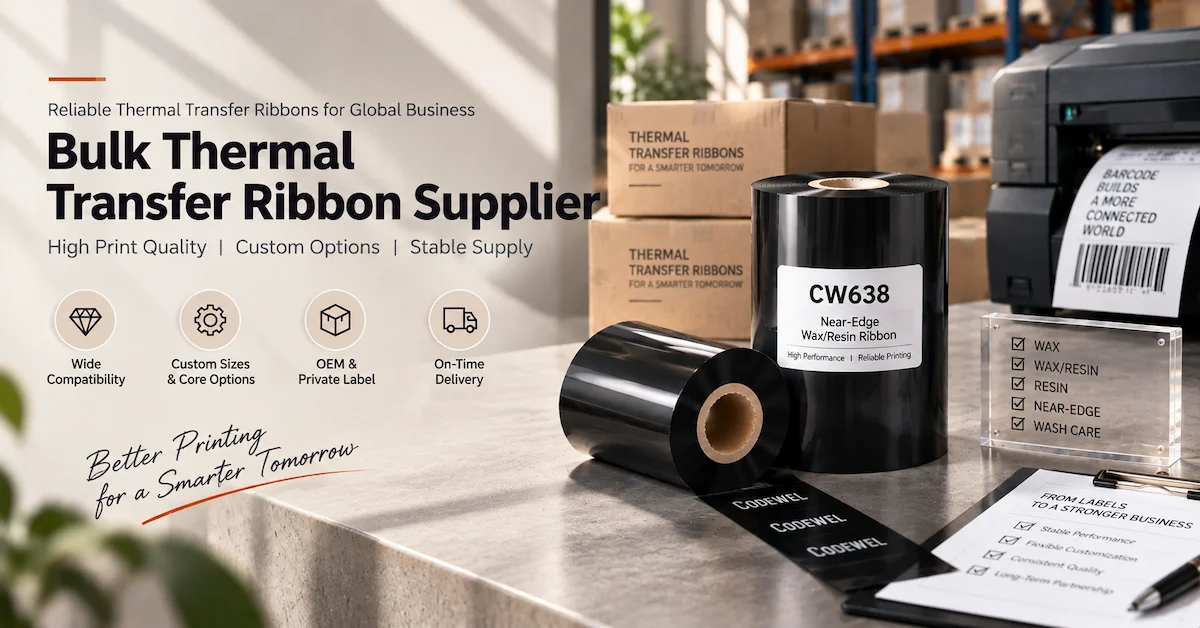
A common industrial sourcing mistake is assuming that full resin must always be the correct choice once a standard wax ribbon is no longer sufficient. Some applications instead need a middle position between economy and durability. Wax-resin formulations can serve warehouse, ticket, coated-label and general manufacturing identification applications where buyers want improved resistance without necessarily requiring the performance profile of a full resin product. CODEWEL lists CW603 as its standard wax-resin family and CW630 as premium wax-resin, while CW638, CW639 and CW641 sit within the Super Wax/Resin range. The final choice should still depend on substrate, printer technology and required resistance. For near-edge equipment specifically, CW638 near-edge wax/resin ribbon provides a more relevant reference than selecting a flat-head ribbon simply because both products use a wax-resin formulation.
When Should Industrial Buyers Consider Resin Ribbon?
Resin becomes particularly relevant when the printed label must remain legible after more demanding handling or exposure and when the label substrate can support the required printing performance. CODEWEL’s CW709 page describes a standard full-resin product with IN or OUT ink-side options, ½-inch, 1-inch or customized cores, multiple standard or customized widths and lengths, and black or custom color options. The same page positions the resin family toward cable and sealing labels, chemical-product packaging, electrical heating parts and identification tags. These specifications are useful for starting a technical discussion, but statements such as “chemical resistant” should always be converted into a defined test: which substance, at what concentration, for how long, under what temperature, and what print-quality result is considered acceptable.
Near-Edge and TTO Applications Require a Different Compatibility Check
Industrial packaging lines create another sourcing problem because formulation alone does not define compatibility. Near-edge and TTO equipment may use ribbon constructions developed for different printhead behavior and production speeds than conventional flat-head printers. CODEWEL’s product structure includes near-edge/TTO wax-resin models such as CW624, CW625 and CW628, together with near-edge resin products such as CW723. Buyers printing variable information on flexible packaging should therefore provide the TTO printer model, packaging film, required ribbon dimensions, production speed and actual print content before comparing products. The CODEWEL TTO wax/resin ribbon range can serve as one starting point, while a more demanding application can be evaluated against the near-edge resin ribbon range.
Compare Industrial Ribbon Models by Application, Not by Product Name Alone
A meaningful model comparison should show why each ribbon deserves testing and which variables remain unresolved. The following table uses CODEWEL’s published product positioning as a sourcing reference; it is not a guarantee that the listed model will pass every industrial application.
| CODEWEL Model / Family | Product Direction | Potential Industrial Use | What the Buyer Should Verify |
|---|---|---|---|
| CW603 | Standard wax-resin | Warehouse labels, tickets, coated labels, general identification | Substrate adhesion, abrasion requirement, printer settings |
| CW638 | Near-edge wax/resin | Near-edge industrial and packaging printing | Printer technology, material, speed and required resistance |
| CW709 | Standard resin | Electronics, automotive, cable, electrical nameplates, industrial identification | Synthetic substrate, abrasion, moisture and actual environmental exposure |
| CW723 / Near-Edge Resin | Near-edge resin | Demanding TTO or near-edge applications | Film, printer model, speed, oils or other specified contact conditions |
| CW805 | Wash-care resin | Garment and textile-care labels | Textile substrate, wash cycle, detergent, drying and ironing conditions |
The table intentionally keeps a “verify” column because the strongest industrial purchasing decision is based on tested conditions, not on wording such as Standard, Premium, Super or Resin.
How Should an Industrial Buyer Evaluate Coating, Slitting, and Winding?
When evaluating an industrial thermal transfer ribbon supplier, sample print quality is only one part of the decision. Industrial buyers should also understand how the ribbon is converted into the finished roll they will repeatedly purchase. Coating influences transfer consistency; slitting affects finished width and edge condition; winding affects roll stability and printer feeding; core and ink-side configuration determine physical installation; identification helps warehouses separate visually similar products. A practical supplier-review checklist should therefore include finished width, roll condition, core specification, ink side, product identification, packaging and a representative print check. If a buyer operates several plants or distributes multiple ribbon grades, controlled model and batch identification becomes even more important because a black resin roll and a black wax-resin roll may look similar while serving very different applications.
Industrial Sample Testing Should Reproduce the Actual Production Job
Do not approve an industrial ribbon because a supplier prints one large barcode successfully on its own laboratory material.The trial should use the buyer’s intended printer, actual label or packaging substrate, realistic print content and representative production settings. If tiny characters, dense barcodes or narrow lines are part of the normal job, include them in the test. If abrasion is a concern, define how rubbing will be performed; if oil or cleaning substances are relevant, identify the exact liquid and exposure method; if the label will be used outdoors, determine which environmental conditions matter to the project. Save the ribbon model, material batch where available, printer, settings and result together. This converts “sample looks good” into an approval record that can be used to troubleshoot later production changes.
Separate Ribbon Usage Conditions From Finished-Print Durability
Industrial articles often create confusion by combining storage temperature, printer operating conditions and finished-label resistance into one broad performance claim. These are different specifications. A ribbon may have recommended storage and printing conditions while the transferred image is evaluated under another set of exposure tests. CODEWEL’s near-edge resin listings, for example, provide usage and storage ranges separately from resistance indicators. Buyers should preserve that distinction when writing specifications or approving a product.A temperature listed in a product table should not automatically be interpreted as continuous operating temperature for the entire printer, label construction or finished assembly.
Quality Control Should Be Connected to the Approved Product Specification
“Strict QC” is not sufficiently detailed for industrial procurement. The useful question is which characteristics are inspected and how they relate to the approved ribbon. For a repeat order, the buyer can verify roll identification, width, core, ink side, winding condition, packaging and a defined printing check, while more demanding projects can add application-specific tests. If the formulation, carrier, finished dimensions, core, winding, color or other approved characteristic changes, both parties should decide whether revalidation is required. This type of control reduces the risk of a technically different material entering production simply because the commercial product name remained unchanged. The principle is particularly important for electronics, automotive and other manufacturing operations where a label problem may not be discovered until after assembly or downstream handling.
Certification Documents Should Be Checked by Product and Scope
Industrial buyers frequently ask suppliers for compliance documents, but document review should remain separate from print-performance testing. A company certificate, test report, material declaration and model-specific document answer different questions. When documentation is required, request the actual file and confirm the company name, product or material covered, test scope, standard or regulation referenced, issue date and applicable validity. Do not assume that a certificate image on a website applies automatically to every ribbon family, customized color or future formulation. This is especially important for CODEWEL because compliance and historical authorization documents should be verified according to their actual content before they are used as evidence in a customer qualification package.
Does Factory Scale Matter When Selecting an Industrial Supplier?
Factory scale matters when it supports repeat production, but it should not replace product qualification. CODEWEL states on its About Us page that its ribbon operation includes more than 10 coating and cutting production lines, a production base exceeding 6,000 square meters and annual production above 100 million square meters. Those figures provide company-level manufacturing context for distributors and industrial customers planning recurring volume, but they are not an automatic promise that a particular custom order can be completed within a specific number of days. Capacity allocation depends on formulation, width, length, quantity, customization, production scheduling, inspection and logistics, so an industrial buyer should request an order-specific production plan after the technical specification has been confirmed.
How Should Buyers Evaluate Lead Time for Industrial Supply?
Industrial supply should be divided into technical confirmation, sample availability, sample testing, custom preparation where applicable, production, inspection and transport. Stocked sizes may follow one schedule, while a customized width, color, core or private-label program may follow another. A multi-SKU distributor order can also contain several different readiness dates. Buyers should ask what event starts the production lead time—sample approval, specification confirmation, artwork approval, payment or another agreed milestone—and which parts of the schedule depend on the buyer.This makes planning more useful than relying on one generic “delivery in X days” claim and helps prevent a delayed technical approval from being mistaken for a production failure.
Industrial Ribbon Cost Should Be Measured Beyond Price per Roll
A lower roll price does not always produce a lower printing cost. Quotations should first be normalized by formulation, width, length, core, ink side, packaging, quantity and delivery terms. Then consider usable ribbon length, setup waste, rejected labels, reprints, operator intervention, downtime, obsolete stock and the cost of maintaining too many special SKUs. For example, a cheaper ribbon that requires frequent darkness adjustments or produces unacceptable labels on the chosen substrate can be more expensive at the process level than a higher-priced ribbon that consistently meets the approved result. A practical purchasing metric is cost per accepted label, calculated using actual ribbon consumption and rejected production data from the buyer’s line. This turns supplier comparison from a price-only discussion into a production-cost decision.
Customization Should Be Separated Into Technical and Branding Requirements
An industrial sourcing project may require a custom width or length, special core configuration, IN/OUT ink side, color, leader-film identification, product label or private-label packaging. These are not all the same type of customization. CODEWEL’s CW638 product information lists customized dimensions, core options, ink-side choices, color options and leader-film logo possibilities, making it a useful example of how a buyer can specify a private-label or application-specific configuration. A request for different durability or transfer behavior, however, should be treated as a technical development requirement and verified separately. Changing a box or logo is a branding change; changing a formulation is a performance change, and the two should not share the same approval process.
How Can Distributors and Manufacturers Reduce Repeat-Order Risk?
A successful first order should become a controlled reference for the next order.Keep the supplier model, buyer SKU, formulation, width, length, core, ink side, color, label or artwork version, packaging, approved sample and test result together. Avoid purchase orders that say only “same as before,” because that wording becomes difficult to interpret after employees, printers, substrates or packaging specifications change. If the customer switches from paper to PET, from a flat-head printer to a near-edge printer, or from indoor handling to a harsher environment, the old ribbon approval may no longer answer the new requirement. Repeat-order control therefore depends on specification control as much as it depends on supplier capacity.
What Should You Send an Industrial Thermal Transfer Ribbon Supplier?
A focused RFQ should include your printer brand and full model, label or film material, current ribbon if available, required ribbon width and length, core, ink side, formulation or current performance problem, print content, expected environmental exposure, sample quantity, initial order, annual forecast, destination and any OEM/private-label requirements. Photos of the current ribbon label, printer nameplate and label material can help when part numbers are unclear. Buyers who have not selected a formulation can first review the CODEWEL thermal transfer ribbon categories, then contact CODEWEL with the application and technical information required for a more focused recommendation and quotation.
Frequently Asked Questions
1. What is the best thermal transfer ribbon for industrial labels?
There is no single best industrial ribbon. The correct product depends on the printer, printhead technology, label substrate, required image quality and actual environmental exposure. Wax-resin may be sufficient for some warehouse or manufacturing labels, while synthetic labels exposed to abrasion, moisture, oil or other demanding conditions may justify evaluation of a resin formulation.
2. Is resin always better than wax-resin for industrial use?
No. Resin generally targets more demanding durability requirements, but that does not mean it is the most economical or technically necessary option for every industrial label.If a wax-resin product passes the buyer’s required printing and durability tests, moving to a more expensive formulation may add little value.
3. Which CODEWEL ribbon is suitable for electronics labels?
CODEWEL describes CW709 standard resin ribbon for applications that include electronic products, electronic components, product identification and electrical nameplates. The actual label substrate, printer and required exposure should still be tested before production approval.
4. Which ribbon should I consider for cable or chemical-product labels?
CODEWEL positions its resin family toward cable/sealing labels, chemical-product packaging and other durable identification applications. CW709 is one candidate, but the application should specify the label material and exact chemical, abrasion or environmental exposure rather than relying on a generic “industrial resistant” requirement.
5. Can I use the same ribbon for flat-head and near-edge printers?
Do not assume so.Printhead technology is an important part of ribbon selection. CODEWEL has dedicated near-edge/TTO wax-resin and near-edge resin families, so buyers should provide the complete printer model before substituting a ribbon selected for another printing technology.
6. What should be tested before approving an industrial ribbon?
Test the actual printer, label material and representative print content under realistic settings. Add application-specific checks for abrasion, moisture, oils, chemicals, washing, heat or other conditions only when they are relevant to the finished label, and record the test method so the result can be repeated.
7. Can industrial ribbons be customized?
Selected CODEWEL ribbon pages list options for customized width, length, core, ink side, color and leader-film identification. Available combinations vary by model, so the exact configuration, MOQ and production requirements should be confirmed before ordering rather than assumed across the entire range.
8. How should I compare two industrial thermal transfer ribbon suppliers?
Give both suppliers the same printer information, material, ribbon dimensions, application conditions and test criteria.Then compare sample performance, specification clarity, finished-roll consistency, customization capability, commercial terms, lead time and repeat-order control rather than comparing only roll price.
9. Do I need to request compliance documents for every industrial ribbon?
Request documentation according to your product, market and customer requirements. Check the actual scope and date of each document rather than assuming that a general company document automatically covers every ribbon model, color, material or customized version.
10. How can I reduce problems after switching ribbon suppliers?
Keep the previous approved ribbon and test data, define the replacement specification, run the candidate under the same printer and material conditions, record the settings and acceptance results, and approve the exact configuration before volume purchasing. Avoid changing the ribbon, substrate and printer settings at the same time because that makes it harder to identify the cause of a printing difference.
Conclusion
Choosing an industrial thermal transfer ribbon supplier is a technical sourcing decision built around repeatable printing, not simply a search for the strongest resin ribbon or the lowest unit price. Industrial buyers should define the printer, printhead technology, substrate, ribbon dimensions, core, ink side, application environment and acceptance criteria first; compare wax-resin, resin and near-edge candidates under controlled sample conditions; and then connect the approved product to quality inspection, customization, purchasing and repeat-order records. CODEWEL provides wax, wax-resin, resin, TTO near-edge and wash-care thermal transfer ribbon options for different printing requirements, while specific products such as CW709 resin ribbon can serve as starting points for electronics, automotive, cable, electrical and other industrial identification projects. Buyers planning industrial, distributor, OEM or recurring-volume programs can contact CODEWEL with the printer model, label material, required ribbon specification, end-use conditions and order forecast so the appropriate product can be evaluated against a clearly defined application.