
Why Choosing the Right Wax Ribbon Manufacturer Matters
A professional wax ribbon manufacturer provides more than finished ribbon rolls. For companies using thermal transfer printing systems, the manufacturer behind the ribbon directly influences printing stability, barcode readability, production efficiency, and long-term supply reliability.
Wax ribbons are widely used in barcode printing because they provide an economical solution for applications that require:
- Clear barcode printing
- High-speed operation
- Cost-effective labeling
- Reliable performance on paper-based materials
However, not all wax ribbons provide the same performance.
Differences in:
- PET base film quality
- Wax ink formulation
- Coating technology
- Slitting accuracy
- Quality inspection
- Production consistency
can significantly affect printing results.
For distributors, label converters, logistics companies, manufacturers, and private-label brands, choosing an experienced wax ribbon manufacturer helps reduce purchasing risks and maintain consistent printing performance.
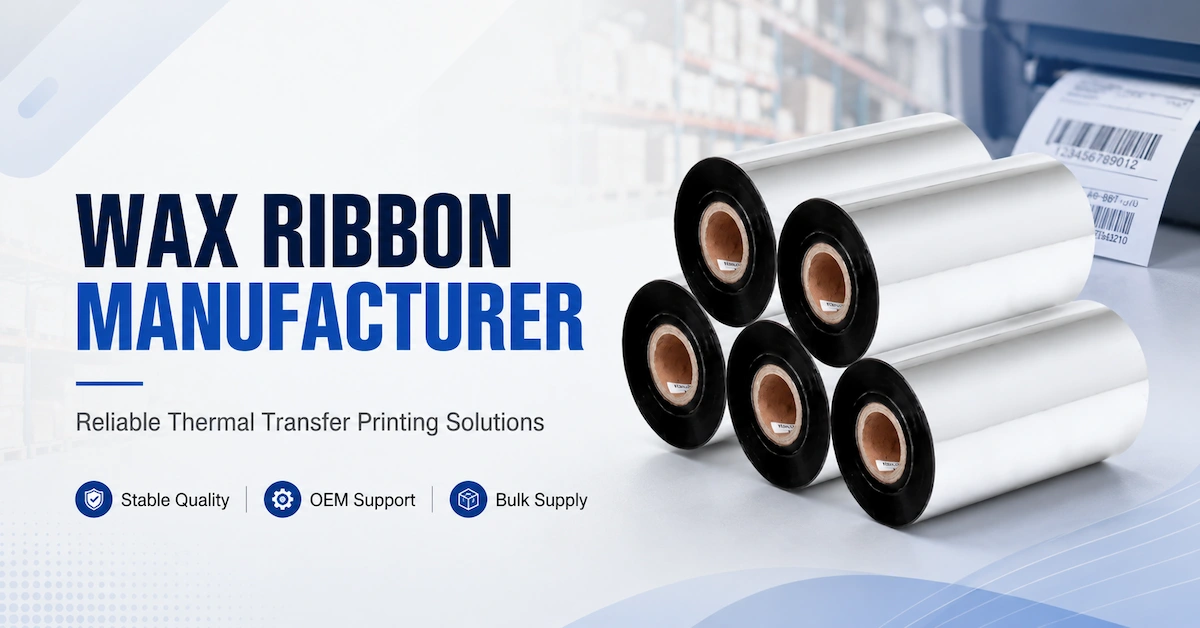
CODEWEL provides a range of wax ribbon products designed for thermal transfer barcode printing applications.
What Is a Wax Ribbon Manufacturer?
A wax ribbon manufacturer specializes in producing thermal transfer ribbons that transfer ink onto labels through controlled heat from a thermal printhead.
During thermal transfer printing:
- The printer heats specific areas of the printhead.
- Heat melts the wax-based ink layer.
- The ink transfers from the ribbon onto the label surface.
- The printed image forms permanent barcode and text information.
Wax ribbon is mainly designed for applications where:
- Cost efficiency is important
- Printing speed is required
- Labels are mainly paper-based
- Extreme durability is not necessary
Compared with higher-performance resin ribbons, wax ribbons focus on balancing:
- Printing quality
- Production speed
- Cost efficiency
A reliable manufacturer should understand the complete printing system, including:
- Printer compatibility
- Label materials
- Printing speed
- Environmental conditions
- Required durability
Rather than simply selling a standard ribbon.
Main Applications of Wax Thermal Transfer Ribbon
Wax ribbons are commonly used in industries where paper labels and general barcode identification are required.
Typical applications include:
Logistics and Shipping Labels
Warehouses and logistics companies often use wax ribbon for:
- Shipping labels
- Package identification
- Tracking labels
- Delivery information
The main requirements are:
- Fast printing
- Low cost per label
- Reliable barcode scanning
Retail Labels
Retail environments commonly require economical barcode printing for:
- Product labels
- Price tags
- Inventory labels
- Shelf identification
Wax ribbons provide sufficient print quality for many everyday retail applications.
Warehouse Management
Warehouse operations depend on accurate barcode identification.
Wax ribbon is commonly used for:
- Inventory tracking
- Location labels
- Storage identification
- Internal management labels
Manufacturing Identification
Manufacturers use wax ribbon for:
- Work-in-process labels
- Product tracking
- Internal identification
- Packaging labels
For applications exposed to chemicals, heat, outdoor conditions, or heavy abrasion, buyers may need wax resin or resin solutions instead.
How Is Wax Ribbon Manufactured?
The quality of a wax ribbon depends heavily on the manufacturing process.
A professional wax ribbon manufacturer normally controls several important production stages:
- Base film preparation
- Ink formulation
- Coating
- Drying
- Back coating
- Slitting
- Rewinding
- Final inspection
- Packaging
Each step affects the final printing performance.
PET Base Film Selection
The PET film is the foundation layer of thermal transfer ribbon.
Important characteristics include:
- Stable thickness
- Smooth surface
- Good mechanical strength
- Heat resistance
- Consistent performance
A high-quality base film supports:
- Smooth ribbon movement
- Stable printing
- Reduced ribbon breakage
- Better production reliability
For large-volume buyers, inconsistent base film quality can create problems between different production batches.
Wax Ink Formulation Technology
The wax ink layer determines how effectively the ribbon transfers images onto labels.
Important performance factors include:
- Print darkness
- Transfer efficiency
- Adhesion
- Surface compatibility
- Printing temperature requirements
Wax-based ink is optimized for:
- Coated paper
- Uncoated paper
- Hang tags
- General barcode labels
Compared with resin-based formulations, wax ink focuses more on:
- Lower printing energy
- Faster printing speed
- Cost efficiency
Back Coating Technology
The back coating is an important but often overlooked part of wax ribbon manufacturing.
A quality back coating helps:
- Reduce friction between ribbon and printhead
- Improve ribbon movement
- Protect thermal printheads
- Support stable printing
Poor back coating quality may result in:
- Increased friction
- Printing instability
- Faster printhead wear
This is why professional buyers should evaluate manufacturing technology instead of only comparing ribbon appearance.
Wax Ribbon Manufacturing Process Steps
A typical production workflow includes:
| Manufacturing Stage | Main Purpose |
|---|---|
| PET Film Preparation | Provide stable ribbon base |
| Ink Mixing | Create consistent wax formulation |
| Coating | Apply uniform ink layer |
| Drying | Stabilize coating performance |
| Back Coating | Protect printhead and improve movement |
| Slitting | Convert jumbo rolls into required sizes |
| Rewinding | Produce finished ribbon rolls |
| Inspection | Confirm specifications and printing quality |
| Packaging | Protect products during transportation |
A manufacturer with complete production control can provide better consistency for repeat orders.
Why Production Consistency Matters for Wax Ribbon Buyers
A single good sample does not always represent long-term supply quality.
For distributors and industrial users, every production batch should maintain similar:
- Print darkness
- Ribbon dimensions
- Roll tension
- Coating performance
- Packaging quality
Inconsistent wax ribbons may create:
- Different printing results
- Customer complaints
- Printer adjustments
- Increased operating costs
Therefore, supplier evaluation should focus on repeatability rather than only sample performance.
Wax Ribbon Structure and Technical Characteristics

Understanding wax ribbon structure helps buyers evaluate whether a product matches their printing requirements.
A thermal transfer wax ribbon usually consists of three main layers:
| Layer | Function |
|---|---|
| Back Coating | Reduces friction, protects the printhead, improves ribbon movement |
| PET Base Film | Provides mechanical support and heat transfer stability |
| Wax Ink Layer | Transfers printed images, text, and barcodes onto labels |
Each layer influences the final printing performance.
A professional wax ribbon manufacturer should control the thickness, uniformity, and performance of each layer to ensure stable printing results.
PET Base Film Performance
The PET base film works as the carrier layer of the ribbon.
Important characteristics include:
- Uniform thickness
- Smooth surface
- Heat resistance
- Mechanical strength
- Stable tension
A high-quality PET film helps maintain:
- Accurate ribbon movement
- Smooth printing operation
- Reduced ribbon breakage
- Consistent transfer performance
For high-volume barcode printing environments, unstable film quality may result in inconsistent printing performance between different production batches.
Wax Ink Layer Performance
The wax ink layer determines how effectively the printed image transfers to the label.
Key performance factors include:
- Print density
- Image clarity
- Adhesion
- Melting temperature
- Printing speed compatibility
Wax ink is generally optimized for:
- Paper labels
- Coated paper
- Shipping labels
- Retail tags
- Warehouse identification labels
Because wax ink requires lower printing energy compared with resin-based formulations, wax ribbons are often suitable for high-speed printing applications where cost efficiency is important.
Back Coating Protection
The back coating is designed to improve the interaction between the ribbon and the thermal printhead.
A quality back coating can help:
- Reduce friction
- Prevent static buildup
- Protect printhead surfaces
- Improve printing stability
For businesses operating large numbers of barcode printers, proper ribbon construction can help reduce maintenance requirements and improve equipment availability.
Wax Ribbon vs Wax Resin Ribbon: Which One Should You Choose?
One of the most common questions from buyers is the difference between wax ribbon and wax resin ribbon.
Although both are used in thermal transfer printing, their performance characteristics are different.
| Feature | Wax Ribbon | Wax Resin Ribbon |
|---|---|---|
| Main Ink Component | Wax-based | Wax + resin blend |
| Cost | Lower | Higher |
| Printing Speed | Excellent | Good |
| Paper Labels | Excellent | Excellent |
| Synthetic Labels | Limited | Better |
| Scratch Resistance | Basic | Higher |
| Chemical Resistance | Limited | Better |
| Common Applications | Logistics, shipping, retail | Manufacturing, product labels, industrial use |
Choose Wax Ribbon When:
Wax ribbon is suitable when your priority is:
- Low printing cost
- High-speed operation
- Paper-based labels
- Standard barcode applications
Typical examples:
- Shipping labels
- Warehouse labels
- Inventory tags
- Retail price labels
Choose Wax Resin Ribbon When:
Wax resin is better when labels require:
- Higher durability
- Better abrasion resistance
- Improved environmental resistance
Typical applications:
- Manufacturing labels
- Product identification
- Coated synthetic labels
- Industrial tracking
CODEWEL also provides wax resin ribbon solutions for customers requiring improved durability compared with standard wax ribbon.
How to Select the Correct Wax Ribbon Specification
Choosing the right wax ribbon requires matching the ribbon with the complete printing system.
Important specifications include:
- Ribbon width
- Ribbon length
- Core size
- Ink side
- Printer model
- Label material
- Printing speed
Ribbon Width Selection
The ribbon width should match the printing requirements.
Consider:
- Label width
- Maximum printer print width
- Printed area size
A ribbon that is too narrow may not fully cover the printing area.
A ribbon that is unnecessarily wide may increase material cost.
Core Size Selection
Different printers require different ribbon core specifications.
Common options include:
- 0.5 inch core
- 1 inch core
Before ordering, buyers should confirm:
- Printer compatibility
- Ribbon winding direction
- Core requirements
Ink Side Selection
Thermal transfer ribbons are commonly available with different ink orientations:
- Ink side in
- Ink side out
The correct choice depends on printer design.
A professional wax ribbon manufacturer should confirm the printer model before recommending specifications.
Printer Compatibility of Wax Ribbon
Wax ribbons are widely used with many thermal transfer printers, including:
- Zebra
- TSC
- Honeywell
- SATO
- Datamax
- Godex
- Toshiba
- Citizen
However, compatibility should always be verified.
Important factors include:
- Printer mechanism
- Printhead type
- Ribbon size
- Printing speed
- Label material
A supplier should not simply claim universal compatibility without checking the actual application.
Quality Control Standards for Wax Ribbon Manufacturing
A reliable wax ribbon manufacturer should have quality control throughout production.
Incoming Material Inspection
Before manufacturing, materials should be evaluated, including:
- PET film
- Wax ink materials
- Core components
- Packaging materials
Stable incoming materials support consistent finished products.
Coating Quality Inspection
The coating process directly affects:
- Printing darkness
- Ribbon stability
- Transfer performance
Quality checks may include:
- Coating uniformity
- Surface condition
- Ink adhesion
- Printing tests
Finished Product Testing
Before shipment, finished ribbons should be checked for:
| Inspection Item | Purpose |
|---|---|
| Ribbon Width | Confirm printer compatibility |
| Ribbon Length | Ensure quantity accuracy |
| Roll Appearance | Prevent handling issues |
| Edge Quality | Reduce wrinkles and feeding problems |
| Printing Performance | Verify actual output |
| Packaging | Protect during transportation |
For distributors and industrial buyers, production traceability is especially important for repeat orders.
OEM Wax Ribbon Manufacturing Services
For distributors and private-label brands, OEM capability is an important supplier selection factor.
A professional wax ribbon manufacturer should support customization options such as:
Product Customization
- Ribbon width
- Ribbon length
- Core size
- Ink side
- Ribbon formulation
- Packaging quantity
Brand Customization
- Private label stickers
- Carton design
- Product labels
- Brand identification
Application Customization
Different industries may require different wax ribbon specifications.
Examples:
- Logistics distributors may need economical bulk packaging.
- Label companies may require multiple sizes.
- Brand owners may require customized packaging.
OEM cooperation helps companies create differentiated product lines while maintaining stable supply.
Why Work With a Professional Wax Ribbon Manufacturer?
Working directly with an experienced manufacturer provides several advantages.
Stable Product Quality
Manufacturing control helps maintain:
- Consistent coating
- Stable printing performance
- Repeatable specifications
Better Technical Support
A professional manufacturer can help evaluate:
- Printer compatibility
- Label material
- Ribbon type
- Application requirements
Flexible Customization
Manufacturers are generally better positioned to support:
- Custom sizes
- OEM packaging
- Bulk orders
- Special requirements
Long-Term Supply Reliability
For distributors and industrial users, stable supply is essential.
A qualified manufacturer should provide:
- Clear production schedules
- Reliable lead times
- Consistent quality
- Communication support
Wax Ribbon Purchasing Checklist
Before selecting a wax ribbon manufacturer, buyers should confirm:
Product Capability
✓ Wax ribbon product range
✓ Different sizes available
✓ Compatible with required printers
✓ Suitable for target labels
Manufacturing Capability
✓ Coating capability
✓ Slitting capability
✓ Production consistency
✓ Quality inspection process
Customization Capability
✓ OEM packaging
✓ Private label support
✓ Customized specifications
Technical Support
✓ Ribbon recommendation
✓ Application testing
✓ Printing troubleshooting
Supply Capability
✓ Production capacity
✓ Lead time
✓ Repeat order stability
A supplier meeting these requirements is more likely to support long-term business development.
Wax Ribbon Applications Across Different Industries
A professional wax ribbon manufacturer should understand that ribbon selection depends on the actual application environment, not only the printer model.
Wax ribbon is widely used because it provides a practical balance between:
- Printing quality
- Cost efficiency
- Production speed
- Barcode readability
However, buyers should confirm whether the application requires higher durability before choosing wax ribbon.
Logistics and Warehouse Applications
Logistics companies are among the largest users of wax thermal transfer ribbons.
Common applications include:
- Shipping labels
- Package identification
- Tracking labels
- Inventory management labels
- Warehouse location labels
Main requirements:
- Fast printing speed
- Clear barcode scanning
- Low cost per label
- Reliable daily operation
For standard paper shipping labels, wax ribbon is often an economical solution.
Retail and Product Label Applications
Retail businesses commonly use wax ribbon for:
- Price tags
- Product labels
- Shelf labels
- Inventory identification
Important requirements include:
- Sharp text printing
- Clear barcode readability
- Efficient label production
Wax ribbon provides good performance for everyday retail labeling where extreme resistance is not required.
Manufacturing Identification Applications
Manufacturers use barcode labels for:
- Work-in-process tracking
- Production management
- Component identification
- Internal logistics
Wax ribbon can be suitable for:
- Paper-based production labels
- Short-term identification
- Indoor manufacturing environments
For automotive, electronics, or chemical environments requiring stronger resistance, buyers may consider resin-based alternatives.
E-Commerce Fulfillment Applications
E-commerce warehouses require large quantities of shipping labels every day.
Wax ribbon is often selected because it provides:
- Lower consumable costs
- High-speed printing
- Stable barcode output
- Easy replacement
For fulfillment centers processing thousands of packages daily, ribbon consistency is more important than choosing the cheapest product available.
How to Reduce Procurement Risks When Buying Wax Ribbon
Choosing a wax ribbon manufacturer requires evaluating more than product pricing.
Many purchasing problems come from:
- Incorrect ribbon selection
- Unstable quality
- Poor compatibility
- Lack of technical support
- Unclear specifications
Risk 1: Choosing Based Only on Price
A cheaper ribbon may create additional costs through:
- More rejected labels
- Poor barcode scanning
- Increased printer adjustment
- Higher maintenance requirements
Professional buyers should compare:
- Printing performance
- Roll consistency
- Supplier reliability
- Total operating cost
Risk 2: Incorrect Label Compatibility
Wax ribbon works best with suitable label materials.
Before purchasing, confirm:
- Paper type
- Label coating
- Required durability
- Printing environment
Using the wrong ribbon may cause:
- Weak adhesion
- Poor image quality
- Easy scratching
- Barcode scanning problems
Risk 3: Lack of Sample Testing
Before placing a large order, buyers should test:
- Actual printer
- Actual labels
- Actual printing settings
- Expected operating conditions
A sample approval process reduces future production issues.
Risk 4: Unstable Production Batches
For distributors and large users, consistent repeat orders are critical.
A reliable manufacturer should maintain:
- Stable raw materials
- Controlled coating process
- Production records
- Batch identification
How CODEWEL Supports Wax Ribbon Buyers
CODEWEL provides thermal transfer printing solutions for businesses requiring reliable barcode printing products.
Its product range covers:
- Thermal transfer ribbons
- Barcode printing consumables
- Printers
- Printheads
- Related printing accessories
Customers can explore the complete thermal transfer ribbon solutions for different printing applications.
For standard barcode printing requirements, CODEWEL provides wax ribbon products designed for logistics, retail, warehouse, and general labeling applications.
For customers requiring improved durability, wax resin ribbon provides a stronger balance between cost and resistance performance.
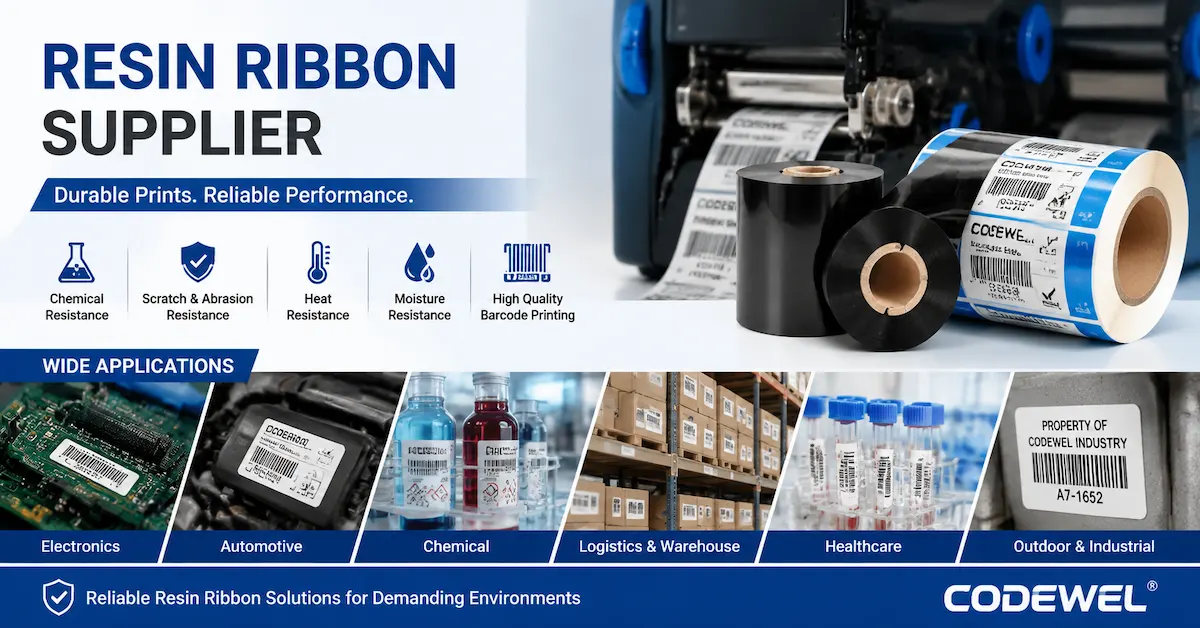
For applications requiring durable synthetic labels, buyers can evaluate resin ribbon solutions.
Why Choose CODEWEL as a Wax Ribbon Manufacturer?
Selecting a manufacturer requires evaluating not only the product but also the supplier's ability to support long-term cooperation.
CODEWEL focuses on helping B2B customers with:
Product Selection Support
Customers can provide:
- Printer model
- Label material
- Ribbon size
- Application requirements
The technical team can help identify suitable ribbon options.
OEM and Custom Manufacturing
CODEWEL supports customized requirements including:
- Ribbon specifications
- Packaging requirements
- Private labeling
- Bulk purchasing solutions
This helps distributors and brands develop their own product offerings.
Stable Supply Capability
For businesses purchasing regularly, supply stability is essential.
A reliable manufacturer should support:
- Repeat orders
- Consistent specifications
- Production planning
- Quality tracking
Technical Application Support
Wax ribbon performance depends on the complete printing system.
CODEWEL can help customers evaluate:
- Printer compatibility
- Label materials
- Ribbon selection
- Printing requirements
For quotation requests or application evaluation, buyers can contact CODEWEL through the contact page.
Wax Ribbon Manufacturer Selection Checklist
Before selecting a supplier, review the following points:
Manufacturing Capability
- Does the supplier control ribbon production?
- Can they maintain stable quality?
- Do they support repeat production?
Product Knowledge
- Can they explain wax, wax resin, and resin differences?
- Can they recommend suitable products?
- Do they understand printer compatibility?
Quality Control
- Are raw materials controlled?
- Is coating quality inspected?
- Are finished rolls tested?
OEM Capability
- Can they customize packaging?
- Can they support private labels?
- Can they manage bulk requirements?
Business Support
- Is technical support available?
- Are lead times clear?
- Is communication efficient?
A manufacturer that meets these requirements is more likely to become a reliable long-term partner.
Frequently Asked Questions About Wax Ribbon Manufacturers
1. What does a wax ribbon manufacturer produce?
A wax ribbon manufacturer produces thermal transfer ribbons using processes such as PET film preparation, wax ink coating, back coating, slitting, rewinding, and quality inspection.
2. What labels are suitable for wax ribbon?
Wax ribbons are commonly used for coated paper, uncoated paper, shipping labels, warehouse labels, retail tags, and general barcode applications.
3. Is wax ribbon compatible with Zebra printers?
Many wax ribbons can be used with Zebra thermal transfer printers, but compatibility should be confirmed based on printer model, ribbon size, and label material.
4. What is the difference between wax ribbon and wax resin ribbon?
Wax ribbon focuses on cost efficiency and paper label printing, while wax resin ribbon provides improved durability and better resistance to scratching and environmental exposure.
5. Can a wax ribbon manufacturer provide OEM services?
Yes. OEM services may include custom sizes, packaging, labels, branding, and specifications depending on supplier capability.
6. How can I evaluate wax ribbon quality?
Test the ribbon on your actual printer and labels. Evaluate print clarity, barcode readability, adhesion, durability, and consistency between samples.
7. What affects wax ribbon pricing?
Pricing depends on:
- Ribbon width
- Ribbon length
- Raw materials
- Order quantity
- Packaging requirements
- Customization needs
8. How do I choose between wax ribbon and resin ribbon?
Choose based on application requirements. Wax is suitable for economical paper labels, while resin is designed for demanding synthetic materials requiring higher resistance.
9. Why is manufacturing consistency important for wax ribbon?
Consistent production ensures that repeat orders provide the same printing performance, reducing adjustments, waste, and customer complaints.
10. How can I request wax ribbon samples from CODEWEL?
Provide your printer model, label material, ribbon specification, and application requirements through the CODEWEL contact page to discuss suitable wax ribbon options.
Conclusion
Choosing the right wax ribbon manufacturer helps businesses achieve reliable barcode printing performance, stable supply, and better long-term purchasing value.
A professional manufacturer should provide more than competitive pricing. Buyers should evaluate manufacturing capability, coating technology, quality control, customization options, technical support, and production consistency.
For logistics, retail, warehousing, and general barcode applications, wax ribbon remains a cost-effective thermal transfer solution.
By working with an experienced supplier, companies can reduce printing problems, improve operational efficiency, and build a more reliable labeling system.
For bulk orders, OEM projects, or application-specific recommendations, contact CODEWEL with your printer model, label material, ribbon specifications, and purchasing requirements.