
How to Choose Thermal Transfer Ribbon for Reliable Printing
When buyers ask how to choose thermal transfer ribbon, the most common mistake is starting with price or simply choosing between wax, wax-resin, and resin.
A thermal transfer ribbon should be selected as part of a complete printing system:
Printer + printhead technology + label material + ribbon formulation + operating conditions + durability requirement
If one of these elements does not match, the ribbon may still produce an image, but that does not mean it is suitable for production.
Common problems caused by an incorrect ribbon selection include:
- Weak barcode contrast
- Smudging or scratching
- Poor ribbon-to-label adhesion
- Inconsistent print density
- Excessive heat settings
- Ribbon wrinkling
- More rejected labels
- Reduced printing speed
- Unnecessary printhead wear
- Unstable performance between repeat orders
For distributors, packaging companies, label converters, warehouses, manufacturers, and OEM buyers, the objective is therefore not simply to find a ribbon that can print.
The objective is to establish a repeatable ribbon specification that works consistently on the actual printer and label material.
Buyers can first review the available thermal transfer ribbon products before narrowing the selection according to their application.
Step 1: Confirm the Printer Before Choosing the Ribbon
Printer compatibility should always be checked before ribbon formulation.
Two ribbons may have the same width and appearance but may still differ in winding direction, core diameter, coating structure, ribbon length, and printhead compatibility.
Confirm the Exact Printer Model
Before requesting samples or quotations, provide the supplier with:
- Printer brand
- Exact printer model
- Print resolution
- Maximum ribbon width
- Ribbon length
- Core diameter
- Ink side
- Printing speed
- Printhead technology
The exact model is more useful than simply saying “Zebra printer,” “barcode printer,” or “thermal printer.”
Different printer models from the same manufacturer may use different ribbon configurations.
Flat-Head and Near-Edge Printers Are Different
Thermal transfer printers generally use either flat-head or near-edge printing technology.
Flat-Head Printing
Flat-head systems are commonly used for:
- Warehouse labels
- Logistics labels
- Product identification
- Inventory labels
- Shipping labels
- Industrial barcode labels
Wax, wax-resin, and resin ribbons are widely available for flat-head systems.
Near-Edge Printing
Near-edge technology is commonly used in higher-speed printing and packaging applications.
Typical applications include:
- Flexible packaging
- Food packaging
- Pharmaceutical packaging
- Date coding
- Batch coding
- TTO printing
Near-edge ribbons are designed differently from conventional flat-head ribbons.
A ribbon that physically fits the printer is not necessarily technically suitable.
Step 2: Identify the Label or Packaging Material
The substrate is one of the most important factors in thermal transfer ribbon selection.
A ribbon that performs well on uncoated paper may not provide sufficient adhesion on PET, PP, PE, coated paper, or flexible film.
Paper Labels
Standard paper labels are usually the least demanding substrates.
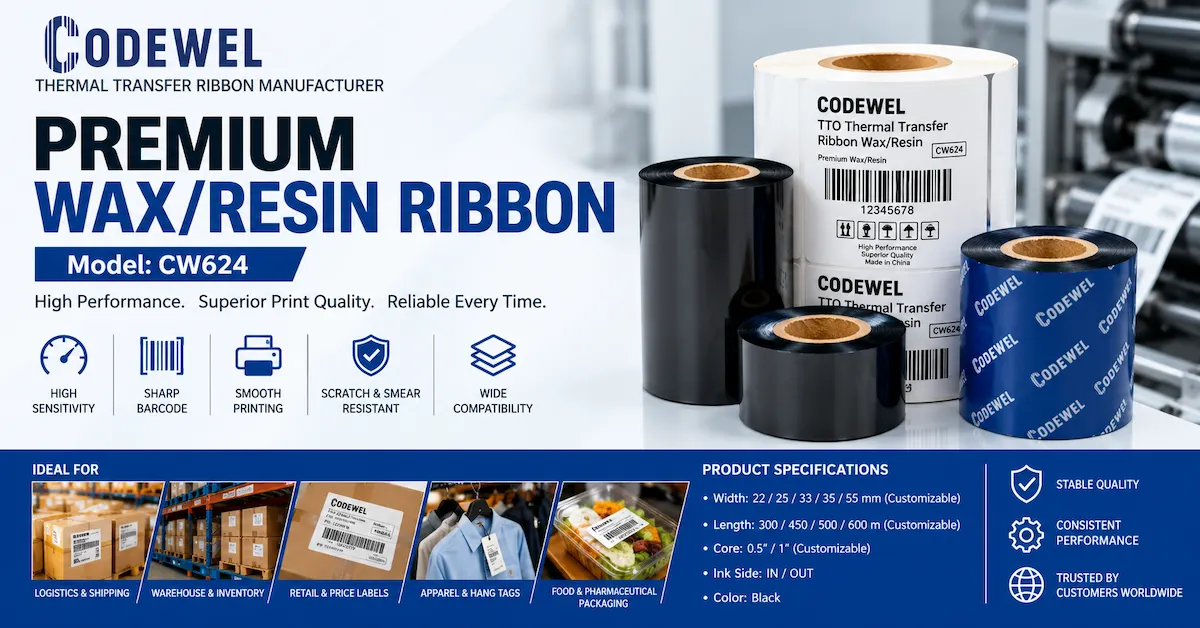
Wax ribbons are commonly evaluated first for:
- Shipping labels
- Carton labels
- Warehouse labels
- Retail labels
- General-purpose barcode printing
If the labels experience significant rubbing or handling, wax-resin may provide a better performance margin.
Coated Paper Labels
Coated paper has a smoother surface than standard uncoated paper.
Depending on the coating and durability requirements, buyers may evaluate:
- Premium wax
- Wax-resin
Wax-resin is often considered when higher scratch resistance or sharper printing is required.
Synthetic Labels
Synthetic materials require more careful evaluation.
Typical materials include:
- PP
- PE
- PET
- Polyester
- PVC
- Synthetic paper
For these substrates, wax-resin or resin ribbon is usually a more suitable starting point than standard wax.
However, material name alone is not enough.
Two PET labels from different suppliers may have different coatings and surface energy, so the final ribbon should always be tested on the actual label stock.
Flexible Packaging Films
Flexible packaging may require TTO or near-edge ribbons.
Selection should consider:
- Film material
- Surface coating
- Packaging machine
- Printing speed
- Coding area
- Heat conditions
- Oil exposure
- Smear resistance
For packaging applications, buyers can also review the TTO thermal transfer ribbon range.
Step 3: Choose Between Wax, Wax-Resin, and Resin Ribbon
This is usually the most important decision in the selection process.
The goal should not be to buy the strongest ribbon.
The goal should be to select the lowest-cost formulation that reliably meets the application requirements.
Wax Thermal Transfer Ribbon
Wax ribbon is typically used for general barcode printing where extreme durability is not required.
Typical Applications
Wax ribbon is often suitable for:
- Logistics
- Warehousing
- Retail
- Shipping
- Inventory control
- General product labeling
Main Advantages
Wax ribbon typically provides:
- Lower material cost
- Good printing on paper
- Lower printing energy
- High-volume printing suitability
- Good general barcode readability
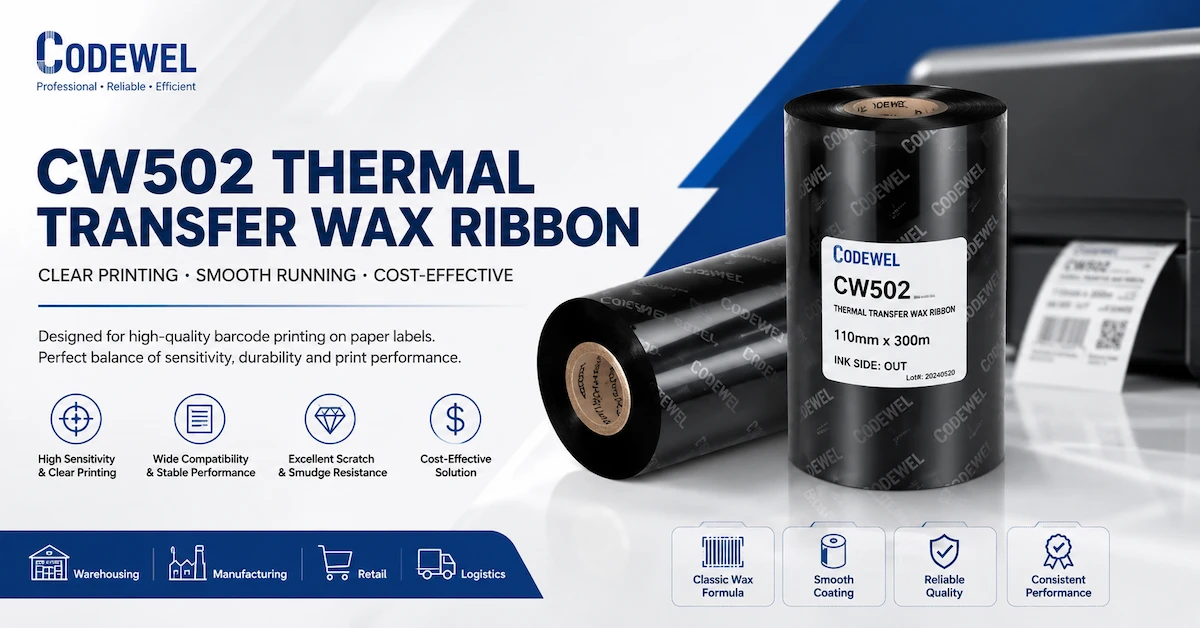
CODEWEL's CW502 thermal transfer wax ribbon is an example of a general-purpose wax ribbon option.
When Wax May Not Be Enough
Wax may not be the best choice if labels must resist:
- Heavy abrasion
- Oil
- Alcohol
- Chemicals
- High heat
- Outdoor exposure
- Long-term industrial use
In these situations, buyers should evaluate wax-resin or resin.
Wax-Resin Thermal Transfer Ribbon
Wax-resin is positioned between wax and resin in both performance and cost.
It is often selected when standard wax does not provide enough durability.
Typical Applications
Wax-resin can be evaluated for:
- Coated paper
- Product labels
- Manufacturing labels
- Logistics labels
- Selected synthetic materials
- Packaging labels
- High-handling applications
Why Buyers Choose Wax-Resin
Wax-resin can offer:
- Better scratch resistance than wax
- Better smear resistance
- Improved print durability
- Good barcode definition
- Wider substrate compatibility
For many industrial buyers, wax-resin provides a useful balance between performance and cost.
Resin Thermal Transfer Ribbon
Resin ribbon is designed for more demanding applications.
It is commonly evaluated where printed information must remain readable after exposure to difficult environmental conditions.
Typical Applications
Resin ribbon may be used for:
- Electronics
- Automotive components
- Chemical labels
- Electrical identification
- Asset tracking
- Cable labels
- Industrial synthetic labels
- High-durability identification
Typical Resistance Requirements
Depending on the ribbon and substrate combination, resin may be selected where resistance is required against:
- Scratching
- Oils
- Alcohol
- Cleaning agents
- Chemicals
- Heat
- Moisture
- Outdoor conditions
Resin is not automatically the correct choice for every synthetic label.
Testing is still necessary.
Step 4: Define the Required Durability
Many RFQs describe the required ribbon as simply “high quality” or “high resistance.”
These descriptions are too vague for accurate product selection.
Instead, define what the printed label must actually survive.
Mechanical Resistance
Ask whether the print will experience:
- Repeated rubbing
- Scratching
- Friction
- Packaging contact
- Conveyor handling
Environmental Resistance
Consider exposure to:
- Water
- Condensation
- Humidity
- High temperature
- Low temperature
- Outdoor environments
Chemical Resistance
If chemical resistance is required, identify the actual substance.
Examples include:
- Alcohol
- Detergents
- Oils
- Grease
- Cleaning chemicals
- Industrial solvents
Saying “chemical resistant” is not enough.
The supplier should know what chemical is involved and how the label will be exposed.
Textile Applications
Textile and wash-care labels may need to withstand:
- Washing
- Detergent
- Dry cleaning
- Ironing
- Repeated flexing
For this type of application, buyers should evaluate dedicated washable thermal transfer ribbon rather than assuming a standard barcode ribbon will work.
Step 5: Confirm Ribbon Width, Length, Core, and Ink Side
After choosing the formulation, the physical specification must also be correct.
A complete thermal transfer ribbon order normally includes:
| Item | Information to Confirm |
|---|---|
| Ribbon type | Wax, wax-resin, resin, TTO, wash-care |
| Width | Required width in mm |
| Length | Required roll length |
| Core | Core diameter or specification |
| Ink side | IN or OUT |
| Printer | Brand and model |
| Substrate | Paper, PET, PP, PE, film, textile, etc. |
| Color | Usually black or required special color |
| Quantity | Sample, trial, and bulk quantity |
How to Select Ribbon Width
The ribbon should adequately cover the print area while remaining compatible with the printer.
A ribbon that is too narrow may leave parts of the printhead unprotected.
A ribbon that is unnecessarily wide can increase material consumption.
For buyers using multiple printers, do not automatically standardize one ribbon width across every machine without testing.
Ink Side In vs Ink Side Out
Thermal transfer ribbons may be coated:
- Ink side in
- Ink side out
The printer determines which configuration is required.
Do not assume based only on ribbon size.
Always verify the exact printer model.
Step 6: Consider Printing Speed and Energy Settings
Ribbon performance is influenced by printing speed and printhead energy.
A ribbon that works at low speed may fail when moved into high-speed production.
Test at Actual Production Speed
Evaluate the ribbon using the same or similar speed expected during normal operation.
Check for:
- Barcode edge quality
- Fine text clarity
- Solid-area coverage
- Ribbon wrinkles
- Missing print
- Smearing
- Inconsistent density
Avoid Using Excessive Heat to Compensate
Increasing print darkness or heat can sometimes make a weak ribbon-substrate combination appear acceptable.
However, excessive energy may create:
- Shorter printhead life
- Ribbon wrinkling
- Poor edge definition
- Excessive buildup
- Reduced production stability
A good ribbon should achieve acceptable quality within reasonable printer settings.
Step 7: Test the Ribbon Before Bulk Purchasing
For B2B procurement, sample testing is one of the most important steps.
Do not move directly from quotation to bulk order without application testing.
Use the Actual Printing System
Whenever possible, test using the real:
- Printer
- Printhead
- Label stock
- Ribbon width
- Printing speed
- Artwork
- Barcode size
- Production settings
The closer the test environment is to real production, the more useful the result will be.
Evaluate More Than Visual Appearance
A ribbon should not be approved simply because one printed label looks dark and clean.
Test:
- Barcode readability
- Fine text
- Edge sharpness
- Solid black areas
- Scratch resistance
- Smear resistance
- Adhesion
- Repeated print consistency
Run More Than a Few Labels
Short tests may hide production problems.
A longer print run can reveal:
- Wrinkling
- Density variation
- Intermittent missing areas
- Heat-related changes
- Alignment issues
- Repeated adjustment requirements
The objective is not to produce one perfect label.
The objective is stable production.
Step 8: Evaluate the Total Printing Cost, Not Only Ribbon Price
For high-volume buyers, ribbon cost per roll is only one part of the actual cost.
A lower-priced ribbon can become more expensive if it creates:
- More waste
- More reprinting
- Lower production speed
- More downtime
- Additional operator adjustment
- Poor barcode readability
- Customer complaints
- Higher printhead consumption
A better metric is:
Cost per acceptable printed label
This makes it easier to compare ribbon options based on real production results.
Do Not Over-Specify the Ribbon Either
The opposite problem also exists.
Some buyers automatically choose resin because they assume it represents the highest quality.
If wax or wax-resin already meets all application requirements, resin may add unnecessary cost.
The correct ribbon is the formulation that meets the required performance with a reasonable safety margin.
Step 9: Check Repeat-Order Consistency
For industrial buyers and distributors, the first approved sample is only part of the purchasing decision.
Repeat-order consistency is equally important.
Evaluate whether the supplier can maintain:
- Ribbon formulation
- Coating quality
- Width tolerance
- Roll length
- Core specification
- Ink side
- Packaging
- Batch identification
- Print performance
Once the ribbon is approved, record the exact specification.
This helps prevent future orders from becoming dependent on descriptions such as:
“same as last time.”
A documented specification is more reliable.
Step 10: Prepare a Complete Thermal Transfer Ribbon RFQ
A detailed inquiry helps suppliers recommend the correct ribbon faster.
Instead of sending:
“Need 110 mm barcode ribbon. Please quote.”
provide a complete application description.
Recommended RFQ Information
Include:
- Printer brand
- Printer model
- Current ribbon model
- Ribbon width
- Ribbon length
- Core size
- Ink side
- Label material
- Application
- Printing speed
- Required resistance
- Quantity
- Annual usage
- Packaging requirements
- Private-label requirements
If the current ribbon model is available, provide that information as well.
For buyers who are still evaluating different ribbon categories, the thermal transfer ribbon product range can be used as a starting point before sample testing.
Thermal Transfer Ribbon Selection Table
| Application | Suggested Starting Point | Main Evaluation |
|---|---|---|
| Standard paper labels | Wax | Print quality and cost |
| Shipping labels | Wax | Barcode readability |
| Coated paper | Wax or wax-resin | Adhesion and scratch resistance |
| High-handling paper labels | Wax-resin | Smear and abrasion resistance |
| PP / PE labels | Wax-resin or resin | Adhesion and durability |
| PET labels | Resin | Scratch and chemical resistance |
| Flexible packaging | TTO wax-resin or resin | Speed, film, and resistance |
| Garment care labels | Wash-care resin | Washing and heat resistance |
| Industrial identification | Resin | Long-term durability |
This table should be used for initial screening only.
Final selection should always be based on testing with the actual printer and substrate.
Common Thermal Transfer Ribbon Selection Mistakes
Choosing Only by Price
Low unit price does not always mean low production cost.
Consider waste, downtime, print quality, and repeatability.
Choosing Resin for Every Application
Higher resistance does not automatically mean better value.
Choose performance according to the application.
Ignoring the Label Material
Printer compatibility alone is not enough.
The ribbon must also match the substrate.
Guessing Ink Side
Ink-side configuration is printer-dependent.
Always confirm IN or OUT before ordering.
Testing on a Different Label
A sample approved on one label material may not behave the same on another.
Use the actual production substrate.
Approving Only One Good Print
Production consistency is more important than a single successful label.
Run a representative test.
FAQ
How do I choose the correct thermal transfer ribbon?
Start with the printer model, then identify the label material, required durability, ribbon dimensions, ink side, and actual operating conditions. Shortlist wax, wax-resin, or resin based on these requirements and confirm the final choice through sample testing.
What is the difference between wax, wax-resin, and resin ribbon?
Wax is generally used for economical paper-label printing. Wax-resin offers improved durability and broader substrate compatibility. Resin is typically used for demanding synthetic labels and applications requiring higher resistance.
Is resin ribbon better than wax ribbon?
Not necessarily. Resin offers greater durability but may be unnecessary for standard paper labeling. The best ribbon is the one that meets the required performance without adding unnecessary cost.
Can wax ribbon print on synthetic labels?
Some combinations may produce an image, but print visibility alone does not confirm suitable adhesion or durability. Synthetic labels usually require wax-resin or resin evaluation.
How do I know whether I need ink side in or out?
The printer determines the required ink-side orientation. Check the printer specification or provide the exact printer model to the ribbon supplier.
What ribbon width should I choose?
The ribbon should cover the required print area while remaining compatible with the printer's ribbon path. Avoid choosing a ribbon that is too narrow or unnecessarily wide.
Why does my thermal transfer print smear?
Possible causes include an unsuitable ribbon-substrate combination, incorrect print energy, excessive speed, insufficient durability, or environmental conditions.
Why does thermal transfer ribbon wrinkle?
Possible causes include ribbon tension, loading, alignment, incorrect width, printer condition, media path, or excessive heat.
Should I test thermal transfer ribbon before a bulk order?
Yes. B2B buyers should test the actual ribbon on the real printer and label material under representative production conditions before approving bulk purchasing.
What information should I provide to a thermal transfer ribbon supplier?
Provide the printer model, ribbon dimensions, core, ink side, label material, application, resistance requirements, quantity, and any OEM or packaging requirements.
Conclusion
Understanding how to choose thermal transfer ribbon requires more than deciding between wax, wax-resin, and resin.
A reliable selection process should begin with the printer, followed by the label material, durability requirements, ribbon dimensions, ink side, production speed, and operating environment.
For B2B buyers, the most important step is to validate the ribbon under real production conditions before bulk ordering.
A correctly selected ribbon should provide not only good print quality, but also stable barcode readability, repeatable production, appropriate durability, and predictable purchasing costs.
Buyers starting a new ribbon project can first compare the thermal transfer ribbon range, then provide the printer model, label material, ribbon dimensions, application, durability requirements, and estimated purchasing quantity to identify suitable samples for evaluation.