
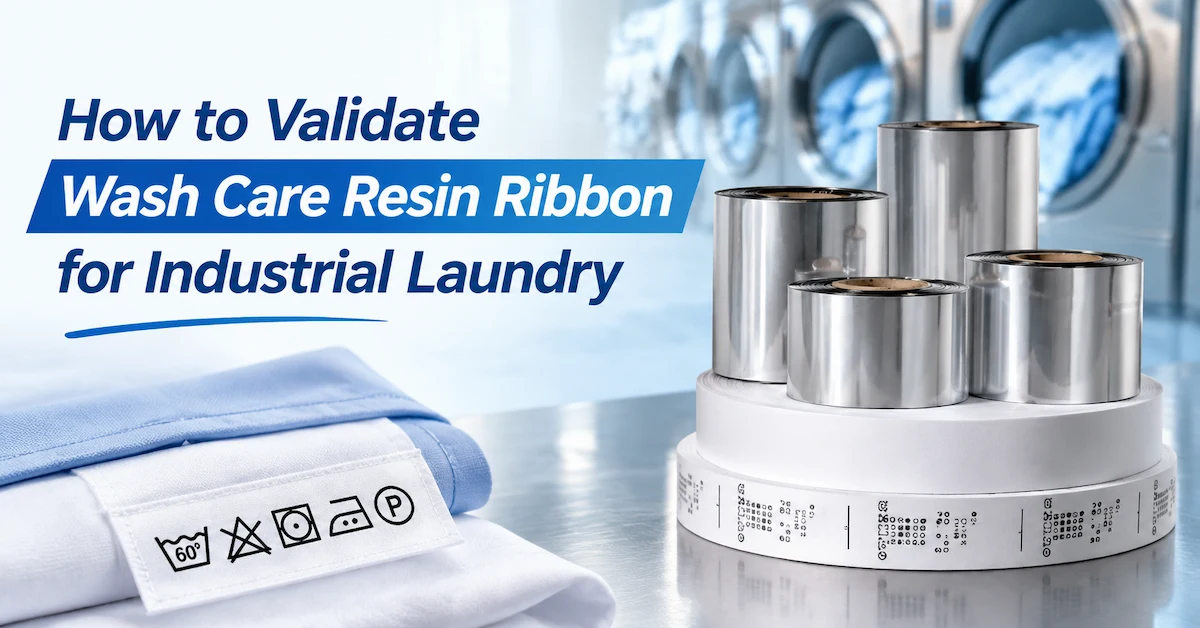
Wash care resin ribbon testing is not the same as checking whether a label looks dark immediately after printing. Industrial laundry labels must keep their identity and care information after repeated handling, washing, drying, pressing, chemical exposure, and contact with other garments or equipment. The correct validation method therefore evaluates the complete system: printer, printhead, ribbon, textile label, print settings, laundering process, and reading method.
This guide is written for industrial laundry operators, uniform and workwear suppliers, textile manufacturers, healthcare laundries, hospitality laundries, label converters, and distributors sourcing washable textile identification. It explains how to define the test, select a suitable wash care resin ribbon, prepare samples, simulate service exposure, record failure modes, compare models, and convert the approved result into a repeat-order specification.
Codewel's published wash care range includes resin ribbon products intended for garment and textile labels. The public product data describes applications on nylon tape, TPU labels, polyester tape, satin, and silk ribbon, with options such as CW803, CW806, CW808, and CW812. Those published starting points should be confirmed with a project-specific sample because label construction, printer settings, wash chemistry, and process severity vary between laundries. Review the Wash Care Resin Ribbon product category before preparing a technical request.
Why Industrial Laundry Requires a Different Validation Standard
A garment care label and an industrial laundry identifier may share the same basic printing technology, but their service conditions can be very different. A retail care label may be read by a consumer and washed occasionally. A healthcare, hospitality, rental-uniform, or linen operation may process the same item repeatedly, sort it through a high-volume system, expose it to heat and chemicals, and rely on the printed information for inventory, ownership, patient or room allocation, or process control.
Failure is not limited to visible ink loss. A label can remain black and still fail because small characters close up, a barcode no longer scans, the textile tape frays, or the attachment releases. A credible test separates ink performance from label construction and records both.
| Service risk | What can fail | What the test should observe |
|---|---|---|
| Water washing | Fading, bleeding, image loss, edge damage, or barcode degradation. | Contrast, small text, barcode readability, label condition, and change after each defined cycle. |
| Dry cleaning | Solvent attack, smearing, loss of adhesion, or surface change. | Image integrity and scan performance after the selected solvent process. |
| Heat and ironing | Transfer softening, distortion, or heat damage to the label. | Text shape, barcode edges, label deformation, and post-press readability. |
| Mechanical abrasion | Surface wear, partial characters, or unreadable narrow bars. | Controlled rubbing result and scan performance at the defined endpoint. |
| Repeated handling | Cracking, curling, fraying, or attachment failure. | Physical label condition and the relationship between print and substrate durability. |
Define the Laundry Application Before Testing
The most common testing mistake is to choose a ribbon first and define the laundry process later. Begin with the item and the workflow. A uniform, towel, bed linen, surgical textile, rental garment, or cleaning cloth may use a different label material, attachment method, print density, and exposure profile. The same CW model can produce different results when printed on a dense satin tape versus a sparse woven tape.
Record the label and printer configuration
- Textile material: satin, nylon, polyester, TPU, woven tape, or another construction.
- Label width, printable width, label thickness, surface texture, and attachment method.
- Printer brand and exact model, printhead DPI, print direction, and ribbon path.
- Ribbon model, width, length, core, ink side, winding direction, and batch reference.
- Artwork elements: care symbols, alphanumeric text, logo, serial number, 1D barcode, or 2D code.
- Print speed, heat or darkness, pressure, gap, sensor settings, and any pre-treatment.
Record the laundry exposure
Describe the real process instead of using only the word washable. Record the wash temperature, detergent or alkaline chemistry, bleach or oxidizer exposure if applicable, wash time, mechanical action, rinse, drying temperature, pressing or ironing temperature, number of cycles, dry-cleaning solvent, and expected storage period. If the laundry process differs by customer or region, create separate test profiles rather than treating one result as universal.
If the label supports automated sorting or inventory, record the actual scanner, distance, orientation, lighting, and software rule. A visual check is not equivalent to a production scan.
Choose the Wash Care Resin Ribbon Candidate
Wash care resin ribbon testing should compare a small number of technically plausible candidates rather than every ribbon in a catalogue. A wash care resin formulation is intended for textile identification where water washing, dry cleaning, ironing, abrasion, or heat resistance may be important. The correct model depends on the label surface, print density, sensitivity, printer energy window, and exposure severity.
| Candidate type | Useful starting point | Questions to verify in the trial |
|---|---|---|
| Standard wash care resin | General garment and textile care-label printing. | Does it transfer cleanly to the textile surface at the required speed and remain readable after the defined wash cycles? |
| High-sensitivity wash care resin | Dense washable labels, sparse woven tapes, or applications where a broad media response is needed. | Can the printhead produce solid characters without excessive energy, smearing, or buildup? |
| Colored wash care resin | Care labels or textile marks that require colors such as white, red, blue, or another approved shade. | Does the color remain distinct after the actual wash, dry-cleaning, ironing, and abrasion exposure? |
| Custom width or core | Printers or labels requiring a defined roll format or private-label configuration. | Are dimensions, ink side, winding, packaging, and repeat-order identification controlled? |
Published Codewel data lists CW803 as a colored wash care resin for nylon tape, TPU labels, and polyester or satin tape, with an advertised printing speed range of 0–6 IPS and heat resistance information in the product specification. CW806 is described for difficult-to-print wash labels and textile substrates, including clear small lettering. CW808 is described for washable satin or cloth labels, with a published speed range of 0–4 IPS. CW812 is described for washable labels and woven tapes and includes water-washing, dry-cleaning, and sand-washing application language. These are product-page starting points, not a substitute for testing the buyer's exact process.
Build a Controlled Wash Care Resin Ribbon Testing Protocol
A good protocol is specific enough that another operator can repeat it. It identifies the sample, the printing conditions, the exposure method, the inspection points, and the pass or fail decision. Avoid changing the ribbon, label, printer setting, and laundry cycle at the same time. Change one controlled variable at a time when troubleshooting.
Stage 1: Prepare and identify samples
Cut or print enough samples for the initial condition, each exposure checkpoint, and a retained reference. Mark the ribbon model, batch, label material, printer, date, and test profile. Include a control sample using the current approved ribbon when one exists. A control allows the buyer to distinguish a new candidate's performance from a change in the laundry process.
Stage 2: Print representative artwork
Use the smallest text, narrowest barcode, densest care symbols, logo, and variable fields used in production. Include the characters most likely to fill in or break up. Print at normal production speed and at the planned heat or darkness setting. If the process has a low and high operating condition, test both to understand the usable window.
Stage 3: Inspect before exposure
Record print density, edge definition, small-character clarity, barcode readability, color uniformity where applicable, smearing, pinholes, wrinkles, and ribbon tracking. Inspect the back of the label for unwanted transfer or residue. Check whether the printhead shows buildup after a realistic run. A ribbon that fails before washing should not move to an exposure test.
Stage 4: Apply the real laundry cycle
Use the same label attachment and garment construction expected in service when possible. Run samples through the defined wash, dry, press, or dry-cleaning process. Do not describe a test as “industrial laundry tested” without recording the actual cycle. If the buyer has several customers with different chemistry or temperature, test the most severe approved profile and keep separate results for other profiles.
Stage 5: Inspect at planned checkpoints
Check the label immediately after printing, after the first cycle, after an intermediate cycle, and at the required final cycle. Record visual condition, text readability, barcode or 2D-code reading, color or contrast, curling, fraying, attachment, and any transfer to neighboring material. Photograph the same area under consistent lighting so that changes are comparable.
Stage 6: Retain and report
Keep the initial print, the final exposed label, the control sample, the ribbon packaging, the media sample, and the test record together. The report should state the model, batch, printer settings, label construction, laundering profile, exposure count, inspection method, result, operator, date, and any deviation. This becomes the technical reference for purchasing and future complaints.
Test the Complete Print Window, Not Only Maximum Darkness
Thermal transfer printing is a balance between ribbon transfer, media response, speed, pressure, and heat. Too little energy can create a pale or incomplete image. Too much energy can increase smearing, reduce fine detail, add residue, or place unnecessary load on the printhead. The best wash care resin ribbon is the one that provides a stable, readable image within the operating window available on the production printer.
| Variable | Low-setting symptom | High-setting symptom | What to record |
|---|---|---|---|
| Heat or darkness | Light characters, incomplete fill, weak barcode contrast. | Smear, excess buildup, filled-in small text, or distortion. | Setting, image result, scan result, and acceptable range. |
| Print speed | May hide the intended production limit if tested too slowly. | Incomplete transfer, tracking instability, or weak edge definition. | Normal speed, peak speed, and result at each setting. |
| Pressure and alignment | Missing areas or uneven density across the label. | Media damage, excess friction, or unnecessary component wear. | Printer setup, media path, pressure state, and defect location. |
| Printhead condition | Existing contamination can be mistaken for ribbon weakness. | A worn element can create repeating missing lines. | Cleaning status, DPI, replacement history, and control result. |
Run a small matrix rather than changing settings informally. For example, print the same artwork at the planned speed with two or three energy levels, then identify the lowest setting that produces a complete readable image and the highest setting that avoids smearing or buildup. The exact values are printer- and media-specific and should be recorded as part of the approved configuration.
How to Test Washing, Dry Cleaning, and Ironing
Each exposure should have a defined objective. “Wash resistance” can mean a label survives one gentle cycle, repeated commercial laundering, or a particular high-temperature process. Those are different claims. A practical validation plan uses the buyer's process and reports the conditions rather than assigning a universal pass number.
Water-washing test
Use the actual textile substrate and attachment method. Record the wash temperature, detergent, alkalinity if known, mechanical action, cycle duration, drying method, and number of cycles. Inspect both the ink and the label. A printed code may remain readable while the tape edge frays or the label detaches, which is still a system failure.
Dry-cleaning test
Identify the solvent or cleaning process used by the target laundry. Check for bleeding, image softening, surface change, and loss of attachment. If a customer uses several dry-cleaning profiles, document the one used for approval and do not extend the result to an untested solvent without technical evidence.
Ironing and heat test
Record the iron or press temperature, contact time, pressure, and whether the label contacts another textile. Codewel product pages publish heat-resistance starting values for wash care models, but the actual result depends on the printed label construction and exposure. Inspect character shape, barcode edges, label deformation, and any transfer or sticking after the heat step.
Abrasion and handling test
Textile labels rub against garments, drums, conveyors, hands, and other items. Use a defined rubbing motion, load, surface, and number of passes where a formal abrasion method is not already specified by the customer. Record the visual endpoint and scanner result. A label that is still dark but no longer scans should fail the barcode requirement.
Set Pass and Fail Criteria Before the Trial
Testing becomes useful when the decision rules are written before the samples are exposed. A pass criterion should describe the minimum acceptable print and label condition. The threshold may differ by application, but it should be objective enough for quality and purchasing teams to use on a future batch.
| Quality area | Example acceptance question | Record |
|---|---|---|
| Text | Are all required characters complete and readable at the planned inspection distance? | Artwork version, image, and operator result. |
| Barcode | Does the production scanner or verifier read the code after the defined exposure? | Scanner, distance, orientation, result, and failure count. |
| Contrast or color | Does the image remain distinct enough for the application after washing, dry cleaning, or ironing? | Initial and final comparison under consistent lighting. |
| Physical label | Does the tape, label, attachment, and edge remain serviceable? | Fraying, curling, detachment, shrinkage, or distortion. |
| Printer behavior | Does the ribbon run without abnormal wrinkles, breaks, buildup, or tracking? | Run length, settings, printhead state, and observed defects. |
| Repeatability | Do separate rolls or batches produce the same approved result? | Roll code, batch, retained sample, and comparison notes. |
Define critical defects separately from cosmetic defects. An unreadable code, missing mandatory care symbol, transfer to the garment, or label detachment may be a critical failure even if the overall label still appears acceptable. If a sample fails, record the failure mode and investigate printer, media, attachment, and process variables before changing the ribbon formulation.
Compare Wash Care Resin Models Without Overclaiming
Use product descriptions to choose samples, not to skip validation. CW803 is positioned for colored printing on nylon, TPU, polyester, or satin; CW806 for difficult wash labels and small text; CW808 for washable satin or cloth; and CW812 for garment, satin, nylon, and woven materials, including water-washing, dry-cleaning, and sand-washing applications. Compare candidates with the same printer, artwork, label, settings, and exposure. If the material changes, restart the comparison.
For model-specific sourcing, request the printer model, label material, artwork, exposure, ribbon dimensions, and color. The Wash Care Resin Ribbon category is the commercial starting point; the individual CW pages provide model-level fields for review.
Convert the Approved Test Into a Purchasing Specification
A successful trial is not complete until purchasing can reproduce it. Create a technical specification linked to the product code and quotation so repeat orders cannot drift in width, core, ink side, packaging, or material.
- Approved wash care resin model and color.
- Ribbon width, length, core, roll diameter, ink side, and winding direction.
- Printer model, printhead DPI, speed, heat or darkness, pressure, and print direction.
- Label material, label dimensions, attachment method, and artwork version.
- Approved wash, dry-cleaning, ironing, abrasion, and storage profile.
- Pass criteria for text, barcode or 2D code, color, physical label condition, and printer behavior.
- Retained golden sample, product label, batch or lot identification, and packaging reference.
- Change-control rule for formulation, raw materials, coating, slitting, core, packaging, or production location.
Keep commercial fields separate but connected: MOQ, sample terms, price, lead time, freight, warranty, private-label packaging, and forecast quantity should be confirmed in the project quotation. A product page can help define the candidate, but it should not be treated as a substitute for current order-specific confirmation.
Common Wash Care Resin Ribbon Testing Mistakes
Testing only the ink, not the label system
A durable printed image cannot compensate for a label that detaches, frays, curls, or shrinks. Test the label construction and attachment method as part of the same service profile.
Using “washable” as the entire specification
Washable may mean different water temperatures, chemicals, cycle counts, and drying conditions. Write the actual exposure profile and keep the result tied to that profile.
Ignoring the printhead condition
Contamination or worn elements can create missing lines and weak density that may be incorrectly blamed on the ribbon. Clean and inspect the printhead, then use a control ribbon where possible.
Frequently Asked Questions
What is wash care resin ribbon testing?
It is a controlled validation of a resin thermal transfer ribbon on a textile label, followed by the washing, dry-cleaning, ironing, abrasion, or storage exposure expected in service. The result should include print quality, readability, physical label condition, printer behavior, and repeatability.
Which labels are suitable for wash care resin ribbon?
Wash care resin ribbon is commonly evaluated on satin, nylon, polyester, TPU, woven tape, and other textile label materials. The actual suitability depends on surface, construction, printer, settings, and the laundry process, so a sample trial is required.
What printer settings matter during testing?
Record printer model, printhead DPI, speed, heat or darkness, pressure, print direction, ribbon path, and sensor settings. A stable result depends on the complete printer, ribbon, media, and setting combination.
How do I test a wash care resin ribbon for dry cleaning?
Identify the actual dry-cleaning solvent and process, print representative artwork on the target label, expose it under the defined condition, and inspect image integrity, readability, smearing, surface change, and attachment. Confirm results for any different solvent profile separately.
What should I request when ordering a sample?
Provide the printer model, printhead DPI, label material, label width, artwork, ribbon width and core, ink side, color, print speed, heat setting, wash or dry-cleaning profile, cycle requirement, and scanner or readability criteria.
How should repeat orders be controlled?
Approve the complete SKU, including model, color, dimensions, core, ink side, packaging, batch identification, printer settings, label material, exposure profile, pass criteria, and retained sample. Require change communication for anything that can affect printing or durability.
Conclusion
Wash care resin ribbon testing should prove more than immediate blackness. It should show that the complete textile label system remains readable, attached, and operational after the industrial laundry exposure it is expected to survive. Start with the actual label and printer, define the wash, dry-cleaning, ironing, abrasion, and storage profile, print demanding artwork, record the settings, inspect at planned checkpoints, and keep a golden sample.
For a sourcing project, use the approved test to create a repeatable specification covering model, color, dimensions, core, ink side, label material, printer settings, exposure profile, pass criteria, packaging, and change control. Review the Codewel Wash Care Resin Ribbon range and send the technical team your printer, textile label, artwork, laundry process, and forecast so the candidate can be validated against the real application.