
How to Select Barcode Printing Supplies Without Increasing Printing Costs
Selecting barcode printing supplies is not simply a matter of finding the lowest price per roll or choosing a compatible printer accessory.
For a B2B buyer, the more important question is:
Will the complete printing combination consistently produce readable labels at the required speed, durability, and operating cost?
A barcode printing system normally involves several connected components:
- Barcode printer
- Thermal transfer ribbon or direct thermal media
- Label material
- Printhead
- Printer spare parts
- Barcode scanner or verification equipment
- Printing software and data system
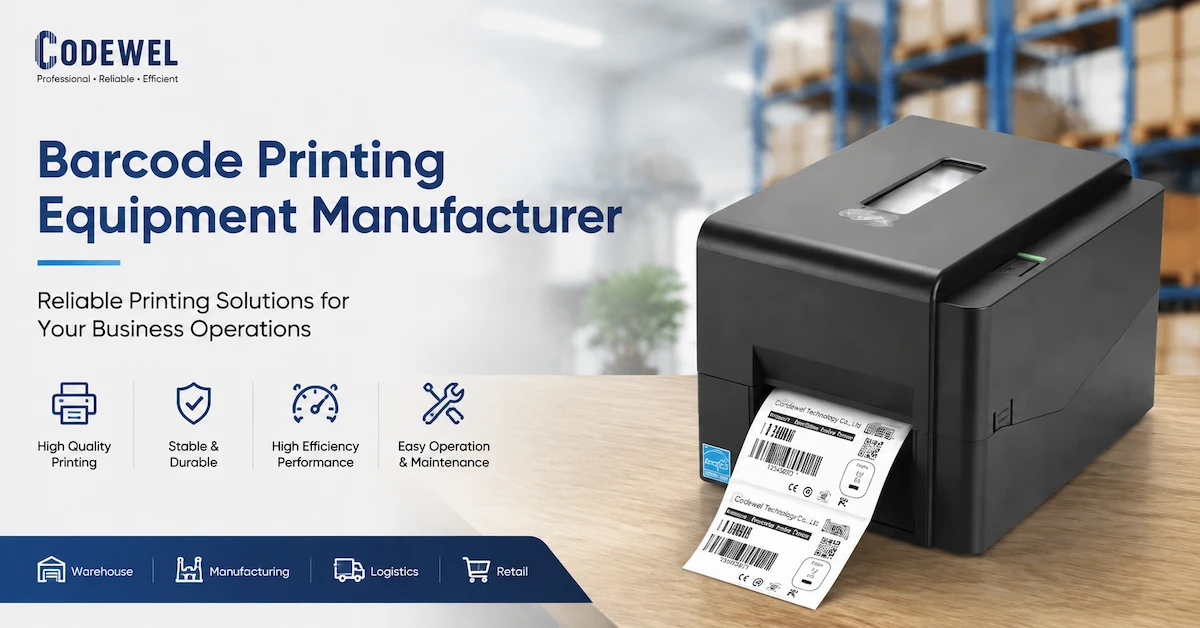
CODEWEL's current product portfolio covers barcode ribbons, printheads, printing consumables, printers, printer spare parts, barcode scanners, and related machines.
This means buyers should evaluate barcode printing supplies as a system, not as isolated products.
The selection process below is designed for manufacturers, importers, distributors, label converters, logistics companies, retailers, warehouses, and barcode solution providers.
Start With the Printing Application
Before comparing products, define what the barcode label must accomplish.
This is the first step because the correct ribbon, label, printer, and printhead depend heavily on the application.
Identify What You Need to Print
Ask:
- Product identification labels?
- Shipping labels?
- Warehouse labels?
- Inventory labels?
- Asset tags?
- Serial-number labels?
- Packaging labels?
- Medical identification?
- Electronics labels?
- Automotive parts labels?
- Textile or wash-care labels?
A shipping label and an automotive identification label may both contain a barcode, but they can require completely different printing materials.
Define the Required Label Life
Determine whether the label needs to remain readable for:
- Several days
- Several weeks
- Several months
- Several years
Short-life logistics labels may not require the same durability as industrial asset labels.
This single factor can significantly influence whether direct thermal or thermal transfer printing is appropriate.
Consider the Working Environment
Check whether the finished label will be exposed to:
- Abrasion
- Moisture
- Heat
- Chemicals
- Solvents
- Sunlight
- Repeated handling
- Outdoor conditions
The more demanding the environment, the more important ribbon formulation and label substrate selection become.
Understand the Main Types of Barcode Printing Supplies
For thermal barcode printing, the most important supplies can be divided into several categories.
| Supply | Main Function | Key Selection Factors |
|---|---|---|
| Thermal transfer ribbon | Transfers ink to label | Formula, width, length, core, ink side |
| Direct thermal media | Creates image without ribbon | Thermal coating, label life, environment |
| Label material | Carries printed information | Paper, PET, PP, PE, textile, etc. |
| Printhead | Applies heat during printing | Model, DPI, width, compatibility |
| Printer | Produces the label | Speed, volume, resolution, media capacity |
| Spare parts | Maintains printer operation | Compatibility, availability, service life |
| Barcode scanner | Reads printed codes | Barcode type, resolution, verification needs |
A common procurement mistake is to approve each component separately.
A better approach is to qualify the printer + printhead + ribbon + label combination together.
Choose Between Direct Thermal and Thermal Transfer Printing
One of the first technical decisions is whether your application needs a ribbon.
Direct Thermal Printing
Direct thermal printing uses heat-sensitive media and does not require a thermal transfer ribbon.
It can be suitable for:
- Shipping labels
- Receipts
- Temporary inventory labels
- Tickets
- Short-term logistics identification
The advantage is a simpler consumable system because there is no ribbon to purchase, install, or dispose of.
However, the printed image may be more vulnerable to environmental exposure depending on the media and application.
Thermal Transfer Printing
Thermal transfer printing uses a ribbon to transfer ink onto the label.
It is generally more appropriate when the printed information needs stronger durability or when the application uses synthetic materials.
Typical applications include:
- Product identification
- Manufacturing traceability
- Asset tracking
- Electronics
- Automotive
- Chemical packaging
- Durable warehouse labels
- Textile and wash-care labels
For these applications, the ribbon formulation becomes one of the most important barcode printing supplies to qualify.
How to Select the Right Thermal Transfer Ribbon
Thermal transfer ribbons are not interchangeable simply because they fit the same printer.
The three major general-purpose formulations are wax, wax-resin, and resin.
Wax Ribbon
Wax is commonly selected for economical printing on paper-based labels.
Typical applications include:
- Shipping labels
- Warehouse labels
- Inventory labels
- General barcode labels
- Retail tags
Advantages include:
- Lower cost
- Lower print energy requirements
- Good performance on suitable paper
- High-speed printing potential
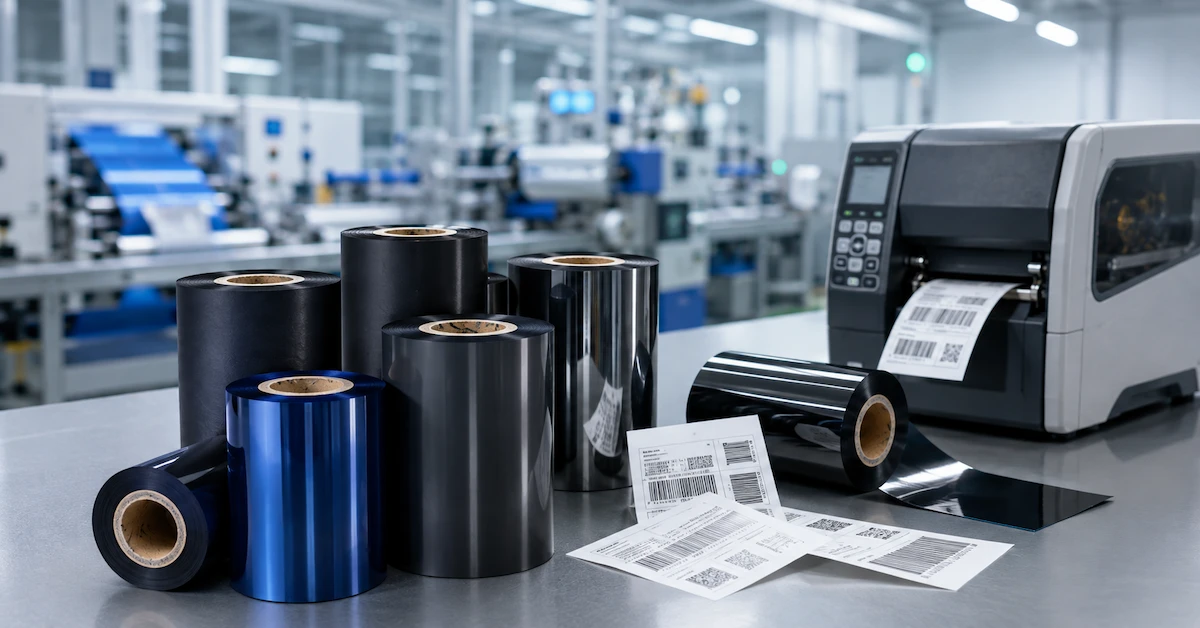
CODEWEL's current ribbon portfolio includes standard and premium wax formulations such as CW500/CW501 and CW518/CW520.
Wax-Resin Ribbon
Wax-resin provides a balance between print performance, durability, and cost.
It can be considered for:
- Coated paper
- Product labels
- Warehouse labels
- Manufacturing identification
- Tickets and waybills
It generally offers better resistance than standard wax while remaining more economical than some high-performance resin applications.
CODEWEL lists standard, premium, super wax-resin, and near-edge/TTO formulations, including CW603, CW630, CW638/CW639/CW641 and related products.
Resin Ribbon
Resin is generally selected when the printed label needs stronger resistance.
Common applications include:
- Electronics
- Automotive
- Chemical products
- Electrical components
- Outdoor identification
- Durable asset labels
CODEWEL's CW709 standard resin ribbon, for example, is specified for applications requiring abrasion, moisture, sunlight, and scratch resistance, with customizable widths, lengths, cores, and colors.
Ribbon Selection Matrix
| Requirement | Recommended Starting Point |
|---|---|
| Low-cost paper labels | Wax |
| General warehouse labels | Wax / Wax-Resin |
| Coated paper product labels | Wax-Resin |
| Better scratch resistance | Wax-Resin / Resin |
| PET or synthetic labels | Resin |
| Chemical exposure | Resin |
| Outdoor identification | Resin |
| Wash-care textile labels | Wash-care resin |
| TTO / near-edge printing | Dedicated TTO ribbon |
This table is a starting point, not a substitute for application testing.
Match the Ribbon to the Label Material
One of the most important rules when selecting barcode printing supplies is:
Do not select the ribbon before confirming the label substrate.
Common substrates include:
- Coated paper
- Uncoated paper
- Thermal paper
- PET
- PP
- PE
- PVC
- Textile materials
For example, a standard wax ribbon may be an economical choice for paper labels but may not provide the required resistance on a synthetic label used in a harsh environment.
Why Substrate Compatibility Matters
The ribbon must transfer properly to the label surface.
An unsuitable combination can cause:
- Weak print density
- Smearing
- Poor adhesion
- Scratching
- Unreadable barcodes
- Increased printer heat requirements
- Excessive printhead wear
A professional barcode printing supplies supplier should therefore ask for the label material before recommending a ribbon.
Match the Ribbon to the Printer
Physical dimensions are only the beginning.
Before placing a bulk order, confirm:
- Printer brand
- Printer model
- Flat-head or near-edge technology
- Printhead DPI
- Maximum print width
- Ribbon width
- Ribbon length
- Core diameter
- Ink-side orientation
- Print speed
- Print energy
CODEWEL's product range currently includes printer categories for Zebra, TSC, Codewel, POS, and TTO printers, as well as a wide range of printheads for major printer families.
Flat-Head vs Near-Edge
This distinction is especially important for industrial buyers.
Standard flat-head thermal transfer systems and near-edge/TTO systems should not automatically use the same ribbon.
Near-edge printing can involve:
- Higher printing speeds
- Different ribbon transfer characteristics
- Flexible packaging applications
- Automated production lines
Therefore, the supplier should confirm the actual printer technology before finalizing the ribbon specification.
Select the Correct Printhead
The printhead is another critical component of barcode printing supplies.
It directly affects:
- Print clarity
- Barcode definition
- Printing stability
- Print resolution
- Printer service life
Check Printer Model Compatibility
Always provide the exact printer model when purchasing a replacement printhead.
Also confirm:
- DPI
- Print width
- Connector
- Mounting structure
- Printer generation
- Compatible ribbon/media
CODEWEL's printhead category includes options for Zebra, TSC, Datamax, SATO, Honeywell Intermec, Citizen, Argox, Godex, Toshiba, CAB, Videojet, Domino, and other printer systems.
When Should You Replace a Printhead?
Typical warning signs include:
- Repeated vertical white lines
- Missing barcode elements
- Uneven darkness
- Reduced print quality
- Increased need for printhead pressure
- Printing problems that remain after cleaning and calibration
Replacing the printhead at the appropriate time can prevent repeated label rejection and production interruptions.
Select the Printer According to Print Volume
The printer itself should be considered part of the overall barcode printing supply chain.
Low to Medium Volume
Desktop thermal printers may be suitable for:
- Offices
- Small warehouses
- Retail locations
- E-commerce fulfillment
- Light manufacturing
High Volume
Industrial printers are more appropriate when the operation involves:
- Continuous printing
- Multiple shifts
- High daily label volume
- Large media rolls
- Production-line integration
The correct question is not:
“Which printer has the highest speed?”
Instead ask:
“Which printer can reliably handle our actual daily workload and media requirements?”
CODEWEL currently lists printer categories including Zebra Printer, TSC Printer, Codewel Printer, POS Printer, and TTO Printer.
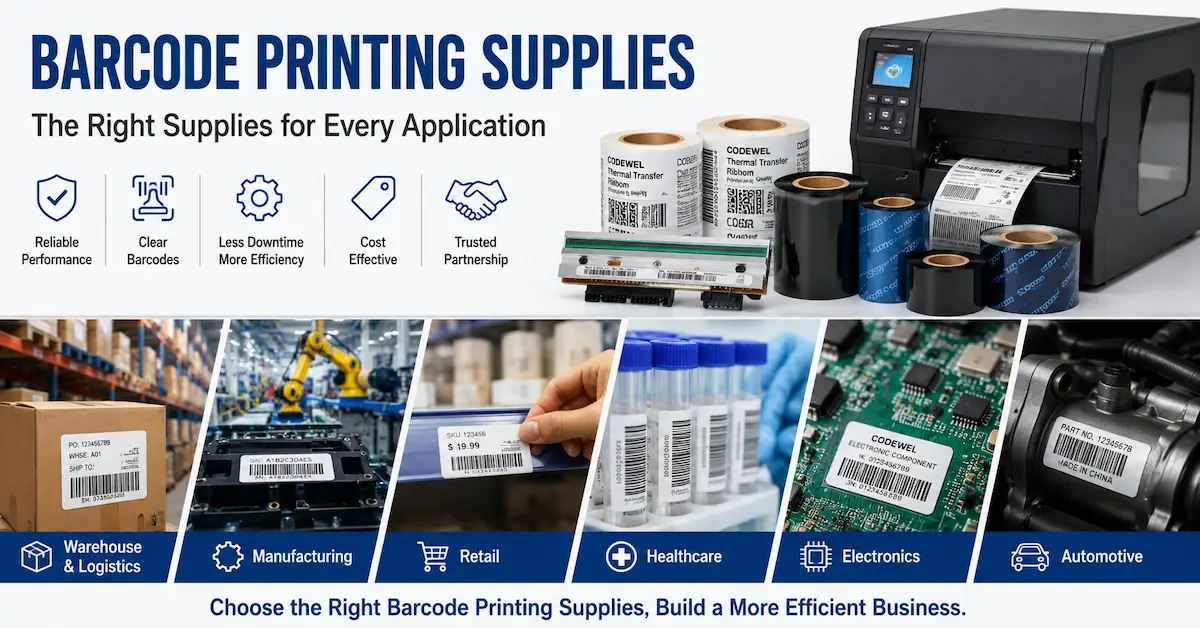
Choose Barcode Printing Supplies by Application
Different industries prioritize different performance characteristics.
Logistics and Warehousing
Typical supplies:
- Wax ribbon
- Wax-resin ribbon
- Paper labels
- Direct thermal labels
Main priorities:
- Cost per label
- Printing speed
- Barcode readability
- Stable supply
- Easy replacement
Manufacturing
Typical supplies:
- Wax-resin ribbon
- Resin ribbon
- Coated labels
- Synthetic labels
Main priorities:
- Traceability
- Durability
- Stable printing
- Serial-number readability
Electronics
Typical requirements include:
- Small labels
- High-resolution printing
- PET or synthetic media
- Resin ribbon
Main priorities:
- Fine print detail
- Chemical/abrasion resistance
- Long-term identification
Automotive
Applications may require:
- Durable component labels
- Synthetic materials
- Resin ribbon
- High-quality barcode printing
The label may need to remain readable during transportation, storage, or repeated handling.
Healthcare
Healthcare and laboratory applications can include:
- Sample identification
- Patient labels
- Medication labels
- Asset identification
The selection should focus on reliable barcode readability and appropriate media compatibility.
Retail
Retail applications may use:
- Price tags
- Shelf labels
- Inventory labels
- Product identification
Cost efficiency and easy printing are often important.
Evaluate Barcode Printing Supplies by Total Cost
The cheapest roll is not necessarily the cheapest solution.
A more useful purchasing calculation is:
Total Printing Cost = Product Cost + Label Waste + Reprints + Printhead Wear + Downtime + Labor
Example of Hidden Cost
Suppose a cheaper ribbon causes:
- More barcode failures
- More printer adjustments
- Higher printhead wear
- More rejected labels
The lower unit price may disappear once these costs are included.
This is why B2B buyers should compare the cost per usable label, rather than only the cost per roll.
What Quality Controls Should a Supplier Provide?
A serious barcode printing supplies supplier should be able to explain how product consistency is controlled.
For thermal transfer ribbons, buyers can ask about:
- Raw-material inspection
- Coating consistency
- Ribbon thickness
- Slitting accuracy
- Winding tension
- Edge quality
- Roll dimensions
- Print performance
- Lot traceability
Poor slitting or winding can contribute to:
- Ribbon wrinkles
- Tracking problems
- Uneven feeding
- Printer interruptions
For critical applications, sample testing should be completed before a large-volume order.
Why Sample Testing Should Come Before Bulk Purchasing
A sample is not just a free trial.
It should answer specific procurement questions:
- Does the ribbon print clearly?
- Does the barcode scan reliably?
- Does it work at the required speed?
- Does it work on the actual label material?
- Does it require excessive heat?
- Does it cause ribbon wrinkling?
- Does it protect the printhead adequately?
- Does the result remain acceptable after handling?
The strongest qualification method is:
Actual Printer + Actual Printhead + Actual Ribbon + Actual Label
This produces more useful purchasing information than a generic supplier specification sheet.
What Should You Ask a Barcode Printing Supplies Supplier?
Before requesting a quotation, prepare a technical RFQ.
| Information | Example Requirement |
|---|---|
| Printer | Brand + exact model |
| Printhead | Model + DPI |
| Printing method | Thermal transfer / direct thermal |
| Ribbon type | Wax / Wax-Resin / Resin / TTO |
| Ribbon width | Required width |
| Ribbon length | Required length |
| Core | 0.5", 1",or customized |
| Ink side | IN / OUT |
| Label material | Paper / PET / PP / Textile |
| Label size | Width × length |
| Print speed | Required IPS |
| Environment | Indoor / outdoor / chemical / heat |
| Daily volume | Labels per day |
| Order quantity | Trial + forecast bulk quantity |
| Packaging | Standard / private label |
| Destination | Country / market |
| OEM | Required or not |
The more complete the RFQ, the easier it is to compare suppliers on an equal basis.
How to Compare Barcode Printing Supplies Suppliers
Do not evaluate suppliers only by quotation price.
Use these criteria:
Product Range
Can the supplier provide:
- Ribbons
- Printheads
- Printers
- Labels
- Spare parts
- Scanners
A broader product range can simplify sourcing and compatibility management.
Technical Knowledge
Does the supplier understand:
- Ribbon formulations
- Printhead compatibility
- Label substrates
- Printing technology
- Industrial applications?
Quality Consistency
Ask whether repeat orders follow the same approved specification.
Production Capacity
For long-term B2B supply, confirm whether the supplier can support forecast demand.
OEM/Private Label Capability
Check whether the supplier can support:
- Custom dimensions
- Custom colors
- Packaging
- Private labels
- Product identification
- Repeat-order specifications
Technical Support
Ask who handles issues involving:
- Poor print quality
- Ribbon compatibility
- Printhead wear
- Printer adjustment
- Application testing
CODEWEL's One-Stop Barcode Printing Supply Capability
CODEWEL positions itself as a manufacturer and supplier covering thermal transfer ribbons, printers, printheads,barcode scanners, and related printing products. The company states that it was established in January 2018 and integrates R&D, production, and marketing.
Its current company information also states that CODEWEL operates a production base of more than 6,000 m², has more than 10 TTR coating and slitting production lines, and annual ribbon output exceeding 100 million square meters. It also states that products are exported to more than 100 countries.
For buyers, the practical advantage is that different parts of the printing system can be evaluated through one supplier.
The current product portfolio includes:
- Barcode ribbons
- Wax ribbons
- Wax-resin ribbons
- Resin ribbons
- TTO near-edge ribbons
- Wash-care resin ribbons
- Printheads
- Printers
- Printing consumables
- Printer spare parts
- Barcode scanners
- Related machines
You can review the CODEWEL barcode ribbon range when comparing wax, wax-resin, resin, TTO, and wash-care applications.
For printhead replacement and compatibility, review the CODEWEL printhead range.
For complete equipment and consumables sourcing, the CODEWEL product portfolio provides a broader starting point.
A Practical 7-Step Selection Process
For procurement teams, the selection process can be simplified into seven steps:
Step 1: Define the Application
Identify what the label will be used for and how long it needs to remain readable.
Step 2: Confirm the Printer
Provide the exact printer model and printing technology.
Step 3: Identify the Label Material
Confirm whether the media is paper, PET, PP, PE, textile, or another substrate.
Step 4: Select the Ribbon Formula
Start with the application:
- Wax for economical paper printing
- Wax-resin for balanced durability
- Resin for demanding synthetic applications
- Wash-care resin for textile labels
- TTO ribbon for near-edge applications
Step 5: Confirm Dimensions
Check:
- Width
- Length
- Core size
- Ink side
Step 6: Run an Application Test
Test the complete combination on the actual printer and media.
Step 7: Approve the Production Specification
Document the approved:
- Product model
- Dimensions
- Formula
- Printer
- Label material
- Packaging
- Quality requirements
- Lot identification
This approved specification should become the reference for repeat orders.
Common Buyer Mistakes to Avoid
Choosing Only by Unit Price
The cheapest ribbon can create higher total costs through waste and downtime.
Assuming Universal Compatibility
Physical fit does not guarantee thermal or mechanical compatibility.
Ignoring Label Material
Ribbon selection without knowing the substrate is unreliable.
Skipping Samples
A sample should be approved before bulk purchasing, particularly for new suppliers.
Using the Wrong Ribbon Type
Wax, wax-resin, resin, wash-care, and TTO products serve different applications.
Buying the Wrong Printhead
Always match the printhead to the exact printer model and resolution.
Failing to Lock the Approved Specification
Without a documented specification, repeat orders can gradually change in dimensions, packaging, or performance.
Frequently Asked Questions About Barcode Printing Supplies
1. What are barcode printing supplies?
Barcode printing supplies include the consumable and replacement components required for barcode labeling, such as thermal transfer ribbons, direct thermal media, labels, printheads, printer spare parts, and related printing products.
2. How do I select barcode printing supplies?
Start with the printer model, printing technology, label material, required label life, print volume, operating environment, ribbon dimensions, and required durability. Then test the complete printing combination before bulk purchasing.
3. Which ribbon is best for barcode labels?
There is no single best ribbon. Wax is commonly suitable for economical paper labels, wax-resin provides a balance of durability and cost, while resin is generally used for demanding synthetic labels and harsh environments.
4. Can I use any thermal transfer ribbon with my barcode printer?
No. Ribbon width, length, core, ink side, printhead technology, printer model, print speed, and label material should be checked before purchasing.
5. Should I choose wax or resin ribbon?
Choose according to the application. Wax is generally more economical for paper labels. Resin is more suitable when abrasion, chemicals, heat, moisture, or long-term durability are important. Wax-resin is often a practical middle option.
6.How do I know whether a printhead is compatible?
Provide the exact printer brand and model, DPI, print width, and existing printhead model. A professional supplier should confirm compatibility before shipment.
7. What information should I provide when requesting a quotation?
Provide your printer model, ribbon type, dimensions, core size, ink side, label material, printing speed, daily volume, application environment, order quantity, and packaging requirements.
8. Why should I test barcode printing supplies before bulk ordering?
Because actual performance depends on the combination of printer, printhead, ribbon, label material, speed, heat, and pressure. A supplier's general compatibility statement cannot replace an application test.
9. How can I reduce the total cost of barcode printing?
Compare cost per usable label rather than price per roll. Also consider label waste, reprints, printhead replacement, printer downtime, maintenance, and labor.
10. Can CODEWEL provide customized barcode printing supplies?
CODEWEL's product portfolio includes multiple ribbon formulations, customized ribbon dimensions and cores, printers, printheads, consumables, and related printing products.Specific OEM, private-label, packaging, and production requirements should be confirmed with CODEWEL before quotation.
Conclusion
Selecting barcode printing supplies should be treated as a technical and commercial decision rather than a simple consumables purchase.
The correct solution starts with the application, then connects:
Printer → Printhead → Ribbon → Label Material → Printing Settings → Barcode Verification
For paper-based, short-to-medium-life labels, wax may provide an economical solution. Wax-resin can offer a practical balance when more durability is required, while resin and specialized formulations are more appropriate for demanding synthetic, industrial, textile, or environmental applications.
For B2B buyers, the safest process is to define the specification, test the complete system, evaluate quality consistency and supply capability, and only then approve the supplier for repeat or bulk purchasing.
CODEWEL's current product portfolio covers ribbons, printheads, printers, consumables, spare parts, scanners, and related equipment, making it possible to evaluate multiple components of the barcode printing workflow through one supplier.
If you are sourcing barcode printing supplies, send CODEWEL your printer model, label material, ribbon size, application, daily print volume, and required durability. The CODEWEL contact page can be used to start a product or OEM inquiry.