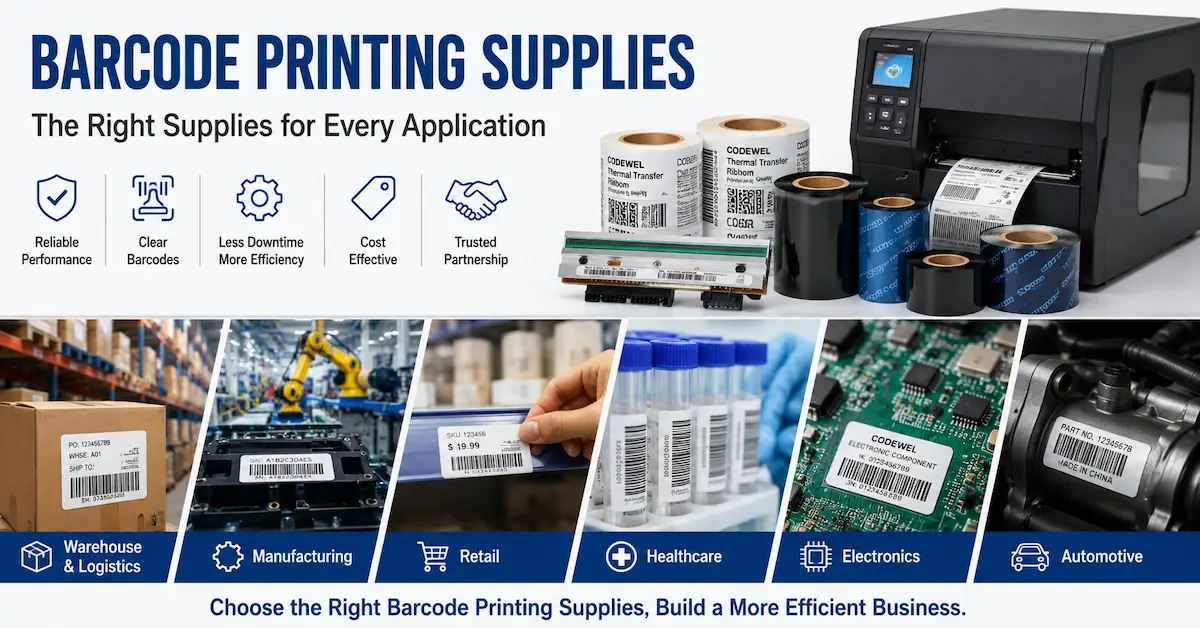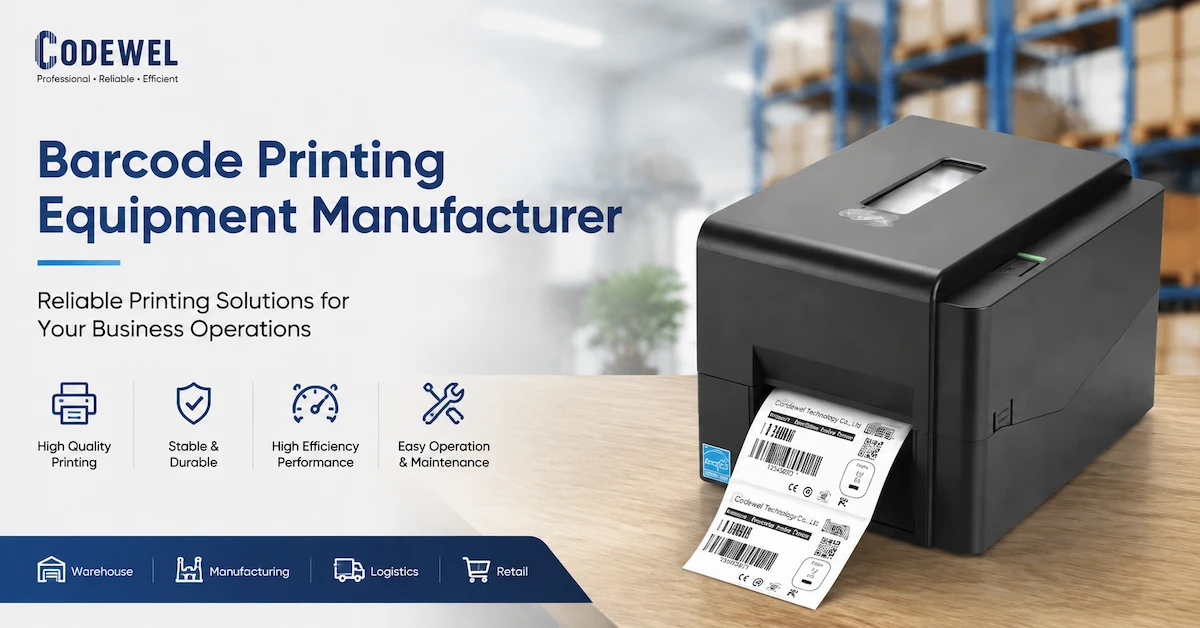

What Is a Thermal Transfer Ribbon Manufacturer?
A thermal transfer ribbon manufacturer specializes in producing printing ribbons used in thermal transfer printing systems. These manufacturers develop and produce different types of ribbons that transfer ink onto labels, packaging materials, synthetic films, and specialty substrates through controlled heat generated by a thermal printhead.
Thermal transfer printing is widely used because it provides excellent print clarity, long-lasting durability, and stable performance in demanding environments. Compared with direct thermal printing, thermal transfer technology allows businesses to select different ribbon formulations based on their application requirements.
A professional thermal transfer ribbon manufacturer typically provides:
- Wax ribbons for economical barcode printing
- Wax resin ribbons for balanced durability
- Resin ribbons for harsh industrial environments
- TTO ribbons for packaging production lines
- Wash care ribbons for textile labels
For global distributors and industrial users, choosing the right manufacturer is not only about purchasing ribbons. It is about building a reliable supply chain with consistent quality, technical support, and customization capability.
For more information about Codewel Print and its complete printing capabilities, visit our thermal transfer printing products.
Why Businesses Choose Professional Thermal Transfer Ribbon Manufacturers
Working directly with an experienced manufacturer provides advantages beyond product supply. Professional factories help customers optimize printing performance, reduce operating costs, and maintain stable production.
Consistent Printing Quality
Thermal transfer ribbons contain multiple functional layers, including:
- PET base film
- Ink coating layer
- Release layer
- Back coating layer
Each layer affects the final printing result.
A reliable manufacturer controls:
- Raw material selection
- Coating thickness
- Ink formulation
- Roll tension
- Slitting accuracy
- Printing performance testing
This ensures that customers receive stable products even during high-volume production.
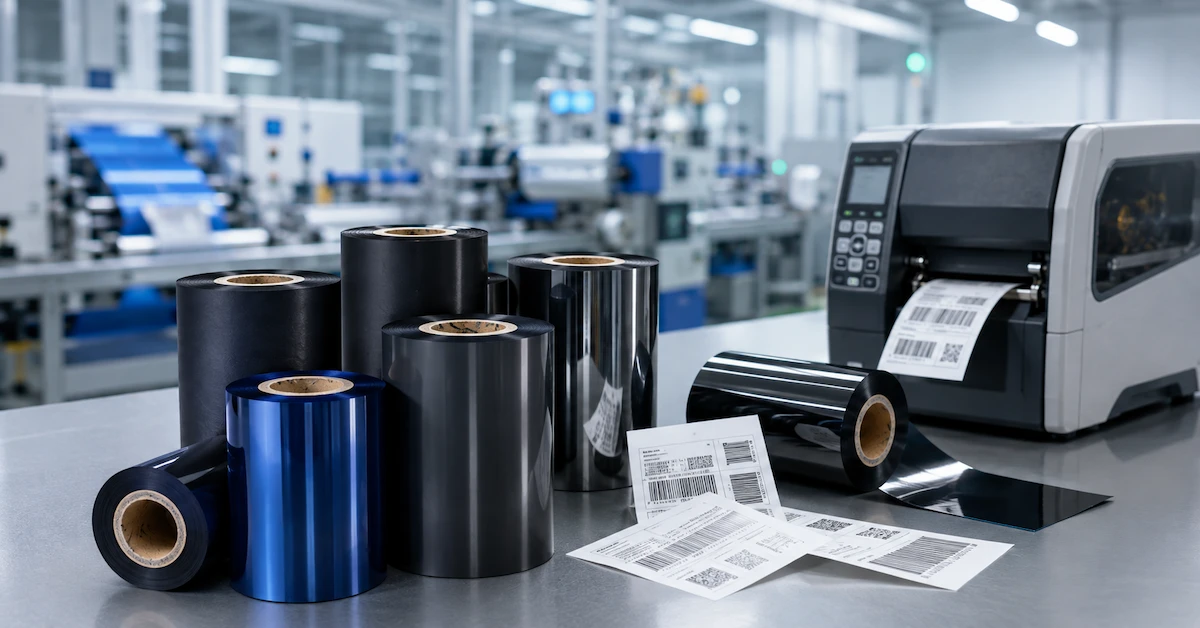
Wide Product Selection for Different Applications
Different industries require different ribbon characteristics.
A professional supplier should provide multiple ribbon options rather than a single standard product.
For example:
Wax ribbon
Suitable for:
- Shipping labels
- Warehouse labels
- Retail labels
Wax resin ribbon
Suitable for:
- Manufacturing labels
- Inventory tracking
- General industrial applications
Resin ribbon
Suitable for:
- Automotive parts
- Electronics components
- Chemical labels
- Outdoor applications
TTO ribbon
Suitable for:
- Food packaging
- Pharmaceutical packaging
- Flexible film printing
To explore different ribbon solutions, customers can review Codewel Print’s thermal transfer ribbon products.
OEM and Custom Manufacturing Capability
Many distributors and brands require customized thermal transfer ribbon solutions.
A capable thermal transfer ribbon manufacturer can support:
- Custom ribbon width
- Custom ribbon length
- Different core sizes
- Private label packaging
- Customized product combinations
OEM capability allows distributors to build their own product portfolio while maintaining stable factory support.
Thermal Transfer Ribbon Types and Their Applications
Wax Ribbon
Wax ribbon is the most commonly used thermal transfer ribbon type for standard barcode printing.
It uses wax-based ink technology to provide economical printing performance on paper labels.
Advantages of Wax Ribbon
- Cost-effective solution
- High printing speed
- Clear barcode readability
- Suitable for large-volume applications
Common Applications
- Logistics labels
- Shipping labels
- Retail labels
- Warehouse identification
Wax Resin Ribbon
Wax resin ribbons combine wax and resin technologies to provide improved durability compared with standard wax ribbons.
It offers a balance between cost and performance.
Advantages of Wax Resin Ribbon
- Better scratch resistance
- Improved print quality
- More durable than wax ribbon
- Suitable for various label materials
Common Applications
- Industrial labels
- Product tracking labels
- Inventory management labels
- Manufacturing identification
Resin Ribbon
Resin ribbon is designed for applications requiring maximum durability.
It creates highly resistant printed images that can withstand challenging environments.
Advantages of Resin Ribbon
- Excellent abrasion resistance
- Chemical resistance
- Heat resistance
- Long-lasting readability
Common Applications
- Automotive labels
- Electronic component labels
- Medical labels
- Chemical product identification
TTO Ribbon
Thermal Transfer Overprinting ribbon is designed for continuous printing applications.
It is commonly used in automated packaging production.
Advantages of TTO Ribbon
- High-speed printing capability
- Stable performance on packaging films
- Suitable for production lines
Common Applications
- Food packaging
- Beverage packaging
- Pharmaceutical packaging
Thermal Transfer Ribbon Manufacturing Process
A professional thermal transfer ribbon manufacturer must maintain strict production control from raw material preparation to final inspection.
The quality of a thermal transfer ribbon depends not only on the ink formula but also on the precision of every manufacturing process step.
PET Film Preparation
PET film acts as the base material of thermal transfer ribbons.
The base film provides mechanical strength and ensures stable ribbon movement during printing.
Important factors include:
- Film thickness consistency
- Mechanical strength
- Surface quality
- Thermal stability
A high-quality PET film helps improve printing accuracy and reduce ribbon breakage during high-speed operation.
Ink Coating Process
The ink coating layer directly affects printing performance.
Manufacturers develop different coating formulas according to application requirements.
Important factors include:
- Ink density
- Adhesion performance
- Transfer efficiency
- Print clarity
- Durability
For example, resin ribbon requires a stronger coating formulation because it is designed for applications requiring resistance against chemicals, heat, and abrasion.
Back Coating Treatment
The back coating protects the thermal printhead and improves printing stability.
A high-quality back coating helps:
- Reduce friction between ribbon and printhead
- Protect printing components
- Maintain consistent printing quality
- Extend printhead service life
This is especially important for companies operating high-volume barcode printing systems.
Slitting and Rewinding
Large master rolls are processed into finished ribbons according to customer specifications.
The slitting process controls:
- Ribbon width
- Roll tension
- Length accuracy
- Edge quality
- Core size compatibility
For distributors and OEM customers, accurate slitting is essential because different printers require different ribbon specifications.
Quality Inspection
Before shipment, professional manufacturers should conduct comprehensive inspections.
Quality control typically includes:
- Appearance inspection
- Dimension checking
- Printing testing
- Compatibility testing
- Batch quality tracking
Reliable quality control helps customers maintain stable printing performance across different production environments.
How to Choose a Reliable Thermal Transfer Ribbon Manufacturer
Selecting the right thermal transfer ribbon manufacturer is an important decision for distributors, manufacturers, and printing solution providers.
A low-quality supplier may cause:
- Poor barcode readability
- Frequent ribbon replacement
- Increased maintenance costs
- Reduced production efficiency
- Printhead damage
A reliable supplier should be evaluated from several important aspects.
Manufacturing Capability and Production Experience
A professional manufacturer should have complete production capability instead of only acting as a trading company.
Important evaluation factors include:
- Production equipment
- Coating technology
- Manufacturing experience
- Quality inspection system
- Production capacity
- Export capability
For long-term cooperation, buyers should choose suppliers that can support both standard products and customized projects.
Learn more about Codewel Print’s manufacturing background through our company profile.
Product Range and Technical Capability
A strong thermal transfer ribbon supplier should provide different ribbon solutions according to customer applications.
A complete product range normally includes:
- Wax Ribbon
- Wax Resin Ribbon
- Resin Ribbon
- TTO Ribbon
- Wash Care Resin Ribbon
Different industries require different performance characteristics.
For example:
| Application | Recommended Ribbon Type |
|---|---|
| Shipping labels | Wax Ribbon |
| Warehouse labels | Wax Ribbon |
| Manufacturing identification | Wax Resin Ribbon |
| Automotive components | Resin Ribbon |
| Electronic labels | Resin Ribbon |
| Food packaging | TTO Ribbon |
| Textile labels | Wash Care Resin Ribbon |
A supplier with broader technical capability can help customers select the most suitable ribbon instead of simply selling standard products.
Printer Compatibility
Thermal transfer ribbons must match different printer systems to achieve stable printing performance.
Professional manufacturers should support compatibility with major printer brands, including:
- Zebra
- TSC
- SATO
- Honeywell
- Datamax
- CAB
- Godex
Correct compatibility helps improve:
- Printing clarity
- Barcode scanning accuracy
- Printer efficiency
- Equipment lifespan
For customers looking for complete printing solutions, Codewel Print also provides related barcode printing products.
Quality Control System
Quality control is one of the most important factors when selecting a thermal transfer ribbon supplier.
A professional manufacturer should control every stage of production.
Incoming Material Inspection
Before production begins, raw materials should be inspected.
Including:
- PET film quality
- Ink material consistency
- Core dimensions
- Packaging materials
Production Process Control
Manufacturing parameters should be monitored during:
- Coating
- Drying
- Slitting
- Rewinding
Final Product Testing
Finished ribbons should be tested for:
- Print density
- Adhesion
- Smudge resistance
- Length accuracy
- Roll appearance
- Printer compatibility
Thermal Transfer Ribbon Specification Table
| Item | Specification |
|---|---|
| Product Type | Thermal Transfer Ribbon |
| Material Structure | PET Film + Ink Coating + Back Coating |
| Available Types | Wax, Wax Resin, Resin, TTO, Wash Care Resin |
| Printing Technology | Thermal Transfer Printing |
| Compatible Printers | Zebra, TSC, SATO, Honeywell and more |
| Applications | Barcode Labels, Industrial Labels, Packaging Printing |
| Customization | Width, Length, Core Size, Packaging |
| Supply Model | OEM, ODM, Bulk Supply |
Wax vs Wax Resin vs Resin Ribbon Comparison
Choosing the correct ribbon type is important because different applications require different durability levels.
| Feature | Wax Ribbon | Wax Resin Ribbon | Resin Ribbon |
|---|---|---|---|
| Cost Level | Low | Medium | Higher |
| Durability | Basic | Good | Excellent |
| Scratch Resistance | Low | Medium | High |
| Chemical Resistance | Low | Medium | High |
| Print Quality | Good | Better | Excellent |
| Best Application | Shipping and retail labels | General industrial labels | Harsh industrial environments |
Wax ribbon is suitable for customers who need economical printing.
Wax resin ribbon provides a balance between price and durability.
Resin ribbon is recommended for demanding applications requiring long-lasting identification.
Thermal Transfer Ribbon Applications Across Industries
Thermal transfer printing is widely used because businesses require reliable identification throughout production, logistics, and supply chain processes.
Manufacturing Industry
Manufacturers use thermal transfer ribbons for:
- Product identification
- Component tracking
- Production management
- Quality traceability
Industrial labels often require resistance against:
- Oil
- Friction
- Heat
- Chemicals
Resin ribbons are commonly selected for demanding manufacturing environments.
Automotive Industry
Automotive manufacturers require labels that remain readable during production, transportation, and long-term usage.
Typical applications include:
- Parts identification
- Serial number labels
- Engine component labels
- Inventory tracking
Recommended solutions include:
- Industrial resin ribbon
- Durable barcode labels
- High-performance printing systems
Electronics Industry
Electronic products require accurate identification because components are often small and require precise tracking.
Applications include:
- PCB labeling
- Component tracking
- Serial number printing
- Manufacturing records
Thermal transfer ribbons provide:
- Fine print quality
- Barcode readability
- Long-term durability
Logistics and Warehouse Management
Warehouses rely on barcode systems for:
- Inventory management
- Shipping identification
- Package tracking
Common products include:
- Wax ribbons
- Thermal labels
- Barcode printers
For complete warehouse printing requirements, customers can explore Codewel Print’s industrial printing solutions.
Food and Pharmaceutical Packaging
Packaging industries require reliable printing on films and packaging materials.
Applications include:
- Production dates
- Batch numbers
- Expiration dates
- Traceability codes
TTO ribbons are commonly used because they support:
- High-speed production lines
- Continuous printing
- Stable coding performance
Thermal Transfer Ribbon Cost Factors
The cost of thermal transfer ribbons depends on multiple factors, including material type, ribbon specification, customization requirements, and order quantity.
For businesses purchasing thermal transfer ribbons in bulk, understanding these cost factors helps improve sourcing decisions and control long-term printing expenses.
Ribbon Material Selection
Different ribbon materials provide different performance levels and price ranges.
Generally:
Wax Ribbon
Wax ribbon is the most economical option and is commonly used for standard paper labels.
Advantages:
- Lower purchasing cost
- Suitable for high-volume printing
- Good barcode readability
Wax Resin Ribbon
Wax resin ribbon provides a balance between cost and durability.
Advantages:
- Better resistance than wax ribbon
- Suitable for general industrial applications
- Improved printing performance
Resin Ribbon
Resin ribbon is designed for demanding environments where durability is critical.
Advantages:
- Higher abrasion resistance
- Chemical resistance
- Heat resistance
- Long-term readability
Choosing the correct ribbon type helps businesses avoid unnecessary costs caused by poor printing performance or frequent replacement.
Ribbon Size and Specification
Customized specifications can influence the final product cost.
Important factors include:
- Ribbon width
- Ribbon length
- Core size
- Ink formulation
- Packaging requirements
For example, companies using different thermal printers may require customized ribbon dimensions to achieve the best printing performance.
Order Quantity and Supply Planning
Order volume is another important pricing factor.
Bulk purchasing usually provides better cost efficiency because manufacturers can optimize:
- Production scheduling
- Raw material usage
- Packaging processes
- Shipping arrangements
For distributors and importers, establishing long-term cooperation with a reliable supplier can provide better price stability and supply security.
Custom Packaging and Private Label Requirements
Many brands and distributors require customized packaging solutions.
OEM projects may include:
- Custom labels
- Brand packaging
- Product identification
- Private label solutions
Although customized packaging may increase initial costs, it helps businesses build their own product identity and strengthen market competitiveness.
OEM Thermal Transfer Ribbon Manufacturing Solutions
For distributors, wholesalers, and brands, OEM manufacturing provides a flexible way to develop customized thermal printing products.
A professional thermal transfer ribbon manufacturer can support customers with complete OEM services from product development to mass production.
Custom Ribbon Specifications
Different customers may have different printing requirements.
OEM manufacturing can support:
- Custom ribbon width
- Custom ribbon length
- Different core sizes
- Special coating requirements
- Application-specific formulations
For example:
A logistics company may require economical wax ribbons for shipping labels, while an automotive manufacturer may need resin ribbons with higher durability.
Private Label Thermal Transfer Ribbon Production
Private label manufacturing allows businesses to sell thermal printing products under their own brand.
Services may include:
- Custom packaging design
- Brand labeling
- Product identification
- Packaging customization
This model is commonly used by:
- Printing distributors
- Barcode solution providers
- Industrial suppliers
OEM Quality Control Support
A reliable OEM partner should maintain strict quality control throughout production.
Quality management includes:
- Raw material inspection
- Coating control
- Slitting accuracy
- Printing performance testing
- Final inspection
This helps ensure every batch meets customer expectations.
Long-Term Manufacturing Partnership
Working with a direct manufacturer provides advantages including:
- Stable supply
- Better communication
- Faster customization
- Technical support
- Reduced sourcing risks
For businesses looking for a complete thermal printing supply chain, Codewel Print provides thermal transfer printing products and customized manufacturing support.
Why Choose Codewel Print as Your Thermal Transfer Ribbon Partner?
Choosing the right supplier is essential for companies that depend on consistent barcode printing performance.
Codewel Print provides thermal transfer printing solutions for global customers, including distributors, manufacturers, and industrial users.
The company focuses on supplying reliable printing products with practical application knowledge and manufacturing support.
Complete Thermal Printing Product Portfolio
Codewel Print provides solutions covering:
- Thermal transfer ribbons
- Barcode printing consumables
- Printheads
- Barcode printers
- Printing equipment
Customers can explore the complete printing product portfolio to find suitable solutions for different applications.
Support for Different Industries
Codewel Print solutions are suitable for:
- Manufacturing
- Automotive
- Electronics
- Logistics
- Packaging
- Retail
- Textile industries
Different industries require different printing performance.
Through proper ribbon selection and application analysis, customers can improve printing quality and reduce operational problems.
OEM and Customization Capability
For distributors and brands requiring customized solutions, Codewel Print supports:
- Product customization
- Packaging requirements
- Bulk supply
- OEM cooperation
This allows partners to develop competitive thermal printing products while maintaining reliable supply.
Professional Printing Solution Support
Successful thermal printing requires more than choosing a ribbon.
Factors such as:
- Printer compatibility
- Label material
- Printing environment
- Application requirements
all influence the final result.
Codewel Print helps customers select suitable products based on their specific printing needs.
For customized requirements, customers can contact Codewel Print team for professional support.
Frequently Asked Questions About Thermal Transfer Ribbon Manufacturer
What does a thermal transfer ribbon manufacturer produce?
A thermal transfer ribbon manufacturer produces different types of printing ribbons used in thermal transfer printers, including wax ribbons, wax resin ribbons, resin ribbons, TTO ribbons, and wash care ribbons.
How do I choose the right thermal transfer ribbon?
The correct ribbon depends on:
- Label material
- Printer model
- Printing environment
- Required durability
Businesses should select ribbon materials according to their actual application requirements.
What is the difference between wax and resin ribbon?
Wax ribbons are designed for economical printing applications, while resin ribbons provide higher durability and resistance against abrasion, chemicals, and heat.
Which thermal transfer ribbon is best for industrial labels?
Resin ribbon is commonly recommended for industrial labels because it provides excellent resistance against harsh environments, including chemicals, heat, and friction.
Can thermal transfer ribbon manufacturers provide OEM service?
Yes. Professional manufacturers can provide OEM services including customized specifications, private label packaging, and bulk production.
Are thermal transfer ribbons compatible with Zebra printers?
Yes. Many thermal transfer ribbons are compatible with Zebra and other major thermal printer brands, including TSC, SATO, and Honeywell.
How can thermal transfer ribbons improve printing quality?
High-quality thermal transfer ribbons provide:
- Clear barcode images
- Stable ink transfer
- Better adhesion
- Longer print durability
What industries use thermal transfer ribbons?
Thermal transfer ribbons are widely used in:
- Manufacturing
- Automotive
- Electronics
- Logistics
- Food packaging
- Pharmaceutical industries
- Textile applications
How should thermal transfer ribbons be stored?
Thermal transfer ribbons should be stored in a dry environment away from direct sunlight, excessive heat, and moisture to maintain stable performance.
Why should companies buy directly from a thermal transfer ribbon manufacturer?
Buying directly from a manufacturer provides advantages such as:
- Better supply stability
- Competitive pricing
- OEM capability
- Technical support
- Quality consistency
Conclusion
Choosing the right thermal transfer ribbon manufacturer is essential for businesses that rely on barcode printing, product identification, and industrial labeling.
A professional supplier should provide more than standard ribbon products. The ideal manufacturing partner should offer:
- Stable production capability
- Multiple ribbon technologies
- Strict quality control
- OEM customization
- Technical support
For barcode distributors, label printing companies, manufacturers, and packaging businesses, working with an experienced thermal transfer ribbon supplier helps create a reliable printing supply chain.
Codewel Print provides professional thermal transfer printing solutions and supports customers with customized products, stable supply, and application-focused recommendations.
For your next thermal printing project, contact Codewel Print to discuss suitable ribbon solutions.