
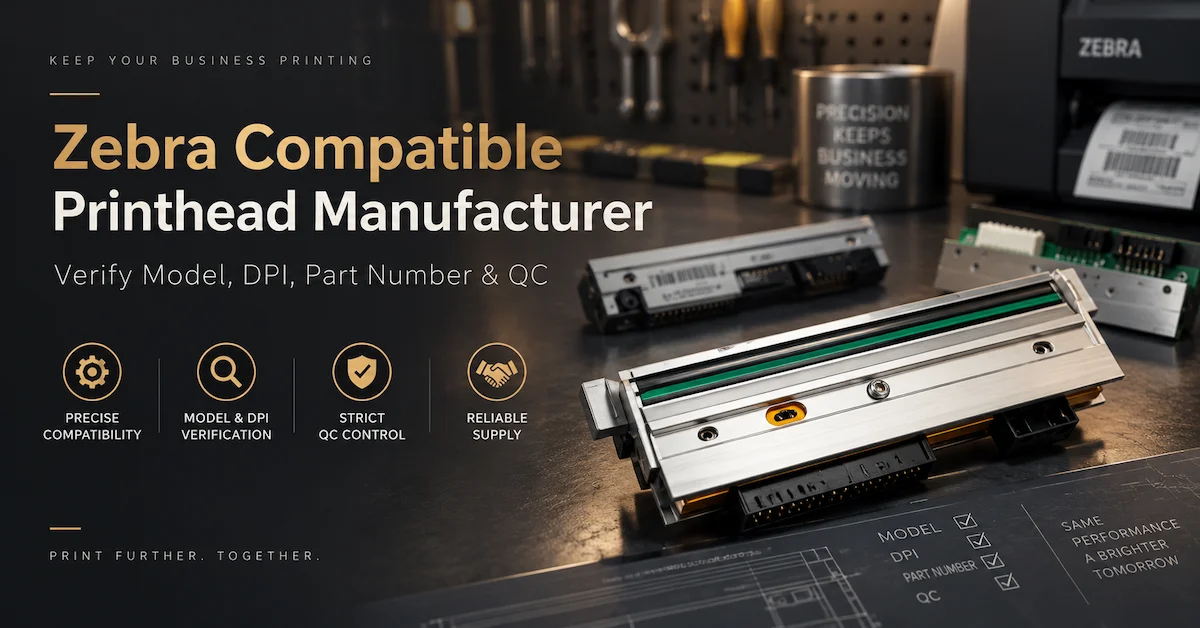
What Should a Zebra Compatible Printhead Manufacturer Actually Prove?
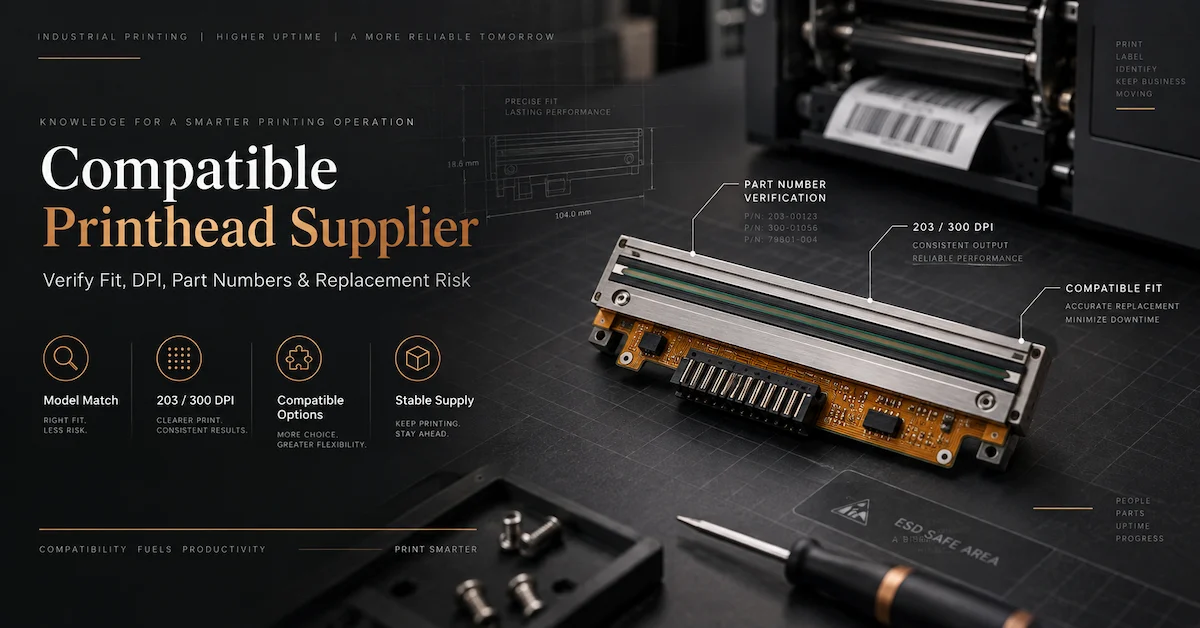
A Zebra compatible printhead manufacturer should help a buyer establish a traceable replacement specification before discussing volume price. “Compatible with Zebra” is not enough because printers within the same brand can use different resolutions, print widths, connectors, mounting structures, and part numbers. CODEWEL’s printhead range covers multiple printer families, while its current compatible Zebra listing for ZD220, ZD230, GC420T, TLP2844, and GK888 identifies a specific 203 dpi compatible configuration rather than claiming that one head works with every Zebra printer. That distinction is important for distributors and maintenance teams because compatibility should always be tied to a defined printer configuration.
Who Should Source Compatible Zebra Printheads?
Compatible heads are relevant to barcode-printer distributors, repair businesses, system integrators, warehouse maintenance teams, label-printing plants, retailers with printer fleets, logistics operators, and industrial manufacturers that need recurring replacement parts. These buyers usually want to balance acquisition cost, availability, print performance, service continuity, and warranty exposure. A compatible solution is less appropriate when a customer contract specifically requires an OEM-original Zebra part, when equipment-service conditions restrict third-party components, or when the installed printer cannot be identified accurately. Before purchasing, clearly state whether the project accepts a compatible product, requires an original product, or needs both options quoted separately.
Manufacturer or Supplier: Confirm Who Actually Makes the Quoted SKU
The keyword Zebra compatible printhead manufacturer implies a manufacturing relationship, so buyers should verify whether the quoted product is manufactured in-house, assembled by the supplier, or sourced from another production partner. CODEWEL’s About Us page describes a dedicated print-head workshop and states that printheads are developed with engineers from Taiwan and manufactured in a dust-free workshop with nano-coating technology. However, these are company-level manufacturing statements; the public page does not establish that every compatible Zebra SKU listed on the website is produced under exactly the same process. For a serious B2B order, ask the supplier to confirm the production source and quality-control scope of the exact model being quoted rather than extending a general factory description to every SKU.
Start With the Exact Zebra Printer Model
A buyer should never request only “a Zebra compatible printhead.” The complete printer model is the first technical field required. ZD220, ZD230, GK888, GC420T, 105SL, 105SL Plus, ZM400, ZT410, and other Zebra families have different product structures and can contain different printhead variants. CODEWEL’s barcode printing supplies guide recommends checking printer model, DPI, print width, connector, mounting structure, printer generation, and compatible ribbon/media when selecting a replacement printhead. A model name therefore narrows the search, but it does not complete the compatibility check.
Build a Printhead Specification Sheet Before Requesting a Quote
A professional RFQ to a Zebra compatible printhead manufacturer should contain one technical record that purchasing, maintenance, and quality personnel can all understand. This is especially valuable when several Zebra printer families are operating in the same warehouse or production plant.
| Specification | Buyer Should Provide | Why It Matters |
|---|---|---|
| Printer brand | Zebra | Defines the equipment family |
| Complete printer model | Exact model and suffix | Different models can use different heads |
| Printer generation | Revision or generation where known | Hardware can change between versions |
| DPI | 203, 300, 600 dpi or installed specification | Resolution must match the printer configuration |
| Existing part number | Number printed on the current head if available | Strong identification reference |
| Print width | Installed width or printer specification | Helps confirm physical compatibility |
| Connector | Clear photo if uncertain | Prevents electrical-interface mismatch |
| Mounting structure | Photos of removed head and mounting points | Confirms mechanical fit |
| Current head condition | Original or compatible where known | Establishes replacement baseline |
| Print symptom | White lines, missing dots, uneven density, etc. | Helps determine whether replacement is necessary |
| Quantity | Trial quantity and expected annual demand | Supports quotation and stock planning |
| Product status required | Compatible, original, or both | Prevents commercial disputes |
| Destination | Delivery country or location | Supports logistics planning |
| Warranty requirement | Buyer’s expected service terms | Must be compared with the exact SKU policy |
Why DPI Must Match the Printer Instead of Being Treated as an Upgrade
DPI means dots per inch and describes printing resolution. A higher number can support finer printed detail, but a 300 dpi printhead is not simply a “better” replacement for a 203 dpi machine. CODEWEL’s original 105SL and 105SL Plus printhead listing illustrates the issue clearly: separate 203 dpi and 300 dpi variants are listed with different part numbers. The 105SL 203 dpi version uses G32432-1M, while the 300 dpi version uses G32433M; the 105SL Plus versions use P1053360-018 and P1053360-019 respectively. Those identifiers should be treated as separate purchasing references, not interchangeable alternatives.
Part Number Matching Reduces Wrong-Model Orders
Printer model, DPI, and part number should be checked together wherever possible. Part numbers help reduce ambiguity when a printer family contains several versions, but they should not become the only reference. Machines may have been repaired previously, customer records can contain mistakes, and labels on old parts can be difficult to read. The strongest verification package usually contains the machine nameplate, existing head label, part number, DPI, connector photograph, mounting photograph, and buyer confirmation of the exact printer model. For higher-volume purchases, preserve these records with the approved supplier SKU so a future buyer does not need to rebuild the compatibility decision from memory.
How Should Buyers Evaluate a Compatible Zebra Printhead Product?
CODEWEL’s compatible ZD220/ZD230/GC420T/TLP2844/GK888 printhead is one useful example. The current page identifies it as New Compatible, lists 203 dpi, states a warranty of 5 months or 50 km, and describes the product as 100% tested. These are product-page specifications for this listing and should not automatically be transferred to every compatible Zebra printhead. Before a larger purchase, confirm the exact model included in the quotation, test the candidate in the intended printer, and retain the approved result as a reference for repeat orders.
Compatible and Original Printheads Should Be Compared With the Same Fields
Price comparison is meaningful only after both options are technically identified. The table below is intended as a sourcing comparison framework, not a ranking of which product is better.
| CODEWEL Listing | Product Status | Resolution | Published Reference | Buyer Should Confirm |
|---|---|---|---|---|
| ZD220/ZD230/GC420T/TLP2844/GK888 | New Compatible | 203 dpi | 5 months or 50 km warranty | Exact printer, mounting, connector, and print result |
| 105SL | Original | 203 / 300 dpi | G32432-1M / G32433M | Correct DPI and machine generation |
| 105SL Plus | Original | 203 / 300 dpi | P1053360-018 / P1053360-019 | Correct part number and installed configuration |
| ZM400 family | Original listing currently shows multiple DPI versions | 203 / 300 / 600 dpi | 79800M / 79801M / 79802M | Exact resolution and product status in quotation |
CODEWEL’s current Zebra-related listings demonstrate why “Zebra printhead” should never be used as the complete SKU description.
What Manufacturing Controls Matter for Compatible Printheads?
A Zebra compatible printhead manufacturer should be evaluated on repeatability rather than a single attractive sample. CODEWEL’s company page describes a print-head workshop using a dust-free production environment and nano-coating technology, but a professional buyer should still ask what steps apply to the specific compatible SKU. Useful questions include how incoming materials are controlled, how the heating-element assembly is inspected, how electrical continuity is checked, how connectors and mounting dimensions are verified, whether finished units are test-printed, and how accepted parts are identified. A supplier should be able to connect “100% tested” to an actual inspection stage rather than leaving it as an undefined marketing statement.
Do Not Treat Company-Level Performance Claims as SKU-Level Specifications
CODEWEL’s About page provides company-level statements about its printhead workshop, including resolution, printing speed, coating technology, and service-life claims. These statements describe the company’s reported manufacturing capability, but they should not automatically become specifications for the ZD220-compatible head or every other Zebra-compatible product. Product-level decisions should rely on the corresponding product page, quotation, technical sheet, and approved sample. This distinction matters because a buyer may otherwise combine a performance value from one company page with a warranty value from another SKU and accidentally create a specification that no actual product supports.
Test the Compatible Head in the Actual Zebra Printer
Sample testing should reproduce the intended application. Install the candidate in the correct printer using the normal service procedure, then print with the customer’s standard media, ribbon if thermal-transfer printing is used, representative print speed, darkness or energy setting, and actual label layout. Include narrow bars, small text, fine graphics, and the barcode types normally used. Check whether the image is complete across the required print width, whether density is uniform, whether the barcode remains readable, and whether the printer operates normally after calibration. Save the printer model, head SKU, DPI, media, ribbon, settings, test date, and result so later batches can be compared against an approved baseline.
Ribbon and Label Material Can Affect the Printhead Test
A new printhead does not operate independently of the consumables around it. Thermal-transfer printing requires interaction among the printhead, ribbon, label material, pressure, speed, and print energy. CODEWEL’s barcode printing supplies guide specifically recommends confirming ribbon/media compatibility when choosing and operating a printhead. If the buyer changes the printhead, ribbon, media, and printer settings at the same time, diagnosing a poor result becomes difficult. A controlled comparison should therefore keep the other variables stable while the replacement head is being evaluated.
Poor Printing Does Not Always Mean the Printhead Has Failed
Repeated white lines, incomplete barcode elements, uneven darkness, or deteriorating print quality can indicate printhead wear or damage, but they can also result from contamination, pressure problems, platen-roller condition, media, ribbon, or settings. CODEWEL’s printhead supplier guide discusses these symptoms as reasons to investigate a printhead rather than as automatic proof that replacement is required. Before ordering a large quantity, maintenance teams should record the defect and complete the appropriate cleaning and calibration steps for the printer. This helps separate a genuine replacement requirement from an unresolved printer or consumable problem.
How Should Buyers Interpret Warranty and Print Distance?
CODEWEL’s ZD220/ZD230-compatible page currently publishes a warranty of 5 months or 50 km. That warranty is associated with that particular listing; it should not become the default warranty for every compatible Zebra printhead. A quotation should state which condition ends the warranty, how printing distance is assessed when relevant, what exclusions apply, and what evidence is required for a claim. Buyers should also avoid treating a warranty distance as a guaranteed operating lifetime. Actual service life can be influenced by ribbon back coating, media abrasiveness, contamination, excessive energy, pressure, maintenance, and operating conditions.
Compare Total Replacement Cost, Not Only Head Price
The lowest purchase price does not automatically create the lowest maintenance cost. A useful comparison includes the printhead price, technician labor, installation time, test labels, ribbon used during setup, printer downtime, rework, return freight, and warranty handling. A compatible printhead may offer a commercially attractive replacement route when it fits correctly and performs reliably; an incorrect low-cost head can create much larger costs if it causes repeated installations or machine downtime. For distributors, return and complaint-processing costs should also be included because a wrong-model shipment affects both margin and customer trust.
Bulk Orders Need a Controlled Approval Process
Before purchasing dozens or hundreds of compatible heads, approve the exact configuration first. Record the supplier model, buyer SKU, applicable Zebra printer, DPI, part number where available, connector, packaging, product status, published warranty, and sample result. If a Zebra compatible printhead manufacturer proposes a product revision later, determine whether the change affects fit or print performance before accepting the revised version for routine supply. This control is especially important for distributors because customer complaints can arise months after the original import shipment, when the staff who approved the first sample may no longer be involved.
OEM, Packaging, and Private-Label Requests Should Not Change Compatibility Records
Distributors may want an internal SKU, private label, outer-box design, or other packaging customization. These commercial requirements should remain separate from the printhead’s technical identity. A private-label code should still be linked internally to the supplier SKU, printer model, resolution, and part number. A packaging change should not cause the approved head specification to disappear from the purchasing file. If a supplier proposes an electrical, mechanical, or material change to support the private-label project, that becomes a technical revision and should be evaluated again.
How Should Buyers Evaluate Manufacturer Capacity and Lead Time?
Do not infer compatible-printhead inventory from CODEWEL’s ribbon-production capacity. The company separately describes a print-head workshop, but public pages reviewed here do not provide one universal capacity figure for every compatible Zebra SKU. For purchasing purposes, ask for stock status, available quantity, replenishment lead time, trial quantity, production or sourcing schedule, inspection time, and shipping schedule for the exact model. This model-specific approach provides more useful information than a general company-size claim and avoids treating unrelated ribbon output figures as printhead capacity.
Use the Existing Compatible Printhead Guide as a Pre-RFQ Checklist
CODEWEL has already published a broader compatible printhead selection guide covering printer model, DPI, part number, mounting structure, compatible/original status, warranty, testing, and repeat-order management. A Zebra-specific sourcing process can build on that checklist by adding exact Zebra printer-family information and validating each candidate against the installed machine. This creates a useful internal workflow for distributors: broad compatibility review first, Zebra model verification second, sample approval third, and volume purchasing only after the technical record is complete.
What Should You Send a Zebra Compatible Printhead Manufacturer for a Quote?
Send the complete Zebra printer model, DPI, current part number, photographs of the printer nameplate and removed head, connector and mounting photos if necessary, required quantity, destination, and whether compatible parts are mandatory or simply acceptable. Include the current printing problem if the replacement is being sourced as part of a repair. If you already have an approved compatible part, provide its supplier code as well. Buyers can review the CODEWEL printhead range, examine the ZD220/ZD230-compatible product, and then contact CODEWEL with the equipment information required for a model-specific review.
Frequently Asked Questions
1. Does CODEWEL Manufacture Zebra-Compatible Printheads?
CODEWEL’s company page describes an in-house print-head workshop, and its product pages list compatible printheads for Zebra printer models. However, buyers needing manufacturer verification for a particular SKU should confirm that product’s exact production source rather than assuming every listed compatible Zebra model is manufactured under the same arrangement.
2. Which Zebra Models Are Listed on CODEWEL’s Compatible Product Page?
One current compatible listing covers ZD220, ZD230, GC420T, TLP2844, and GK888 at 203 dpi. Compatibility still needs to be checked against the exact installed printer and mounting configuration before ordering.
3. Is a Compatible Zebra Printhead the Same as an Original Zebra Printhead?
No. Compatible and original describe different product status. CODEWEL’s website contains both compatible listings and original Zebra printhead listings, so the quotation and purchase order should identify which one is being supplied.
4. Can I Replace a 203 dpi Zebra Printhead With a 300 dpi Head?
Do not assume so. CODEWEL’s 105SL and 105SL Plus listings show separate 203 dpi and 300 dpi versions with different part numbers. Match the replacement to the printer’s installed configuration unless the equipment documentation supports a defined conversion.
5. Why Is the Part Number Important?
The part number helps distinguish variants within the same printer family. Use it together with printer model, DPI, photographs, and mounting information rather than as the only compatibility reference.
6. What Warranty Does the Compatible ZD220/ZD230 Printhead Have?
The current CODEWEL product page lists a warranty of 5 months or 50 km for that compatible 203 dpi product. Other printhead models may have different terms, so confirm warranty by exact SKU.
7. Should I Test One Compatible Printhead Before a Bulk Order?
For a new application or supplier qualification, a representative sample test is useful. Use the actual printer, media, ribbon, label design, and operating settings, then retain the result as the approval reference for subsequent purchasing.
8. Can Poor Print Quality Be Caused by Something Other Than the Printhead?
Yes. Ribbon, label media, platen condition, pressure, dirt, calibration, and printer settings can all influence print quality. Troubleshoot the printing system before assuming the head alone is responsible.
9. How Should a Distributor Manage Multiple Zebra-Compatible Printheads?
Create a separate SKU for every approved combination of printer model, DPI, part number, compatible/original status, and supplier reference. Do not group several technically different heads under one generic “Zebra compatible” item.
10. What Should I Ask Before Placing a Repeat Order?
Confirm that the supplier SKU, printer compatibility, DPI, part number where relevant, product status, warranty, packaging, and any approved technical characteristics remain unchanged. If a significant specification changes, decide whether a new sample evaluation is required.
Conclusion
Selecting a Zebra compatible printhead manufacturer is a technical verification and supply-control decision rather than simply a search for a cheaper Zebra replacement part. Buyers should confirm the exact printer model, DPI, part number, connector, mounting structure, compatible/original status, manufacturing source where required, sample performance, warranty, and repeat-order controls before committing to volume purchases. CODEWEL currently publishes compatible Zebra products such as its ZD220/ZD230/GC420T/TLP2844/GK888 203 dpi printhead, maintains a broader printhead product range, and describes a dedicated print-head workshop on its About Us page. Buyers can contact CODEWEL with the Zebra printer model, DPI, existing part number, photographs, required quantity, and destination so the exact compatible configuration and sourcing terms can be reviewed before ordering.