
Why the Right Wax Resin Ribbon Manufacturer Matters
For businesses purchasing thermal transfer ribbons in bulk, the supplier's manufacturing capability can directly affect printing quality, production efficiency, and long-term operating costs.
A wax resin ribbon is not simply a roll of coated film.
Its performance depends on the interaction between:
PET carrier + ink formulation + back coating + coating process + slitting + winding + printer + printhead + label substrate
This is why two ribbons with the same width and length can produce noticeably different printing results.
For distributors, label converters, manufacturers, logistics companies, and private-label brands, choosing a wax resin ribbon manufacturer rather than simply selecting the lowest-cost seller can reduce several common risks:
- Inconsistent print density
- Ribbon wrinkling
- Poor barcode readability
- Smearing
- Excessive printhead wear
- Unstable high-speed printing
- Batch-to-batch variation
- Unexpected lead-time problems
CODEWEL identifies itself as a manufacturer of customized thermal transfer ribbons and operates a production base of more than 6,000 m² with 10+ coating and cutting TTR production lines and annual output exceeding 100 million square meters. Its products are exported to more than 100 countries.
For B2B buyers, these manufacturing capabilities matter because the goal is not simply to purchase a ribbon.The goal is to establish a repeatable printing specification that can be supplied consistently over time.
What Is a Wax Resin Ribbon?
A wax resin ribbon is a thermal transfer ribbon formulation that combines wax and resin components.
It is positioned between conventional wax ribbons and resin ribbons in terms of performance and cost.
The general objective is to provide a balance of:
- Print quality
- Durability
- Scratch resistance
- Smear resistance
- Solvent resistance
- Printing efficiency
- Cost control
Wax resin ribbons are commonly considered for applications such as:
- Warehouse labels
- Waybills
- Tickets
- Product identification
- Inventory labels
- Manufacturing labels
- Coated paper labels
- Selected synthetic media
The exact performance depends on the formulation, label substrate, printer, printhead,printing speed, and heat settings.
Therefore, a professional supplier should avoid describing every wax resin ribbon as having identical performance.
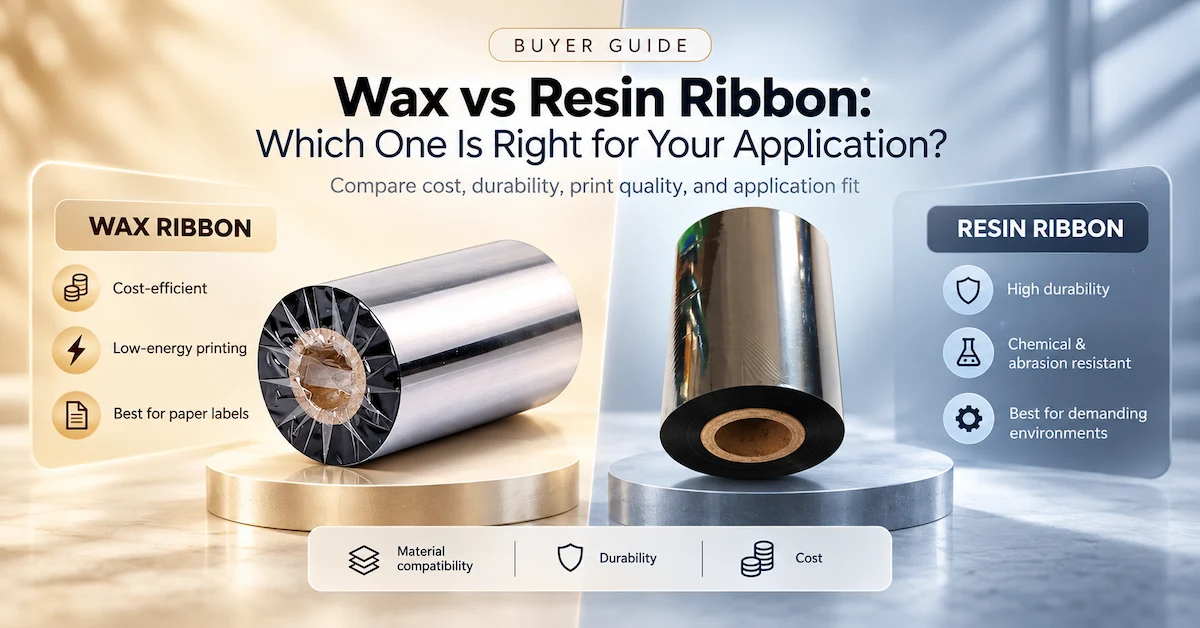
Wax vs Wax Resin vs Resin Ribbon
For procurement teams, the most useful comparison is not simply “which ribbon is best?”
Instead,ask:
Which formulation provides the required performance at the lowest practical total cost?
| Feature | Wax Ribbon | Wax Resin Ribbon | Resin Ribbon |
|---|---|---|---|
| Relative Cost | Low | Medium | Higher |
| Paper Compatibility | Excellent | Excellent | Good |
| Coated Paper | Good | Very Good | Very Good |
| Scratch Resistance | Basic | Better | High |
| Smear Resistance | Basic | Better | High |
| Solvent Resistance | Limited | Moderate | High |
| Print Durability | Basic | Good | Excellent |
| Typical Positioning | Economy | Performance/Cost Balance | High Durability |
| Common Applications | Shipping, warehouse | Industrial/general labels | Harsh environments |
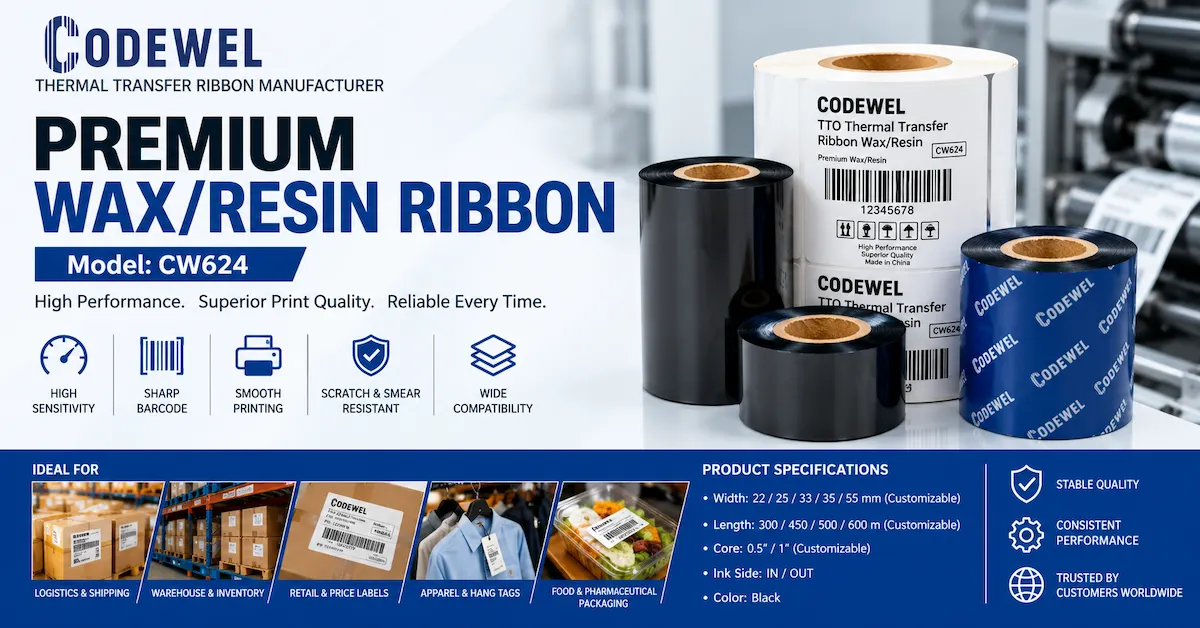
CODEWEL's current product range includes standard wax/resin CW603, premium CW630, super wax/resin CW638/CW639/CW641, and near-edge/TTO wax resin products including CW624/CW625/CW628.
This product structure allows buyers to select different performance levels instead of forcing one formulation into every application.
Who Should Buy Wax Resin Ribbons?
The ideal buyer depends on the application and purchasing model.
Distributors and Importers
Distributors often need:
- Stable product specifications
- Competitive wholesale pricing
- Consistent packaging
- Repeat-order consistency
- Private-label options
- Multiple sizes
- Reliable production capacity
For these buyers, the manufacturer must be capable of supporting the product line over multiple purchasing cycles.
Label Converters
Label converters need reliable compatibility between:
- Ribbon
- Label stock
- Printer
- Printing speed
A ribbon that works on one substrate may not produce the same result on another.
Manufacturing Companies
Manufacturers may use wax resin ribbons for:
- Product labels
- Component identification
- Work-in-process tracking
- Inventory labels
- Production records
The priority is often a combination of durability, barcode readability, and stable high-volume printing.
Logistics and Warehousing Companies
Typical applications include:
- Warehouse labels
- Waybills
- Shipping-related identification
- Inventory tracking
Here, cost per usable label and reliable high-volume printing are often more important than maximum chemical resistance.
Private-Label Brands
Private-label buyers may require:
- Custom dimensions
- Custom packaging
- Brand identification
- Different product grades
- Consistent specifications
- Long-term supply
This makes direct manufacturer cooperation particularly valuable.
What Should a Wax Resin Ribbon Be Made Of?
A thermal transfer ribbon generally contains several functional layers.
PET Carrier Film
The PET carrier provides the base structure of the ribbon.
Its characteristics influence:
- Mechanical strength
- Thickness
- Heat transfer
- Printing stability
- Ribbon handling
Ink Coating
The ink coating determines much of the final printing performance.
For wax resin ribbons, the formulation needs to balance:
- Sensitivity
- Adhesion
- Print density
- Scratch resistance
- Smear resistance
- Solvent resistance
Back Coating
The back coating protects the printhead side of the ribbon and helps control friction during printing.
A suitable back coating can contribute to:
- Reduced friction
- Better printhead protection
- Stable ribbon movement
- More consistent printing
CODEWEL's published technical information identifies the ribbon structure around PET film, ink coating, and back coating, with different formulation families designed for different applications.
How Is Wax Resin Ribbon Manufactured?
A manufacturer's process is one of the most important differences between a true factory and a simple trading company.
A typical production workflow includes:
Raw Material Selection → Ink Formulation → Coating → Drying → Slitting → Winding → Inspection → Packaging → Shipment
Raw Material Selection
The manufacturer first controls the incoming materials used for:
- PET carrier
- Wax/resin components
- Pigments
- Additives
- Back-coating materials
Inconsistent raw materials can create differences in:
- Print density
- Adhesion
- Friction
- Durability
Ink Formulation
Wax resin performance depends heavily on formulation.
The manufacturer needs to balance:
- Melting behavior
- Transfer sensitivity
- Adhesion
- Surface resistance
- Printing speed
The objective is not simply to maximize resin content or wax content.
The objective is to create a formulation suitable for the target substrate and printing conditions.
Coating
Coating consistency is critical.
Important parameters can include:
- Coating thickness
- Coating uniformity
- Drying conditions
- Surface consistency
Uneven coating can result in inconsistent print density across the ribbon.
Slitting
Large master rolls must be converted into customer-specific widths.
Slitting quality affects:
- Ribbon edge quality
- Width accuracy
- Winding stability
- Printer feeding
Poor slitting can contribute to:
- Ribbon wrinkles
- Tracking problems
- Uneven winding
- Printing interruptions
Winding
Correct winding tension is essential.
If tension is inconsistent, the ribbon may:
- Loosen
- Telescope
- Wrinkle
- Feed inconsistently
For bulk buyers, winding consistency should therefore be part of supplier evaluation.
Wax Resin Ribbon Specification Checklist
Before requesting a quotation, buyers should define the complete specification.
| Specification | What to Confirm |
|---|---|
| Ribbon Type | Standard / Premium / Super / TTO |
| Formula | Wax Resin |
| Width | Required mm |
| Length | Required m |
| Core Size | 0.5", 1",or customized |
| Ink Side | IN / OUT |
| Color | Black or customized |
| Printer | Brand + model |
| Printhead | Type + DPI |
| Label Material | Paper / coated paper / synthetic |
| Print Speed | Required IPS |
| Environment | Indoor / industrial / demanding |
| Packaging | Standard / private label |
| Quantity | Trial + bulk forecast |
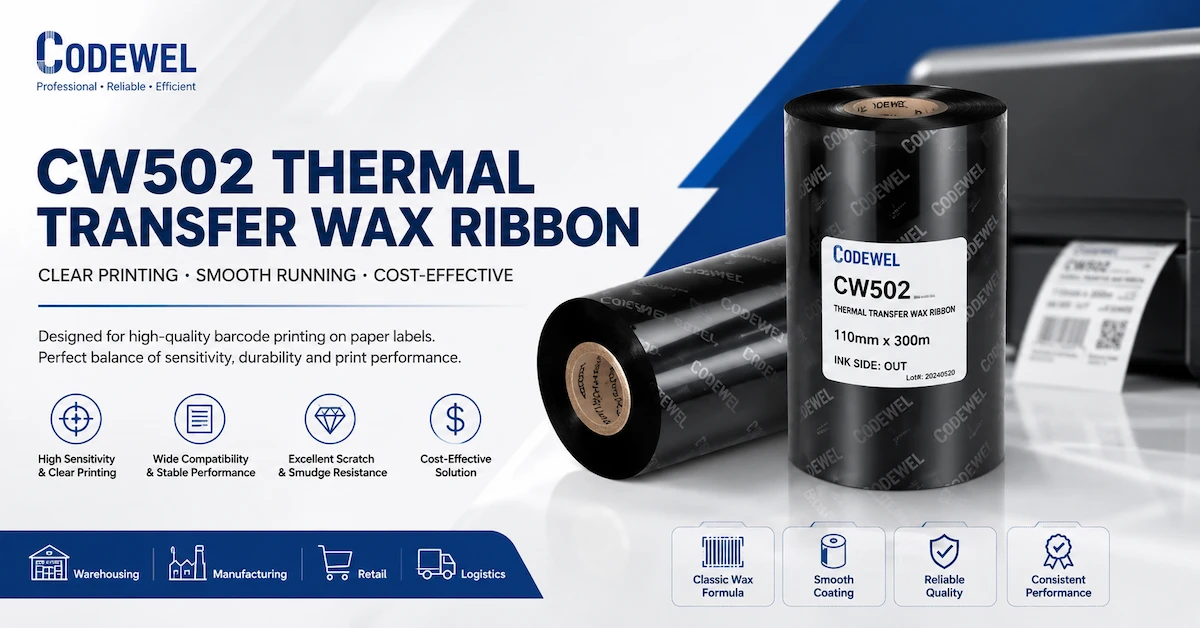
CODEWEL's published product specifications show customizable ribbon widths, lengths, core sizes, and ink-side options on relevant products. Its TTO wax/resin CW624, for example, lists 22/25/33/35/55 mm basic widths and 300/450/500/600 m basic lengths, with customized options available.
This illustrates an important purchasing principle:
Do not compare suppliers using only “wax resin ribbon” as the product specification.
Compare the same formulation, dimensions, core, ink side, packaging, and application requirements.
How to Match Wax Resin Ribbon With Label Material
Ribbon selection should always begin with the substrate.
Coated Paper
Wax resin can be a strong option when buyers require better durability than standard wax while maintaining reasonable printing economics.
Standard Paper
Wax resin can be used where buyers want additional resistance beyond standard wax.
However, if the application is very cost-sensitive and does not require extra durability, standard wax may be more economical.
Synthetic Materials
For PET, PP, or other synthetic materials, buyers should verify whether wax resin provides the required adhesion and durability.
In more demanding applications, a resin formulation may be more appropriate.
Textile Materials
Textile and wash-care applications generally require specialized wash-care resin formulations rather than ordinary wax resin.
The key lesson is:
Ribbon selection should follow the application, not the other way around.
How to Test a Wax Resin Ribbon Before Bulk Ordering
A sample test should be more than checking whether the ribbon prints.
A proper B2B qualification should evaluate the complete printing system.
Test 1: Print Density
Check whether:
- Text is clear
- Barcodes are dark enough
- Fine details remain visible
Test 2: Barcode Scannability
Print the actual barcode format used by the customer.
Then verify whether it scans consistently.
Test 3: Scratch Resistance
Rub the printed area using a defined test method appropriate to the application.
The purpose is to determine whether the printed image survives expected handling.
Test 4: Smear Resistance
Check whether printed information becomes blurred during handling.
Test 5: Printing Speed
Test at the actual production speed.
A ribbon that performs well at low speed may behave differently at high speed.
Test 6: Printhead Heat
Check whether acceptable print quality requires excessive darkness or heat.
Excessive energy requirements can increase printhead stress and operating cost.
Test 7: Ribbon Tracking
Observe:
- Wrinkles
- Ribbon movement
- Edge stability
- Winding behavior
The best test is:
Actual Printer + Actual Printhead + Actual Ribbon + Actual Label
This is much more useful than relying only on a generic specification sheet.
What Quality Control Should a Wax Resin Ribbon Manufacturer Have?
Quality control should cover the entire manufacturing chain.
Incoming Material Inspection
The manufacturer should control raw materials before production.
Coating Inspection
Important controls include:
- Coating consistency
- Surface condition
- Formulation consistency
Slitting Inspection
Check:
- Width
- Edge quality
- Winding
- Roll condition
Printing Performance Testing
The finished ribbon should be tested under appropriate printing conditions.
Final Inspection
Before shipment, verify:
- Product specification
- Quantity
- Packaging
- Labeling
- Roll condition
Batch Traceability
For long-term B2B supply, batch records can help identify production lots and manage repeat-order consistency.
CODEWEL states that its ribbon production base includes more than 10 coating and cutting TTR production lines and that each roll undergoes quality control for barcode-printing durability.
How to Compare Wax Resin Ribbon Manufacturers
A good supplier evaluation should include more than price.
Manufacturing Capability
Ask:
- Does the company actually coat ribbons?
- Does it perform slitting in-house?
- How many production lines are available?
- What is the annual production capacity?
CODEWEL states that it has more than 10 TTR coating and cutting production lines, a 6,000+ m² production base, and annual output exceeding 100 million m².
Product Portfolio
A manufacturer supporting multiple formulations can be more useful when customers have different application requirements.
CODEWEL's current portfolio covers:
- Wax
- Wax resin
- Resin
- TTO near-edge
- Wash-care resin
This allows buyers to move between different formulations without necessarily changing suppliers.
Technical Support
The supplier should be able to discuss:
- Printer compatibility
- Label materials
- Printing speed
- Printhead requirements
- Ribbon formulation
Supply Stability
Ask about:
- Production capacity
- Standard lead time
- Peak-season capacity
- Repeat-order management
- Stock strategy
OEM Capability
For distributors and brands,confirm:
- Custom sizes
- Custom cores
- Packaging
- Private labeling
- Product combinations
Wax Resin Ribbon Manufacturer vs Trading Supplier
The distinction matters for long-term B2B purchasing.
| Capability | Manufacturer | General Trading Supplier |
|---|---|---|
| Formulation Control | Direct | Depends on factory |
| Coating Control | Direct | Usually indirect |
| Slitting Control | Direct | Depends on factory |
| Custom Width/Length | Stronger | Varies |
| OEM Packaging | Usually available | Varies |
| Technical Support | Factory-based | May be intermediary |
| Batch Consistency | Easier to control | Depends on source |
| Production Capacity | Direct visibility | Limited visibility |
| Troubleshooting | Faster technical feedback | May involve multiple parties |
| Long-Term Supply | More controllable | Source may change |
A trading company can still be useful for small or mixed purchases.
But buyers with recurring demand, private-label requirements, or strict printing specifications should evaluate the manufacturer's actual production control.
What Determines Wax Resin Ribbon Cost?
The price of wax resin ribbon depends on more than ribbon length.
Important cost factors include:
- Formula
- PET film
- Coating weight
- Ribbon width
- Ribbon length
- Core
- Packaging
- Order quantity
- Customization
- Shipping terms
A lower price may indicate a different specification.
For example:
110 mm × 300 m standard ribbon
and
110 mm × 300 m premium ribbon
should not be compared as if they were identical products.
Compare Cost Per Usable Label
For B2B buyers, a more useful metric is:
Cost Per Usable Label = Ribbon Cost + Waste + Reprints + Downtime + Maintenance
A slightly more expensive ribbon can be commercially better if it provides:
- Fewer rejected labels
- Better barcode readability
- Less ribbon waste
- Lower printhead wear
- More stable production
OEM and Private Label Wax Resin Ribbon
OEM buyers often need more than a standard catalog product.
Potential customization includes:
- Ribbon width
- Ribbon length
- Core size
- Ink side
- Color
- Packaging
- Brand labels
- Carton configuration
CODEWEL's published product information indicates customized dimensions, cores, colors, and packaging options across relevant ribbon products.
Who Needs OEM Wax Resin Ribbon?
Typical buyers include:
- Barcode ribbon distributors
- Printing-equipment distributors
- Label suppliers
- Industrial consumables brands
- Regional wholesalers
- Private-label companies
What Should Be Defined Before OEM Production?
A practical OEM specification should include:
- Product formula
- Ribbon dimensions
- Core
- Ink side
- Label material
- Printer model
- Printing speed
- Packaging
- Brand artwork
- Order quantity
- Quality requirements
- Target market
CODEWEL as a Wax Resin Ribbon Manufacturer
CODEWEL's manufacturing positioning is centered on thermal transfer ribbons and barcode printing solutions.
The company states that it was established in January 2018 and integrates R&D, production, and marketing. It also states that it has experience in OEM production of barcode printers and introduced experienced thermal transfer printer engineers from Taiwan.
For thermal transfer ribbons, CODEWEL reports:
- 6,000+ m² production base
- 10+ TTR coating and cutting lines
- 100M+ m² annual output
- 100+ export countries
- Wax, wax resin, resin, TTO, and wash-care ribbon categories
Its wax resin range includes different product levels and technologies, including CW603, CW630, CW638/CW639/CW641 and TTO/near-edge CW624/CW625/CW628.
For buyers, the value is not simply having multiple ribbon models.
The more important advantage is being able to evaluate the formulation, printer, printhead, substrate, application, and purchasing specification as one system.
Buyers can explore the CODEWEL barcode ribbon product range or review the broader CODEWEL product portfolio.
A Practical Wax Resin Ribbon RFQ Template
Before contacting a manufacturer,prepare the following information:
| Buyer Information | Example |
|---|---|
| Application | Warehouse / manufacturing / retail |
| Printer Model | Exact printer model |
| Printhead | Model + DPI |
| Ribbon Formula | Wax Resin |
| Ribbon Width | 110 mm |
| Ribbon Length | 300 m |
| Core | 1 inch |
| Ink Side | IN / OUT |
| Label Material | Coated paper |
| Print Speed | Required IPS |
| Daily Usage | Rolls per day |
| Order Quantity | Trial + forecast |
| Packaging | Standard / private label |
| Destination | Country |
| OEM | Yes / No |
Providing this information allows a manufacturer to recommend a product more accurately and provide a more meaningful quotation.
Questions to Ask Before Approving a Supplier
Before placing a bulk order,ask the supplier:
- Are you the actual manufacturer?
- Where is the coating performed?
- Where is slitting performed?
- What wax resin formulations do you offer?
- What ribbon dimensions can be customized?
- What core sizes are available?
- Is ink side customizable?
- Which label substrates have been tested?
- Which printer systems are compatible?
- Can you provide samples?
- How do you control coating consistency?
- How do you control slitting accuracy?
- How are production batches identified?
- What is your normal production capacity?
- Can you support private-label packaging?
- Can you maintain the same specification for repeat orders?
Common Buyer Mistakes When Purchasing Wax Resin Ribbon
Choosing by Price Alone
The cheapest quotation may represent a different formulation or specification.
Ignoring the Label Substrate
A ribbon must be evaluated together with the actual label.
Buying Without a Printer Test
Compatibility should be verified using the actual printer.
Comparing Different Specifications
Always normalize:
- Formula
- Width
- Length
- Core
- Ink side
- Packaging
Skipping Bulk Sample Approval
A production sample should be approved before the first major order.
Failing to Document the Specification
A written specification protects both supplier and buyer during repeat orders.
Assuming Wax Resin Is Suitable for Every Application
Some demanding applications may require resin.
The goal is not to sell the strongest ribbon.
The goal is to select the right ribbon for the application.
Frequently Asked Questions About Wax Resin Ribbon Manufacturers
1. What is a wax resin ribbon manufacturer?
A wax resin ribbon manufacturer develops and produces thermal transfer ribbons using wax-resin formulations, typically controlling processes such as coating, slitting, winding, inspection, and packaging.
2. What is wax resin ribbon used for?
Wax resin ribbons are commonly used for warehouse labels, product identification, waybills, tickets, inventory labels, manufacturing labels, and other applications requiring a balance between print quality, durability, and cost.
3. Is wax resin better than wax ribbon?
Not universally. Wax is generally more economical for suitable paper-label applications, while wax resin provides additional durability and resistance. The correct choice depends on the substrate and operating conditions.
4. Is wax resin suitable for synthetic labels?
It can be suitable for some synthetic materials, but the actual ribbon and substrate combination should be tested. For highly demanding synthetic applications, resin ribbon may be more appropriate.
5.How do I choose a wax resin ribbon manufacturer?
Evaluate formulation capability, coating and slitting control, printer compatibility, sample testing, quality management, production capacity, OEM capability, and repeat-order consistency—not only price.
6. What information should I provide for a wax resin ribbon quotation?
Provide the printer model, label material, ribbon width and length, core size, ink side, print speed, application environment, quantity, packaging requirements, and destination market.
7. Can wax resin ribbons be customized?
Yes. Depending on the manufacturer, customization may include width, length, core size, ink side, color, packaging, and private-label requirements.
8. How can I test a wax resin ribbon before bulk purchasing?
Use the actual printer, printhead, label material, and production speed. Check print density, barcode readability, scratch resistance, smear resistance, ribbon tracking, and overall printing stability.
9. What affects wax resin ribbon price?
Formula, coating specification, PET carrier, width, length, core, packaging, order quantity, customization, and logistics can all affect the final cost.
10. Can CODEWEL supply wax resin ribbon for OEM projects?
CODEWEL's published product information indicates customized ribbon dimensions, cores, colors, packaging, and OEM-related capabilities. Its product range includes standard, premium, super wax resin, and TTO/near-edge wax resin products. Specific OEM specifications, MOQ, lead time, and pricing should be confirmed with CODEWEL for each project.
Request a Wax Resin Ribbon Specification and Sample
If you are comparing wax resin ribbon manufacturers, do not send only:
“Please quote 110 × 300 mm wax resin ribbon.”
A better RFQ includes:
Printer model + label material + ribbon size + core + ink side + printing speed + application + monthly quantity + packaging requirements.
This gives the manufacturer enough information to recommend the correct formulation instead of sending a generic price list.
For distributors, manufacturers, label converters, and private-label buyers, CODEWEL can be evaluated as a direct thermal-transfer-ribbon manufacturing partner with coating, slitting, OEM, and multi-formulation capabilities.
You can review the wax resin and other thermal transfer ribbon products from CODEWEL and submit your requirements through the CODEWEL contact page.
Conclusion
Choosing a wax resin ribbon manufacturer should be based on more than unit price.
The right supplier should be able to demonstrate control over:
- Ribbon formulation
- PET carrier materials
- Coating
- Slitting
- Winding
- Quality inspection
- Printer compatibility
- Application testing
- OEM customization
- Production capacity
- Repeat-order consistency
Wax resin occupies an important middle position between economical wax ribbons and higher-durability resin ribbons. That makes it particularly useful for buyers looking for a balance between printing performance, durability, and cost.
For B2B procurement, the safest approach is to define the complete specification, test samples using the actual printing system, approve a production standard, and then evaluate whether the manufacturer can maintain that specification at scale.
CODEWEL's published manufacturing information supports its positioning as a customized thermal transfer ribbon manufacturer, with a 6,000+ m² production base, 10+ coating and cutting lines, annual output exceeding 100 million m², and exports to more than 100 countries.
For a new project or recurring bulk requirement, send CODEWEL your printer model, label material, ribbon dimensions, application, monthly demand, and OEM requirements so the appropriate wax resin ribbon specification can be evaluated before quotation.